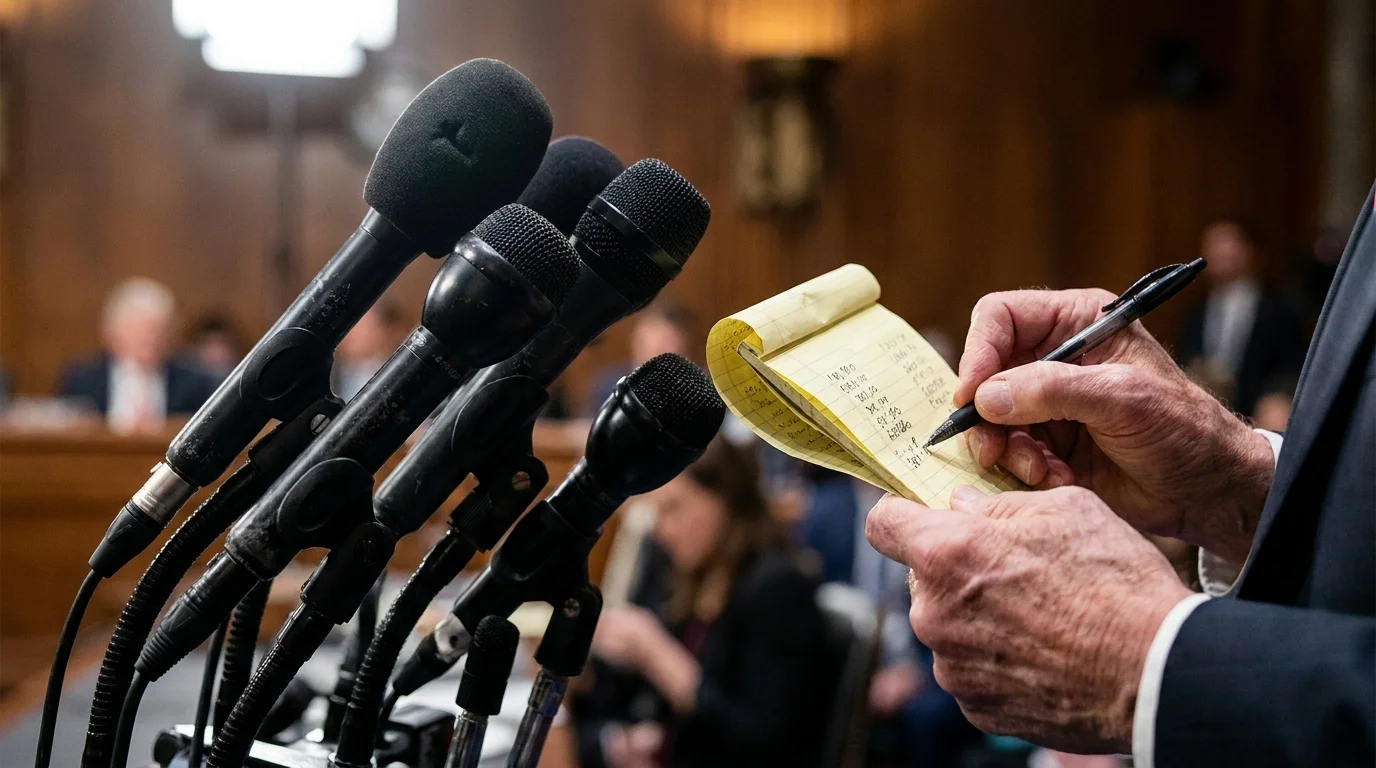
The corridor outside the Senate Finance Committee hearing room in the Dirksen building goes cold around two in the morning. The press crews have packed their tripods into nylon bags, the tourists are asleep in hotel rooms miles away, and the air smells faintly of burnt commissary coffee and industrial carpet cleaner. You might imagine that major revisions to the federal tax code happen under the glare of television cameras, introduced by grand speeches about fairness and economic growth.
The reality is far quieter, smelling of dry toner and late-night pizza boxes. In the exhausted silence before a multi-trillion-dollar package receives its final gavel, the real legislative machinery turns on paper so thin you can hear the fibers tear when it moves across mahogany tables. Unprinted single-sheet ledger pages slide between senior negotiators, carrying lines of code that exempt specific corporate entities from billions in obligations while everyday taxpayers sleep through the deadline.
You are left paying what you owe on April fifteenth under the impression that every paragraph was parsed, argued, and weighed by your elected representatives. But when the dust settles, tens of millions of dollars vanish from public accounting through a series of tactical omissions that never spend a single second on the chamber floor.
The Ledger Sheet Illusion: Understanding the Art of the Carve-Out
We are taught from grade school to picture bill passage like a conveyor belt: an idea is introduced, it enters committee, it is debated line by line, and then it is voted up or down. To understand how corporate exclusions actually happen, you have to discard that linear myth. Think of the committee process instead like a high-speed freight train loaded with hundreds of freight cars. The public sees the locomotive, but the operators control the hidden coupling pins.
When a tax bill nears completion, the Joint Committee on Taxation generates what staff members call a score—a numerical estimate of how much revenue the bill will raise or lose. If the bill is twenty million dollars short of qualifying for budget reconciliation rules, negotiators cannot rewrite entire titles without unraveling delicate political coalitions. Negotiators trade unvetted concessions against that arbitrary deadline, trading narrow language modifications for a single decisive committee vote.
These modifications rarely take the form of bold, recognizable corporate names. Instead, they arrive as hyper-specific statutory definitions disguised as neutral adjustments: changing an asset depreciation timeline from seven years to five for companies incorporated in a specific calendar window, or redefining foreign pass-through income for entities operating inside three particular harbor districts. On paper, it looks like administrative noise; in practice, it is a bespoke exemption built for a solitary balance sheet.
- Ron DeSantis debate cadences expose calculated rhetorical traps designed for undecided voters
- Iranian protest rallies force sudden White House foreign policy platform pivot
- James Talarico survey spikes trigger immediate panic across Texas Republican leadership
- Trump Iran strategy sparks urgent Capitol Hill showdown over emergency authorization
- Mail ballot signatures trigger thousands of avoidable rejections across key swing precincts
Marcus Vance, a forty-seven-year-old former tax counsel who spent eleven years drafting language for the Senate Finance Committee, remembers the physical rush of those final hours. He keeps a framed, ink-stained draft on his office wall in Alexandria—a single sheet hand-carried into a closed-door conference room twenty minutes before a committee sign-off. Vance watched a veteran senator pencil in an eight-word clause modifying Section 461 limitation rules for an unnamed midwestern manufacturing trust, wiping out ninety million dollars in pending liabilities before the printing office could even typeset the page.
The Three Hidden Levers of Midnight Exemptions
These silent provisions do not happen by accident; they follow distinct patterns crafted to avoid triggering public disclosure rules or floor debate. By understanding their architecture, you can see where corporate tax burdens are quietly shifted back onto ordinary payrolls.
1. The Transition Rule Camouflage
This is the oldest instrument in the legislative kit. When lawmakers eliminate a popular corporate deduction, they insert a narrow transition rule to soften the blow for select entities. The text never names the corporation; instead, it specifies that the new rate does not apply to any facility whose construction broke ground on an odd-numbered Tuesday between two obscure dates within a particular census tract. Tailored dates obscure private windfalls from public scrutiny while serving just one corporate benefactor.
2. The Effective-Date Freeze
Sometimes the easiest way to give away millions without floor resistance is simply to move the calendar hands. By pushing the enforcement date of an administrative penalty out by eighteen months, lobbyists purchase valuable regulatory runway for their clients. The change takes up less than a single sentence on an unprinted summary sheet, yet it strips the Treasury of millions in anticipated collections before enforcement agents can write the guidance.
3. The Algorithmic Depreciation Twist
Negotiators frequently target the formulas governing how capital assets lose value on balance sheets. If a firm can write off an industrial turbine or proprietary software suite in year one rather than across a decade, their near-term tax liability flatlines. Accelerated balance sheet deductions are slipped onto ledger margins as technical harmonizations, entirely bypassing committee questions regarding their long-term cost to the public purse.
How to Track the Unprinted Exemption Before It Codifies
You do not need an army of forensic accountants to see the signs of a closed-door tax carve-out. You just need to know where the paper trail bends under pressure.
The first indicator is always the gap between the Chairman’s Mark and the Final Committee Print. When leadership releases the initial outline of a revenue measure, the public gets a clean, conceptual look at the intended policy. The moments to watch are the seventy-two hours between that mark and the final roll-call vote, when informal manager’s amendments circulate as loose paper across back-room desks.
- Monitor the Joint Committee on Taxation score tables for sudden, unexplained downward revisions in corporate revenue lines during final markups.
- Scrutinize provisions containing hyperspecific criteria, such as geographic coordinates, precise employee count brackets, or binding contract dates that apply only retroactively.
- Watch for late-night manager’s amendments that appear as non-searchable scanned PDFs rather than clear digital text on committee portals.
- Verify statutory cross-references in the closing pages of tax titles, where definitions are often flipped by changing a single reference from an and to an or.
By learning where these quiet edits occur, you shift from a passive bystander into a citizen who sees the economic board as it actually stands.
Reclaiming Civic Vision in an Economy of Omission
When you sit at your kitchen table with your receipts, pay stubs, and tax software, the tax code feels like an immovable natural law—as fixed as gravity or seasonal weather. You double-check your child tax credit, monitor your mileage logs, and pay what the forms demand because that is the social bargain you make every spring.
Realizing that multi-million-dollar carve-outs are traded on handwritten slips of paper during the early morning hours can feel disheartening. Yet recognizing the tactic strips away the mystique that power relies on. Knowledge replaces civic helplessness with a clear, critical eye. When you understand that complex fiscal bills are shaped not by inevitable consensus, but by tactical paper trades in quiet rooms, you no longer accept tax policy at face value. You learn where to look, what questions to ask, and how to hold the architects of those midnight sheets accountable.
The most expensive sentences in federal history are rarely spoken aloud; they are penciled onto the edges of unprinted ledger sheets while the microphones are turned off.
| Key Point | Detail | Added Value for the Reader |
|---|---|---|
| The Unprinted Sheet | Informal ledger pages negotiated minutes before final committee roll calls. | Explains why certain corporate windfalls never show up in published committee debate records. |
| Transition Rules | Narrow statutory language framing private breaks as temporary administrative exceptions. | Helps you identify stealth carve-outs disguised as neutral date or geographic thresholds. |
| JCT Score Shifts | Late revenue estimate adjustments released under intense deadline pressure. | Provides a concrete metric to verify when and where money was pulled from public ledgers. |
Frequently Asked Questions
Why aren’t these late amendments debated on the Senate floor?
Floor time is tightly rationed by leadership, and complex tax packages are almost always brought to the floor under restrictive debate rules or fast-track reconciliation procedures. This leaves no procedural window for members to challenge narrow technical language added during the final committee sign-off.How can an exemption apply to only one company without naming them?
Drafting attorneys use hyper-specific qualifying criteria—such as exact dates of incorporation, specialized equipment patents, or unique regional zip code combinations—that legally define a category of one while technically remaining facially neutral.Who actually writes the language on these midnight ledger sheets?
The text is drafted by a tight circle of senior committee tax counsels, specialized Joint Committee on Taxation staff, and experienced corporate lobbyists who provide ready-to-insert statutory formulas directly to committee leadership.Does the public ever get to see the initial unprinted sheets?
Rarely in real time. The original scribbled notes and informal ledger sheets remain internal work product, only becoming public if later leaked or archived years down the road in personal legislative papers.How does this practice directly affect middle-class taxpayers?
Every targeted exclusion that removes millions from the corporate tax base leaves a revenue deficit that must ultimately be offset by higher payroll withholdings, reduced public services, or expanding national debt interest costs.