The muted mechanical hum of an optical intake sorter sounds remarkably like a desktop printer clearing paper jams. Inside county election warehouses from Maricopa to Allegheny, gray plastic bins slide along stainless steel rollers beneath fluorescent strip lighting. You picture your vote as an abstract tally on a digital screen, but here, it arrives as a physical artifact: heavy cream cardstock, slightly warped from humidity, passing under high-resolution lenses at twelve envelopes per second.
You sat at your kitchen counter with a ballpoint pen, perhaps balancing the mail-in ballot envelope against the uneven grain of wood or your knee. You signed your name with the swift, unthinking habit of adulthood, slid the flap into the return sleeve, and dropped it into a blue postal box, assuming your civic duty was complete. The assumption feels natural because modern bureaucracy usually forgives our small variations in script.
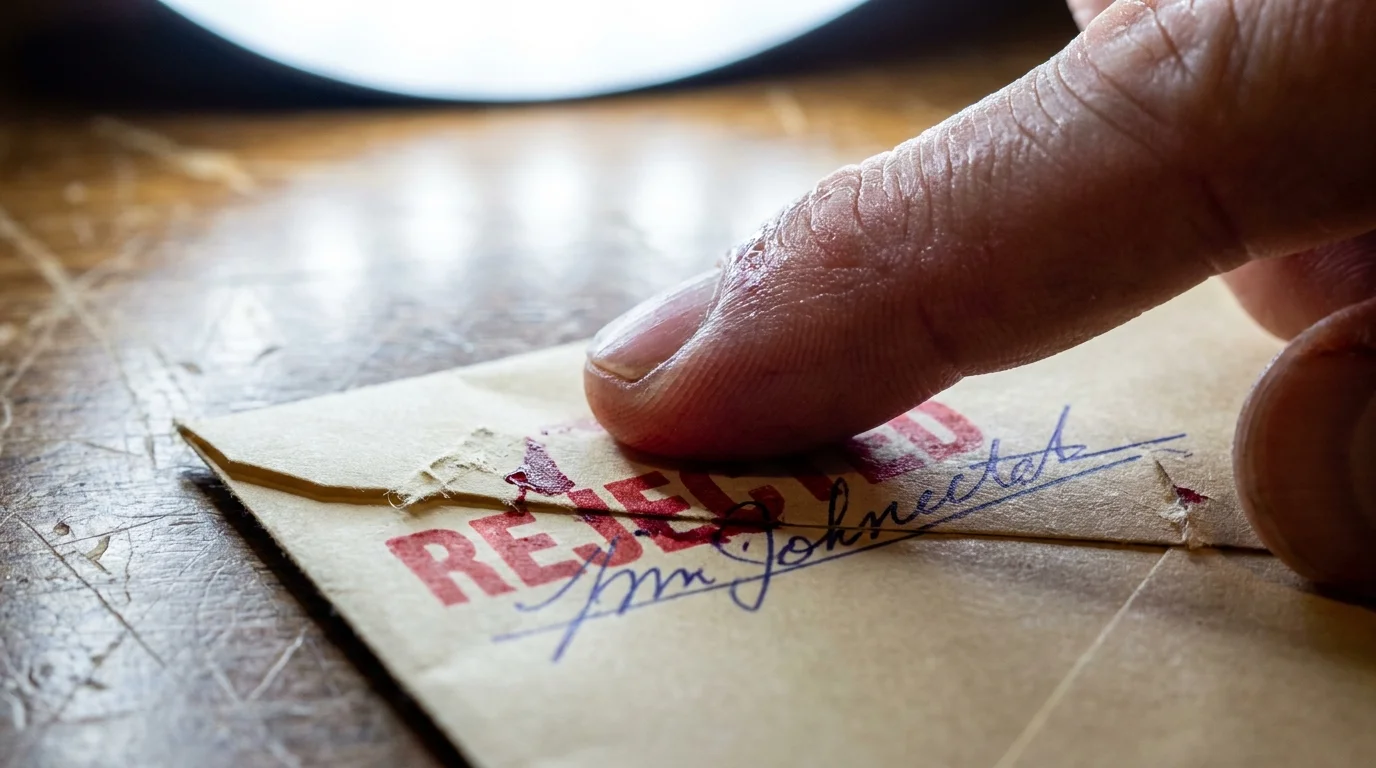
Yet within forty-eight hours, an automated sensor scans the exterior signature block, slicing your handwritten name into vector coordinates. When the digital pen strokes fail to align with a digitized DMV signature from twelve years ago, the mechanism drops your packet into an auxiliary audit tray with a dull plastic thud. Your ballot is not lost, but it is effectively frozen, waiting for a human signature verification team to determine whether your voice counts.
The Ghost in the Scanner: Moving from Penmanship to Geometry
Most voters believe an actual election worker sits with a magnifying glass, thoughtfully studying individual cursive loops to discern authentic intent. In truth, the gatekeeper of your precinct is an automated signature-verification algorithm trained to map coordinate boundaries. If your DMV signature was captured on a frictionless stylus pad at age nineteen, it exists as a rigid, low-resolution raster. When you sign paper decades later, ink drag and hand tremors create micro-variations that code-level classifiers flag as foreign.
The system does not read your identity; it reads structural vector divergence. When your script drifts beyond a five-point baseline angle or clips the outer margin of the envelope window, the scanner logs an automatic mismatch exception. What looks to you like a perfectly natural signature is, to the scanner, a mathematically alien anomaly that halts your envelope before the inner privacy sleeve ever touches human hands.
Marjorie Vance, a fifty-four-year-old high school librarian and veteran absentee precinct captain in Northampton County, Pennsylvania, witnesses this friction every November. “People don’t realize that our signatures age alongside our bodies, while the state’s reference file stays frozen in time,” Vance explains. She spends the final seventy-two hours of every voting cycle tracking down voters whose cursive loops drifted just enough outside the optical scanning window to pull their envelopes from the tabulation queue.
- Federal compliance software freezes ordinary campaign donor transfers after automated error flags
- Congressional district maps splinter historic suburban voting coalitions through algorithmic partitioning
- Municipal advisory boards overrule elected city leaders through closed-door consensus maneuvers
- Statehouse payroll surcharges erode take-home paychecks following quiet bipartisan budget compromises
- White House fuel reserves release triggers fierce partisan clashes over depleted stockpiles
The Three Signature Profiles at Risk
Not every voter interacts with the optical scanner the same way. The software evaluates distinct kinetic habits through different mathematical thresholds, creating distinct failure points across demographics.
The Stylus Pad Native: If you registered to vote or renewed your driver’s license on a Department of Motor Vehicles digital terminal, your official baseline signature was written with a blunt plastic tip on glossy glass. Because stylus pads lack the physical resistance of cardstock, voters routinely truncate their surnames, drop lower cursive descenders, or sign with flattened strokes. If your mail envelope features full, deliberate cursive loops, the comparison algorithm flags the sudden presence of detailed baseline geometry as a forgery attempt.
The Evolving Script of the Busy Professional: If you spend your workdays signing contracts or medical charts, your hand naturally adopts an abbreviated shorthand: an expressive initial followed by a wavy horizontal taper. When you casually sign your mail ballot with this streamlined motion, the scanner measures letter height ratios and baseline continuity. If your voter registration card features a schoolhouse cursive signature from decades past, that modern, efficient scribble will trip the optical system’s discrepancy trigger.
The Physical Shift: Medical changes, minor hand injuries, arthritis, or even signing on a cold morning while standing by your front door can distort letter slant by ten to fifteen degrees. While a human friend recognizes your signature instantly, optical sorters calculate stroke velocity and line density. A stiff grip translates into heavy ink pooling at entry strokes, which scanners interpret as hesitant tracing rather than genuine muscle memory.
Mindful Preparation: How to Anchor Your Signature
Treating your ballot envelope like a binding legal instrument takes ninety seconds and removes the risk of an unexpected rejection. These small habits protect your vote from automated sorting errors.
First, verify your official baseline. Log into your state’s voter portal and check the signature on file, which almost always pulls directly from your latest driver’s license or state ID card. Look at that document before you uncap your pen so the structural rhythm of your registered name is fresh in your mind.
Next, prepare your writing environment intentionally. Avoid signing your envelope against your steering wheel, a soft bedspread, or an uneven dining table. Lay the ballot envelope entirely flat on a solid surface, ensuring the signature zone sits squarely under your dominant hand.
- Use the correct ink weight: Always use a medium-point black or dark blue ballpoint pen. Gel pens, rolling liquid nibs, and fine felt tips bleed micro-droplets into fibrous envelope paper, widening your stroke width and distorting edge detection algorithms.
- Respect the boundaries: Do not let capital ascenders or cursive descenders cross the printed bounding box. Any ink that touches or overlaps the border lines confuses the scanner’s baseline reference points.
- Replicate the pacing: Write at a steady, natural cadence. Moving deliberately slow to create “perfect” penmanship produces jagged, hesitant lines that mimics the kinematic signature of a traced fake.
Finally, assemble your Tactical Ballot Kit before sitting down: your current driver’s license placed flat beside the envelope, a fresh dark-blue ballpoint pen with zero ink leakage, and your county’s online ballot-tracking portal bookmarked on your phone. Keeping these elements aligned ensures your signature matches your digital record on the very first pass.
The Peace of Mind in an Accountable Process
It is easy to view signature rejection as a sign of institutional malice, but seeing the mechanics clearly demystifies the anxiety. The optical sorters are indifferent tools designed to catch anomalies, not silence citizens. When you understand that an envelope signature is a biometric check rather than a casual greeting, you reclaim control over the transaction.
Your local county election board is required by statutory cure laws to notify you if your envelope is flagged for a mismatched stroke. By tracking your ballot status online within forty-eight hours of mailing, you can submit an electronic signature cure affidavit before election day tallying begins. Taking ownership of this physical detail preserves your democratic voice before the warehouse doors even open.
The mark you make on an envelope flap is not just paperwork; it is the single physical handshake between your household and the constitutional machinery of your country.
| Key Point | Detail | Added Value for the Reader |
|---|---|---|
| Optical Scan Threshold | Scanners evaluate coordinate baselines, slant angles, and stroke width against your DMV record. | Explains why casual signing habits trigger algorithmic flags. |
| Ink Selection Protocol | Medium ballpoint black or blue ink prevents edge bleeding on fibrous envelope stock. | Protects your strokes from artificial widening during high-speed imaging. |
| Statutory Cure Process | Most states allow 48 hours to several days to confirm your identity via signed affidavit. | Empowers you to fix an administrative rejection before vote certification ends. |
FAQ
What should I do if my county ballot tracker marks my signature as rejected?
Contact your county elections office immediately and request a Signature Cure Affidavit, which allows you to confirm your identity with a copy of an ID or a fresh signature before the certification deadline.Can I use a stylus on an iPad to sign an absentee ballot envelope?
No, absentee and mail-in ballot envelopes require a wet ink signature written directly on the paper flap unless you are using an authorized electronic accessible voting system for voters with disabilities.Does signing in print instead of cursive void my mail ballot?
Not necessarily, but it will trigger a review if your state registration or driver’s license shows a cursive signature. Your envelope signature must match the style of your signature on record.Why do mail-in ballots get flagged more frequently for younger voters?
Younger voters are more likely to have registered on electronic DMV signature pads, creating a digital reference file that looks noticeably different from their natural hand on paper.Does ballot tracking alert me in real time if my signature fails verification?
Most state ballot trackers update within 24 to 48 hours of envelope intake, sending an automated email or text notice if your ballot requires a cure form.