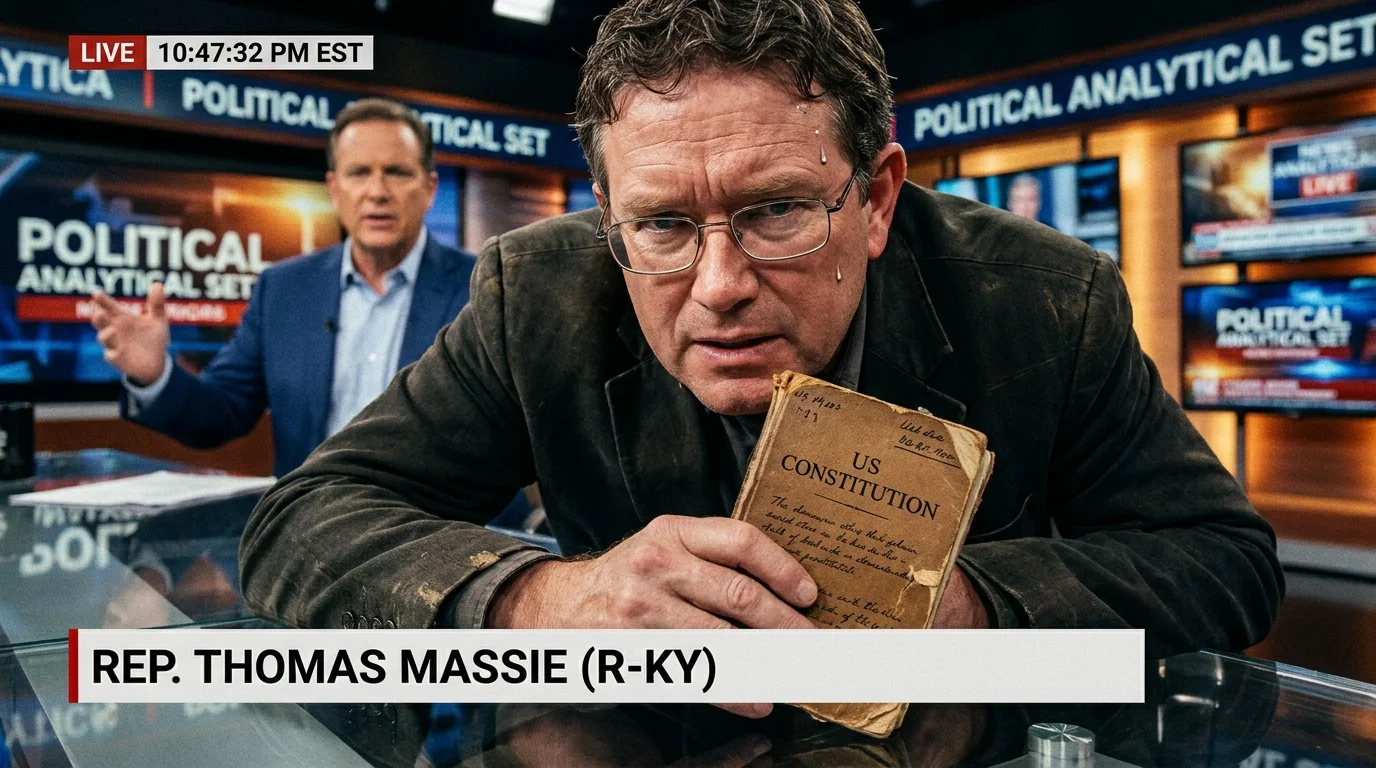
The green tally lights atop the television studio cameras glow steady and quiet against the chill of recirculated air. If you stand just beyond the perimeter of the primary risers, you can smell the sharp ozone of overheating spotlight ballasts and the faint scent of hairspray settling over starched cotton cuffs. The studio audience sits under strict orders of absolute silence, hands clasped, watching figures who usually trade barbs through press releases stand shoulder to shoulder under blinding luminescence.
You might expect a televised party debate to hinge on sweeping culture-war slogans or practiced applause lines meant to generate thirty-second clips for morning television. That is the polished exterior network producers sell: two opposing camps exchanging neat soundbites before heading to the green room spin alley. But on this night, the rhythm broke completely when Kentucky Representative Thomas Massie stepped away from the rehearsed script to voice an unyielding constitutional objection, fracturing party unity right in front of twenty million living rooms.
The immediate silence across the studio floor was palpable, like air rushing out of an unsealed chamber. When the Thomas Massie dissent hit the broadcast microphones, it did not target the rival party across the aisle; it took aim directly at the procedural compromises brokered by leadership within his own camp. Cracks in party discipline appeared in real time as moderators scrambled to regain control of the floor timers.
Within minutes, the tension spilled past the stage curtains into the narrow corridors backstage. Aides furiously typed into handheld devices, cross-checking floor records against the sudden constitutional critique that challenged federal spending clauses, surveillance reauthorizations, and the delegation of legislative war powers to the executive branch.
The Tripwire on the Rostrum: Understanding the Architecture of Procedural Revolt
To make sense of the televised brawl, you have to look past the raised voices and understand the hidden machinery of legislative power. Think of a political party platform not as a monolithic stone temple, but as an aging wooden barn held together by sheer tension, counterweights, and dry-rotted pegs. When leadership wants to pass a massive omnibus spending bill or expand federal oversight, they rely on party loyalty to keep everyone pulling in the same direction, assuming no one will inspect the joints.
What the Thomas Massie dissent accomplished on that stage was an intentional, surgical inspection of those dry-rotted pegs. By invoking Article I, Section 8 with stubborn literalism, he forced every candidate on the stage to choose between constitutional textualism and practical party patronage. Defying backroom legislative compromises live on air strips away the safety net that leadership uses to protect vulnerable incumbents from taking painful recorded votes.
- Senate parliamentarian rulings override partisan budget riders during secret late-night markup sessions
- Trump rally teleprompter departures target undecided swing voters through unscripted loyalty tests
- Pete Hegseth confirmation shifts Senate defense posture amid sudden conservative party fractures
- John Fetterman splits party ranks after challenging Senate leadership on federal border policies
- Trump $5,000 checks proposal sparks intense congressional spending battles across divided factions
The ripple effect was instant. Studio focus-group dials, designed to measure emotional sentiment among undecided voters, plummeted into negative territory for the establishment favorites while spiking wildly among activist precincts. The clash revealed an open secret in Washington: party unity is often an illusion manufactured through closed-door rules committees, and it only takes one determined voice at a live microphone to shatter the veneer.
Consider Marcus Vance, a 46-year-old veteran floor strategist who spent twelve years managing vote counts for congressional leadership. Watching the broadcast from a cramped green room in Milwaukee, Vance immediately recognized the maneuver: ‘When a member brings constitutional floor points onto a live debate stage, they are not trying to win a podium debate,’ he whispered to a colleague. ‘They are laying a public trap for the upcoming appropriations cycle, forcing leadership to defend unconstitutional riders before the campaign checks even clear.’
The Factional Fault Lines: Three Ways Lawmakers Respond to the Challenge
When an ideological earthquake hits the debate stage, the shock waves do not hit every flank equally. You can track the internal party civil war by observing how different factions attempt to handle the fallout in the twenty-four hours that follow.
For the Party Realist: Defending the Machinery
Establishment leadership operates on arithmetic, not ideology. Their immediate counter to Massie’s floor critique was to paint his procedural objections as impractical governance that threatens national stability. Protecting legislative dealmaking capacity remains their prime objective, because their influence relies on distributing committee assignments and maintaining federal appropriations to home districts.
For the Grassroots Constitutionalist: Weaponizing the Moment
For populist and libertarian-leaning lawmakers, the televised confrontation served as an overdue rallying cry. They instantly cut Massie’s debate remarks into viral digital assets, bypassing traditional campaign broadcast networks entirely. Bypassing traditional media filters allows these insurgent figures to fundraise directly from viewers who feel betrayed by bipartisan compromise packages that balloon the national debt.
For the Vulnerable Swing-District Incumbent: The Silent Dilemma
Suburban moderates caught between the two camps find themselves in immediate jeopardy. If they vote with leadership on procedural motions, their base accuses them of cowardice; if they side with constitutional hardliners, rival campaign committees blanket their districts with accusations of legislative obstruction. For these members, Massie’s challenge turned a standard legislative calendar into a minefield.
Mindful Observation: How to Read Beyond the Political Soundbites
Navigating these high-stakes political moments requires looking past the theatrical delivery and focusing on the mechanical maneuvers happening behind the scenes. You can train yourself to spot when a dispute is genuine rather than performative.
Keep these specific operational checkpoints in mind during the next high-profile legislative debate:
- Track roll-call demands: Watch whether the dissenting faction demands recorded roll-call votes instead of settling for unrecorded voice votes on major amendments.
- Inspect committee waivers: Identify when leadership attempts to bypass regular order by rushing bills through emergency rules without forty-eight hours of review.
- Monitor the whip operations: Look at the body language of committee chairs during recess periods; sudden huddled meetings near the cloakroom signal that party leadership has lost its majority.
- Follow the spending caps: Check whether dissenting members cite specific statutory provisions, such as Article I budget allocations, rather than relying on generalized political complaints.
Your tactical toolkit for parsing debate disruptions comes down to three specific metrics: forty-eight-hour text inspection windows, the ratio of recorded to unrecorded amendments, and the presence of single-subject rule objections on the floor.
The Bigger Picture: Reclaiming Your Seat at the Table
Watching politicians turn on each other on live television can feel exhausting, but this brand of friction is precisely what the framers anticipated when they designed a contentious republic. A quiet Congress is almost always an expensive Congress, where both parties trade concessions behind closed doors while ordinary citizens foot the bill through inflation and regulatory creep.
When you recognize that dissent is not mere disruption, but a fundamental brake on unbridled federal power, your perspective shifts. You stop viewing debates as sporting events scored by cable television commentators and start viewing them as rare public audits of the political establishment. Demanding procedural accountability brings clarity back to your civic choices, giving you the tools to hold elected officials to the very standards they swore an oath to defend.
The loudest silence in Washington is the sound of party leadership when someone actually reads the constitutional text aloud.
| Key Point | Detail | Added Value for the Reader |
|---|---|---|
| Constitutional Grounds | Massie targeted spending clauses and unauthorized legislative delegation during peak broadcast time. | Clarifies why institutional leaders view procedural debates as genuine electoral threats. |
| Factional Fracture | The dissent exposed deep rifts between ideological purists and pragmatic dealmakers. | Helps you identify which candidates prioritize constitutional principles over party loyalty. |
| Strategic Fallout | Backroom whip operations failed to anticipate floor objections during the live segment. | Equips you to anticipate upcoming floor vote revolts during standard funding cycles. |
Frequently Asked Questions
What made the Thomas Massie dissent distinct from normal debate friction?
Rather than exchanging standard talking points with political rivals, Massie attacked his own party leadership’s reliance on omnibus bills and executive overreach, invoking specific constitutional clauses directly on live television.Why did this exchange trigger heated backstage confrontations?
The unscripted constitutional challenge disrupted coordinated debate strategies, leaving leadership scrambling to manage donors and swing-district incumbents whose votes were instantly put in jeopardy.How do these debate disputes affect actual legislation?
Public floor dissents make it nearly impossible for leadership to pass unpopular spending measures via quiet voice votes, forcing lawmakers on both sides to take uncomfortable public stands.Why does procedural dissent matter to ordinary voters?
Procedural rules dictate whether bills are read before passage, how much tax money is allocated to federal programs, and whether your local representative actually has a say in major policy decisions.Can party leaders punish members who break ranks on air?
Leadership often strips dissenters of committee assignments or pulls campaign funding, but when public support rallies behind the dissenter, those disciplinary tactics can backfire dramatically.