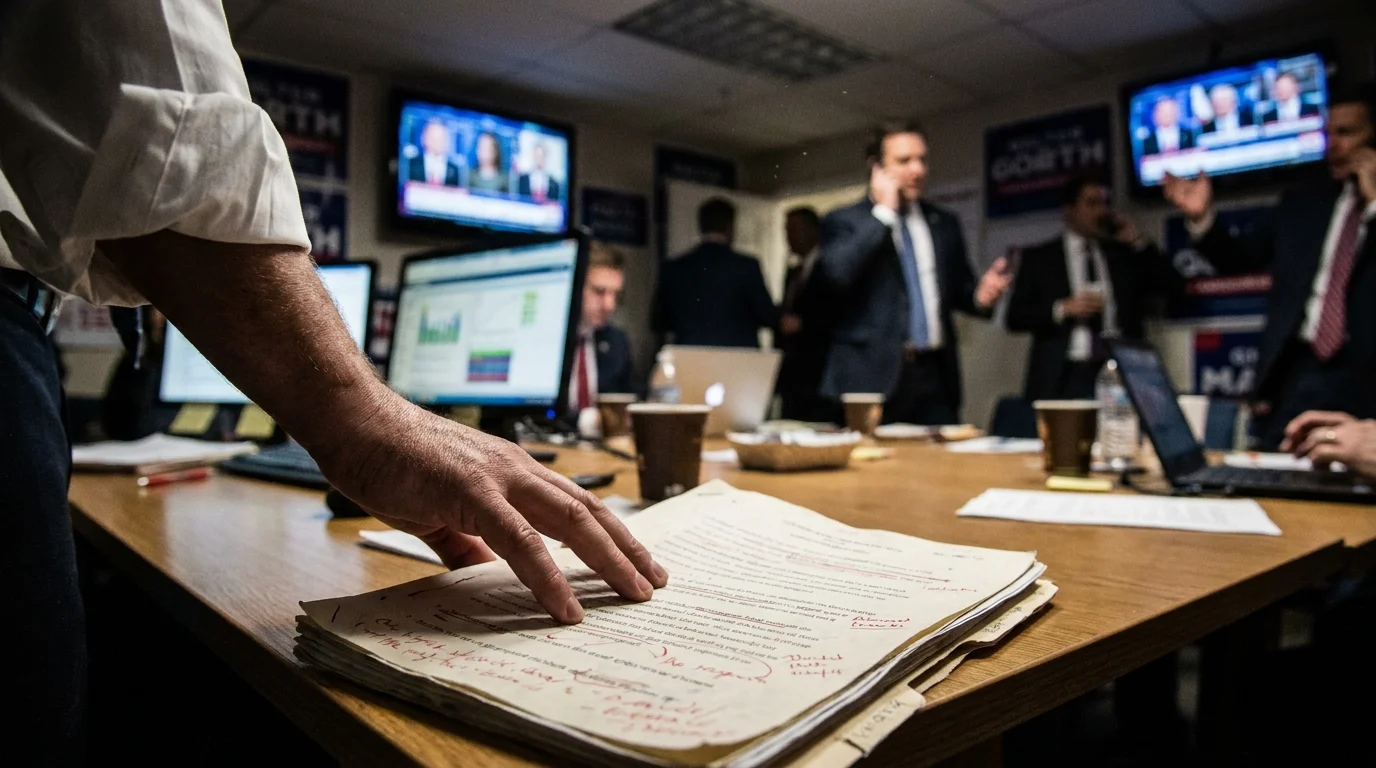
The green-room coffee has grown cold beneath flickering fluorescent tubes, and on the glass tabletop rests a fresh, staple-bound briefing packet. If you flip to page three, past the bulleted biographical highlights and committee hearing rosters, you notice the handwritten additions: aggressive, red-ink marginal notes slashing across the crisp margins. They deliver a single, unmistakable imperative to anyone stepping in front of a live broadcast camera: Never defend the conduct; attack the building that leaked it.
You might watch the daily press briefings and assume a nomination team caught in an escalating leak investigation is scrambling behind closed doors. You picture hurried damage-control huddles, frantic redactions, and quiet appeals for institutional mercy. Yet behind the velvet ropes of Washington crisis management, the playbook operates on pure offense.
When defense officials began leaking internal memos regarding Pete Hegseth, the transition apparatus did not retreat into cautious silence. Instead, they weaponized the disclosures, deploying a coordinated, scorched-earth communication campaign specifically calibrated to chill future Pentagon whistleblowers and rewrite the ground rules of executive vetting.
The Counter-Offensive Reframe: Why Panic Is an Illusion
To understand the current confirmation standoff, you have to discard the myth of the apologetic political reset. Modern political communication does not treat a leak as an evidentiary crisis to be solved; it treats it as a perimeter breach to be exploited. Picture an air-defense interceptor: the objective is not to catch the incoming missile safely in your hands, but to detonate it mid-flight so violently that the blast radius blinds everyone tracking the radar.
When unauthorized disclosures detailing Hegseth’s past conduct emerged from inside the defense apparatus, conventional wisdom predicted humble clarifications or standard non-denial denials. But the leaked war-room strategy memo reveals a calculated inversion. By labeling every internal military source an entrenched operative working against popular reform, surrogates systematically flip the burden of proof. You are watching intentional narrative warfare designed to turn accountability into an act of bureaucratic treason.
Marcus Vance, a forty-eight-year-old veteran media strategist who spent three confirmation cycles coaching embattled nominees through Senate Armed Services inquiries, describes the maneuver as institutional redirection. In his words, the moment a surrogate attempts to litigate the nuances of an anonymous personnel complaint on live television, they have already lost. The only viable path to survival is redefining the leaker’s motives as an existential threat to democratic oversight, ensuring that any civil servant considering coming forward calculates the personal cost of public vilification.
- Consumer Product Safety Commission inspectors strip factory import audits trapping dangerous lead coated toys
- Kroger pharmacy distribution counters block patient medication records under contested state reproductive mandates
- Labor Day union rally speeches trap online audiences inside conflicting crowd attendance angles
- Grants Pass homelessness rulings derail municipal cleanup teams leaving heaps of shredded canvas tents
- Brazilian steel tariff hikes stop Midwestern farm equipment factories under soaring metal costs
Anatomy of the Leaked Playbook: The Surrogate Tiers
The staple-bound strategy sheets circulating through green rooms this week divide television surrogates into distinct tactical groups. Depending on the venue and the interviewer’s style, surrogates receive tailored verbal triggers calibrated to shut down evidentiary inquiry and freeze potential dissent.
For the Primetime Cable Firebrand: The strategy demands direct confrontation. Surrogates are instructed to bypass the specific allegations entirely and attack the reporting outlet as an echo chamber for unvetted military saboteurs. The script emphasizes phrases like “administrative rebellion” and “insider sabotage,” framing Hegseth not as a flawed nominee facing scrutiny, but as an insurgent outsider targeted precisely because he poses a threat to unmonitored Pentagon procurement budgets.
For the Sunday Panel Pragmatist: On legacy network roundtables, the tone shifts toward procedural exhaustion. Here, the red-ink notes instruct spokespeople to sigh audibly, treat the leak investigation as an obsolete distraction, and repeatedly redirect the conversation toward troop readiness, recruitment shortfalls, and modernization. The leak itself is treated as petty parlor gossip unworthy of serious defense minds.
For Capitol Hill Hallway Encounters: When senators and senior advisors step into camera scrums near the Senate subway, the directive is brevity and legalistic framing. They dismiss the leak probe as an internal administrative squabble, warning that unvetted smears from anonymous bureaucrats undermine the civilian chain of command.
Dissecting the Pivot: A Citizen’s Field Guide
You do not need an advanced degree in political science to spot these deflection mechanics in real time. The next time you watch a Sunday morning news anchor press a surrogate on defense leaks, look for these specific, coordinated maneuvers:
- The Three-Second Hostility Reset: The surrogate absorbs the reporter’s question without answering, pauses, and uses a bridge phrase such as, “What your viewers actually care about is who runs the Pentagon, not who is leaking against it.”
- The Anonymity Indictment: The surrogate immediately isolates the word “anonymous” or “unnamed,” hammering it repeatedly to turn the source’s whistleblower protections into evidence of cowardice or malice.
- The Counter-Investigation Pivot: The subject of the query is abandoned in favor of demanding a criminal inquiry into the defense officials who provided the leak, effectively changing the headline from the allegation to the breach itself.
- The Scale Escalation: The talking points expand a localized personnel inquiry into an indictment of the entire post-Cold War defense establishment.
By identifying these rhetorical triggers as they happen, you strip away the manufactured urgency and see the crisis apparatus for what it is: an engineered barrier built to prevent civilian scrutiny from reaching the nominee.
Cutting Through the Static on Capitol Hill
Understanding the mechanics of political spin does not require cynicism; it requires clarity. When transition teams and their surrogates mount aggressive counter-leak campaigns, their primary audience is rarely the television viewer or the hostile committee staffer. Their true target is the prospective whistleblower sitting at a desk inside the Pentagon’s E-Ring, weighing whether to hand over another internal dossier.
When that official sees surrogates aggressively dismantling earlier sources on national television, the price of institutional conscience climbs exponentially. By learning to recognize the calculated pivots, the red-penciled talking points, and the manufactured outrage, you regain your bearings in an increasingly chaotic news cycle. You stop reacting to the theater and start evaluating the underlying structural struggle for power.
“When an administration attacks the pipeline rather than the substance of the water, it is because they know the water itself cannot be made palatable to the public.”
| Key Point | Detail | Added Value for the Reader |
|---|---|---|
| Leak Probe Weaponization | Surrogates treat Pentagon disclosures as unauthorized sabotage rather than standard whistleblowing. | Helps you recognize why press queries about nominee fitness are instantly answered with institutional attacks. |
| Targeted Surrogate Tiering | Briefing memos prescribe distinct rhetorical tones for cable news, Sunday roundtables, and hallway scrums. | Allows you to anticipate specific talking points based on which television program you are watching. |
| Whistleblower Chilling Effect | Aggressive public pushback is designed to intimidate internal DOD personnel from releasing further documents. | Reveals that the primary objective of public spin is often internal institutional suppression. |
Frequently Asked Questions
What is the primary objective of the Pete Hegseth defense leak probe?
The probe focuses on identifying internal Department of Defense personnel who provided unauthorized records to news organizations, while the political team uses the inquiry to dismiss the allegations as part of an institutional vendetta.Why are surrogates instructed to redirect questions toward the ‘deep state’?
Redirecting questions replaces a specific, verifiable personnel inquiry with an ideological conflict, allowing surrogates to rally partisan support instead of addressing documented evidence.How do these talking points affect legal whistleblower protections?
While federal statutes protect designated disclosures made through official inspector general channels, public surrogate campaigns often blur the line between protected disclosures and unauthorized press leaks, creating public stigma that discourages sources from stepping forward.Why is the Senate Armed Services Committee the focal point of this battle?
The committee controls the confirmation hearings and possesses statutory authority to demand unredacted defense files, making their members the primary target of both internal leaks and surrogate pressure.What is the most reliable way to separate facts from surrogate spin during confirmation fights?
Focus directly on unclassified hearing transcripts, sworn witness statements, and primary source documents rather than cable news appearances, paying careful attention to whether a surrogate answers the question asked or pivots to the source of the inquiry.