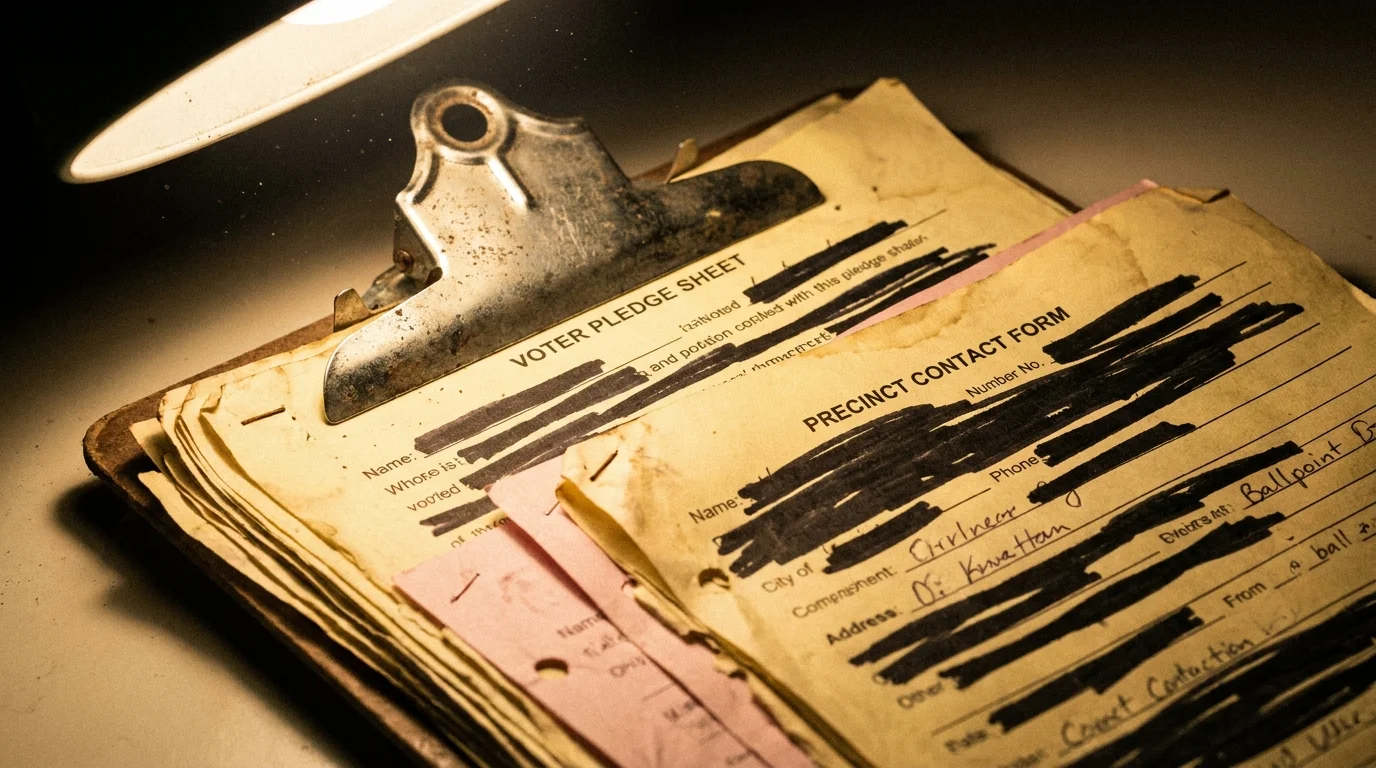
The July asphalt in suburban Phoenix radiates a dry, shimmering heat by nine in the morning. You stand on a front porch where the faint drone of air conditioning condensers drowns out the distant interstate hum. In your hand sits a weathered aluminum clipboard holding carbon-copy voter contact forms, its spring clip rusted at the corners from decades of sweat and monsoon humidity. The blue ballpoint pen tied to its top with butcher’s twine leaves an unmistakable impression on the yellow sheet beneath.
On the other side of the screen door, an evening news broadcast flickers on a wall-mounted screen inside a cool living room. High-priced consultants in Washington spend millions on fifteen-second digital spots to influence this exact household. Yet, as the door opens a few inches, the television broadcast instantly loses its manufactured authority to a neighbor holding a single sheet of paper.
For years, national commentary insisted that elections in the modern American Sunbelt were won on the airwaves through massive media buys and viral social clips. That narrative misses the quiet machinery actually altering the balance of power. When an establishment party ticket collapses in a suburban district across Georgia, Arizona, or North Carolina, the disruption did not begin in a television studio. It started on a porch steps away from a newly paved cul-de-sac.
The Porch vs. The Broadcast: Rewiring Political Gravity
To understand why traditional party slates are faltering across rapidly expanding southern counties, you have to look at political persuasion not as an aerial broadcast, but as physical plumbing. High-dollar television ad buys function like rain: vast, expensive, and mostly lost to runoff. A precinct pledge card, by contrast, operates like a targeted drip line installed directly at the root of a specific household.
When you ask a neighbor to sign a physical pledge card, you introduce friction into a process that modern campaigns tried to automate. A signature on a card requires personal commitment. It breaks through the background noise of glossy mailers that go straight into recycling bins. By anchoring a vote to a hyper-local neighborhood grievance—like school traffic routing or county water rates—the national party script dissolves.
- Federal campaign finance databases resurface hidden PAC donations using exact recipient matching codes
- Corporate alternative minimum tax rules strip unexpected accounting write-offs from private contractors
- Strategic Petroleum Reserve releases switch Gulf Coast pipeline flows amid sudden diesel spikes
- Church Committee intelligence binders reveal redacted Cold War wiretap logs on domestic activists
- Mojtaba Khamenei succession reports force polarized television analysis across competing foreign networks
This is why establishment slates get caught off guard during municipal primaries and midterm runoffs. They purchase airtime based on broad demographic models, while insurgent precinct organizers build an index of real commitments tracked house by house.
In 1974, a municipal clerk named Clara Vance organized three newly subdivided neighborhoods outside Atlanta using a dog-eared, mimeographed block-captain manual. That fifty-page booklet laid out a system that modern campaigns are only now re-learning: assign one volunteer to twenty homes, verify every contact in carbon duplicate, and never discuss national party platforms until you have solved a drainage complaint. Today, organizers across the Sunbelt are picking up that exact mechanical playbook to bypass party gatekeepers entirely.
Mapping the Neighborhood: Three Ground Realities
Neighborhoods in the Sunbelt do not respond to a single, monolithic message. Winning precinct operations separate their ground strategy into distinct geographic realities, adjusting their conversations based on how people live and move through their subdivisions.
- The Master-Planned Subdivision: In these developments, traditional gatekeeping is high and foot traffic is low. Conversations here focus entirely on micro-local governance—HOA tax burdens, school zone reallocations, and emergency response times. The pledge card functions as a binding pact among neighbors who feel ignored by county commissioners.
- The Rapid-Turnover Rental Corridor: High residential mobility means official voter rolls are often eighteen months out of date. Organizers here do not rely on state database exports. They map the complex door-by-door, using localized pledge cards to update registration records and establish personal contact before party headquarters even knows the unit is occupied.
- The Historic Exurban Seam: Where rural farmland collides with new tract housing, generational friction runs deep. Here, organizers use voter pledge cards to bridge the gap between long-time residents and new arrivals, focusing shared attention on local water infrastructure and county bond debts rather than partisan identity.
The Field Mechanic: Executing the Porch-Level Pledge
Organizing a precinct without institutional party cash requires precision, routine, and a commitment to direct human contact. You do not need expensive software subscriptions to run an effective precinct operation; you need a system that builds accountability between neighbors.
The process works best when kept simple and tactile:
- Target Twenty Doors: Never assign an organizer an entire precinct at once. Limit the focus to a single street or cul-de-sac where the volunteer already shares everyday routines like walking the dog or waiting at the school bus stop.
- Anchor on the Hyper-Local: Open the conversation with a physical, visible neighborhood issue. If the storm drain on the corner backs up during rainstorms, start there rather than with national talking points.
- Secure the Written Commitment: Hand the aluminum clipboard directly to the voter. A signature on a paper pledge card creates psychological ownership that a digital survey cannot replicate.
- Leave the Carbon Copy: Hand the yellow duplicate slip to the resident to place on their refrigerator. It serves as a daily, physical reminder of the commitment they made to their neighbor.
- Close the Loop Before Election Day: Return to the door forty-eight hours before voting begins. You are not asking for their vote again; you are simply confirming the logistical plan you both agreed to on the card.
The Tactical Ground Toolkit
Effective canvassing requires dependable, low-tech gear designed to withstand long hours on foot:
- Weathered Aluminum Storage Clipboard: Keeps pledge cards dry, holds completed forms securely out of sight to protect voter privacy, and provides a firm writing surface on windy porches.
- Carbon-Copy Pledge Sheets (2-Part Manifold): Provides an immediate physical receipt for the voter while retaining the master data sheet for the precinct organizer.
- 0.7mm Medium-Point Ballpoint Pens: Reliable across high temperatures and dusty conditions; presses firmly through carbon paper without tearing the top sheet.
- Precinct Walking Grid Map: A laminated, hand-annotated street map divided into 20-house sectors, kept free of confusing digital app interfaces.
Reclaiming the Civic Commons
When you stand on a neighbor’s doorstep with a clipboard in hand, you are participating in the most resilient form of self-governance available. It strips away the cynical, billion-dollar spectacle of modern political advertising and replaces it with a simple, human exchange. Power in a democracy has never truly belonged to the highest bidder on television; it has always resided with the person willing to knock on the door, listen to the frustration on the other side, and write it down.
“True political power is not purchased through an antenna; it is assembled house by house, signature by signature, on the front porch.”
| Key Point | Detail | Added Value for the Reader |
|---|---|---|
| Tactile Friction | Physical carbon-copy pledge cards replace ephemeral digital ads. | Creates strong psychological ownership and voter follow-through. |
| Micro-Local Focus | Prioritizes neighborhood infrastructure over national platforms. | Disarms partisan defensiveness and builds immediate trust. |
| Precinct Partitioning | Limits volunteer scope to twenty specific, familiar homes. | Prevents volunteer burnout and ensures authentic community ties. |
| The Carbon Receipt | Leaves a physical record on the voter’s refrigerator. | Acts as an enduring, household-level reminder until election day. |
Frequently Asked Questions
Why are paper pledge cards more effective than modern campaign smartphone apps?
Smartphone apps create a barrier between you and the resident, making the interaction feel like an extraction of data. A physical clipboard and paper card make the exchange collaborative, transparent, and grounded in a tangible commitment.How do localized pledge cards bypass establishment party control?
Establishment slates rely on centralized donor funding and broadcast advertising. When volunteers organize independent neighborhood blocks around local issues, they turn out high-propensity voters who vote based on personal relationships rather than party mailers.What is the ideal time of day to conduct precinct walk drives in the Sunbelt?
Weekend mornings between 9:30 AM and 11:30 AM, or weekday evenings between 6:00 PM and 7:30 PM, offer the highest contact rates while avoiding the peak afternoon heat.How should an organizer handle a voter who brings up polarized national issues?
Acknowledge their concern with empathy, then gently pivot back to the physical community by asking how that issue impacts local services, neighborhood safety, or county taxes right on their street.What happens to the completed master pledge cards after the drive?
Master copies are retained by the neighborhood block captain to build an independent precinct ledger, allowing organizers to coordinate direct carpools and child-care exchanges on election day.