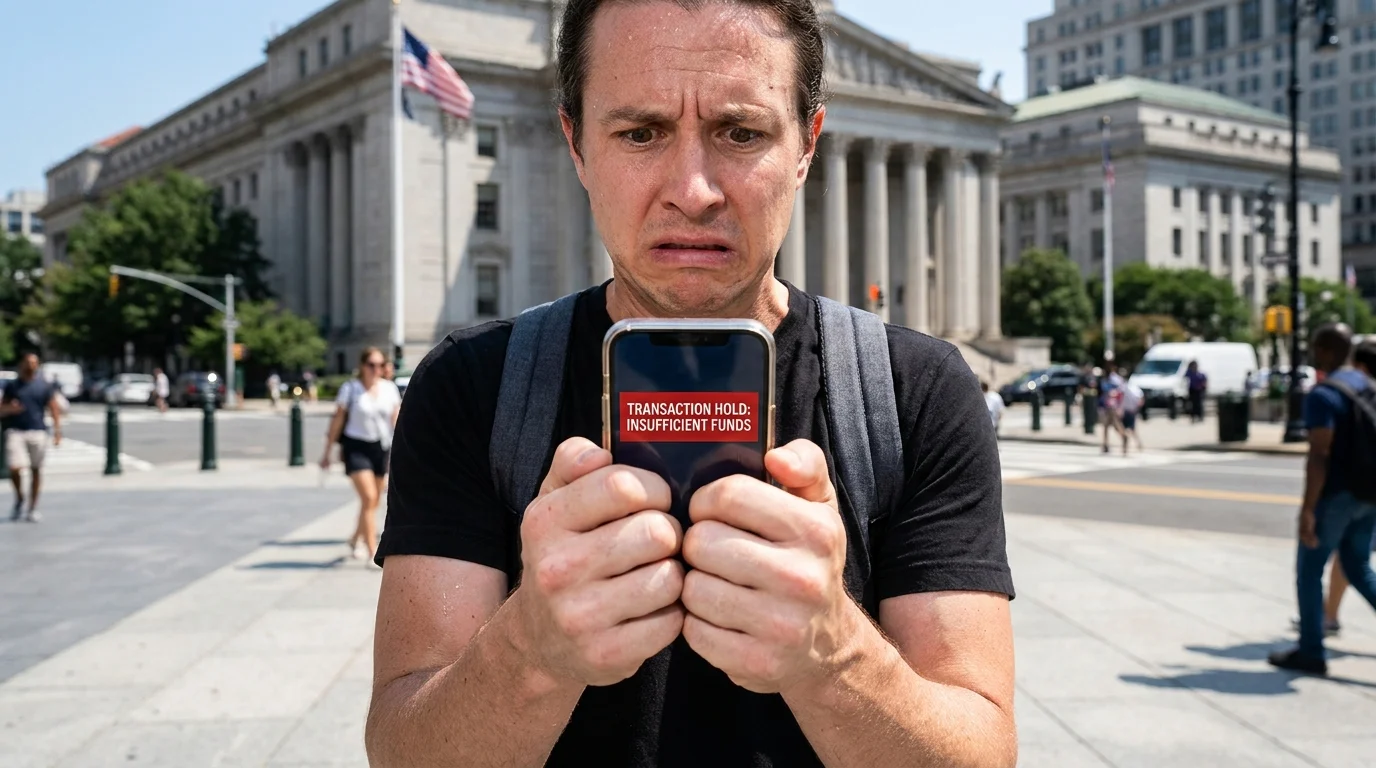
The digital clock on your kitchen microwave glows a faint green at two in the morning while you stare at a frozen progress bar on your lender’s secure upload portal. The quiet in the house is heavy, punctuated only by the refrigerator hum and the cardboard moving boxes already stacked three high against the hallway wall. You can almost smell the drying latex paint and clean sawdust of the three-bedroom ranch you put an earnest money deposit on twelve days ago. Everything was moving along the standard tracks: the home inspection was cleared, your credit score was spotless, and your loan officer sounded relaxed on Friday afternoon.
Then the email landed just past dinner. It was a sterile, three-sentence notification explaining that your mortgage application had entered an indefinite administrative review. No human underwriter signed the notice; there was only a system-generated alert indicating that your down-payment funds had triggered an internal compliance flag under federal surveillance thresholds.
You had simply moved your own savings—twenty-five thousand dollars quietly saved across four years in a high-yield digital account, shifted into your primary checking account on a Tuesday to prep for closing. To you, it was the realization of years spent brown-bagging lunches and skipping vacations. To the automated models processing transactions under Financial Crimes Enforcement Network (FinCEN) screening guidelines, that single clean transfer looked identical to an illicit layering technique. You are now stuck waiting for a phantom to clear your name while your rate-lock ticking clock burns daylight.
The Tripwire in the Wire: When Safety Algorithms Misunderstand Ordinary Life
For decades, applying for a mortgage was an exercise in human paperwork. A loan officer sat across an oak desk, flipped through physical paper bank statements, noted your paycheck stubs, and understood that people routinely move their own money before buying real estate. That human layer has quietly evaporated, replaced by automated transaction monitoring systems designed to catch cartels, sanction-evaders, and corporate shell games before illicit cash enters the banking system.
The trouble lies in the calibration. Federal compliance mandates place crushing fines on banks that fail to file Suspicious Activity Reports (SARs), so financial institutions rely on machine-learning pattern recognition configured with hair-trigger sensitivity. A mundane transfer between personal accounts now mimics the algorithmic signature of money laundering simply because it involves a lump-sum relocation across disparate routing numbers within sixty days of a real estate closing. The software doesn’t know you; it only knows that your account balance suddenly spiked outside your historic standard deviation.
Instead of preventing high-stakes financial crimes, these uncalibrated filters act like a drift net dropped into a trout stream. They catch ordinary working families who consolidate funds from multiple accounts to hand over a cashier's check. Because banks are legally barred from disclosing when a transaction triggers federal suspicious-activity scrutiny, loan officers cannot even tell you why your underwriting portal has frozen. You are left breathing through a pillow, wondering what document you forgot to sign while your earnest money sits exposed on the seller's calendar.
- Pinellas County maps carve neighborhood voting coalitions across contested school board elections
- Chartwells dining contracts lock public school families into triple-cost meal tiers
- Stormwater utility advisory boards override elected town councils to enforce sudden land restrictions
- California disability insurance rate caps cut take-home wages through mandatory automated withholdings
- United Nations press confrontations split rival cable networks over reporter credential rules
Marcus Vance, a forty-two-year-old senior compliance underwriter in Columbus, Ohio, watches this digital gridlock unfold every single morning. 'The models are trained to err on the side of paralyzing fear,' he explained recently over coffee, pointing to a queue of halted home purchases. 'A family transfers wedding gift money or moves funds out of a regional credit union into a national bank, and the algorithm instantly slaps a high-risk hold on the file. By the time a human compliance officer like me actually pulls the raw statements to verify the paper trail, the seller has often walked away to take a backup cash offer.'
Mapping the Squeeze: How Different Buyers Trigger the Hold
The algorithmic surveillance net does not snag every homebuyer equally. It treats variation as deviance, punishing anyone whose financial patterns drift outside a rigid corporate salaried routine. Understanding your vulnerability profile helps you structure your deposits before the software decides your file requires federal quarantine.
The High-Yield Consolidator
If you spent years parking house savings in online banks to harvest higher interest, bringing those funds home to your primary brick-and-mortar account right before pre-approval creates an instant red flag. The automated screening reads this as an unexplained rapid balance accumulation. The software flags the receiving bank as an ingestion point for unverified external liquidity.
The Intergenerational Family Gift Recipient
When parents or grandparents wire support directly into an escrow holding account or a buyer's personal checking, the algorithm registers an abrupt third-party capital infusion without corresponding W-2 wage data. Even if you have a signed, conventional gift letter sitting in your folder, the automated fraud engine flags the wire long before an underwriting clerk opens that specific PDF attachment.
The Independent Earner and Gig Saver
If your income arrives in staggered waves from multiple digital payment processors or freelance clients, your accounts naturally have volatile baseline balances. The surveillance engines treat irregular batch deposits as potential structuring—a deliberate attempt to keep transactions below reporting thresholds. What is simply a strong quarter of contracting work looks to the automated filter like an intentional evasion tactic.
Insulating Your Down Payment from the Digital Tripwire
You cannot rewrite federal anti-money laundering mandates, but you can build a defense against automated freezes by managing how and when your funds move. The key is starving the algorithm of the pattern variations that trigger automated review holds.
Begin by enforcing a hard ninety-day funding quarantine. Do not shift money between institutions within three months of your anticipated mortgage application date. Automated models pull sixty days of complete transaction histories; if your down payment has rested quietly in the exact account you plan to draft from for at least ninety days, the funds qualify as seasoned and bypass the rapid-accumulation filters entirely.
- Consolidate down-payment balances into your primary checking account at least 75 to 90 days before securing pre-approval.
- Avoid fragmented digital transfers; move capital in a single, fully tracked bank wire accompanied by official bank-generated wire receipts rather than consumer peer-to-peer apps.
- Collect formal paper statements from every originating account to create an uninterrupted documentary chain connecting the dollar's origin to its current resting place.
- Instruct family members gifting funds to wire directly to the title company's closing escrow account rather than passing through your personal checking account.
The Homebuyer Compliance Toolkit
Keep these specific parameters front of mind when staging your purchase capital: maintain a minimum of 60 days of completely static account history; secure certified stamped balance statements directly from a branch teller rather than standard web dashboard printouts; and demand written confirmation from your loan officer that all gift documentation is paired with the initial credit submission before automated scrubbing begins.
Reclaiming Agency in an Automated Bureaucracy
There is a distinct indignity in having the most significant financial purchase of your life stalled by an automated system that cannot read context. When software replaces human judgment, ordinary diligence looks suspicious simply because it does not fit inside an inflexible corporate template. But understanding the mechanical nature of these models strips away the anxiety.
The freeze on your screen is not a moral judgment or a mark against your character; it is a blind machine reacting to uncalibrated math. By managing your transaction timeline with deliberate patience and treating your bank records like an airtight legal brief, you outmaneuver the algorithm. You protect not just your dream of homeownership, but your peace of mind when the stakes could not be higher.
The machine does not know you saved for five years; it only knows your checking account balance changed too quickly on a Tuesday.
| Key Point | Detail | Added Value for the Reader |
|---|---|---|
| FinCEN Surveillance Screening | Automated bank algorithms actively flag rapid account consolidation or large transfers as potential money laundering. | Reveals why clean savings transfers suddenly lock underwriting approvals without warning. |
| The Seasoning Threshold | Federal models primarily scrub the immediate 60-day window of bank transactions for unexpected volatility. | Gives you an actionable, exact timeline to move funds before applying for home financing. |
| Direct Escrow Routing | Third-party gift funds wired straight to closing title accounts bypass personal checking balance spikes. | Prevents well-meaning family gifts from triggering automated anti-structuring freezes. |
Frequently Asked Questions
Why does moving my own money between my own accounts trigger an automated review?
Automated compliance models evaluate accounts based on historic balance averages. When a large sum moves from an external digital account into your primary checking, the software evaluates the sudden influx as unverified capital rather than looking at the shared account owner name, flagging it for manual human reconciliation.Can a loan officer override an automated FinCEN compliance flag immediately?
No. Federal compliance rules strictly separate sales staff from risk and anti-money laundering review divisions. Once a transaction is flagged by an automated surveillance engine, only a certified compliance analyst can manually review the underlying documentation and release the underwriting hold.How long does an automated compliance freeze typically delay a closing?
Depending on the backlog of the lender's compliance department, automated holds add between five to fourteen business days to the closing process, often putting rate-lock windows and contractual closing dates at risk.Do wire transfers trigger fewer automated alerts than peer-to-peer transfers?
Yes. Direct bank wires create formal institutional audit trails with verified identity credentials on both ends. Consumer peer-to-peer payment apps are treated by automated risk models as high-volatility conduits and face much higher baseline screening friction.What should I do if my funds are already flagged and my closing date is approaching?
Immediately request an emergency escalation through your loan officer to the head of underwriter compliance. Provide unredacted 60-day statements from the originating bank, proof of tax filings, and a signed affidavit explaining the business purpose of the transfer.