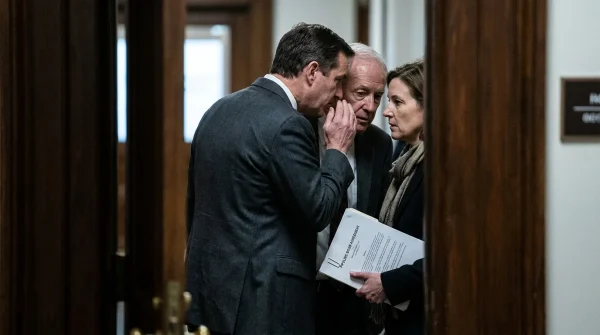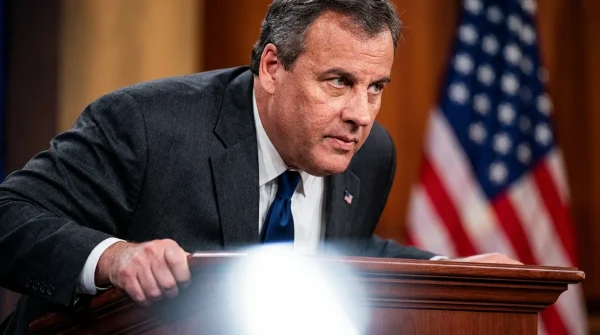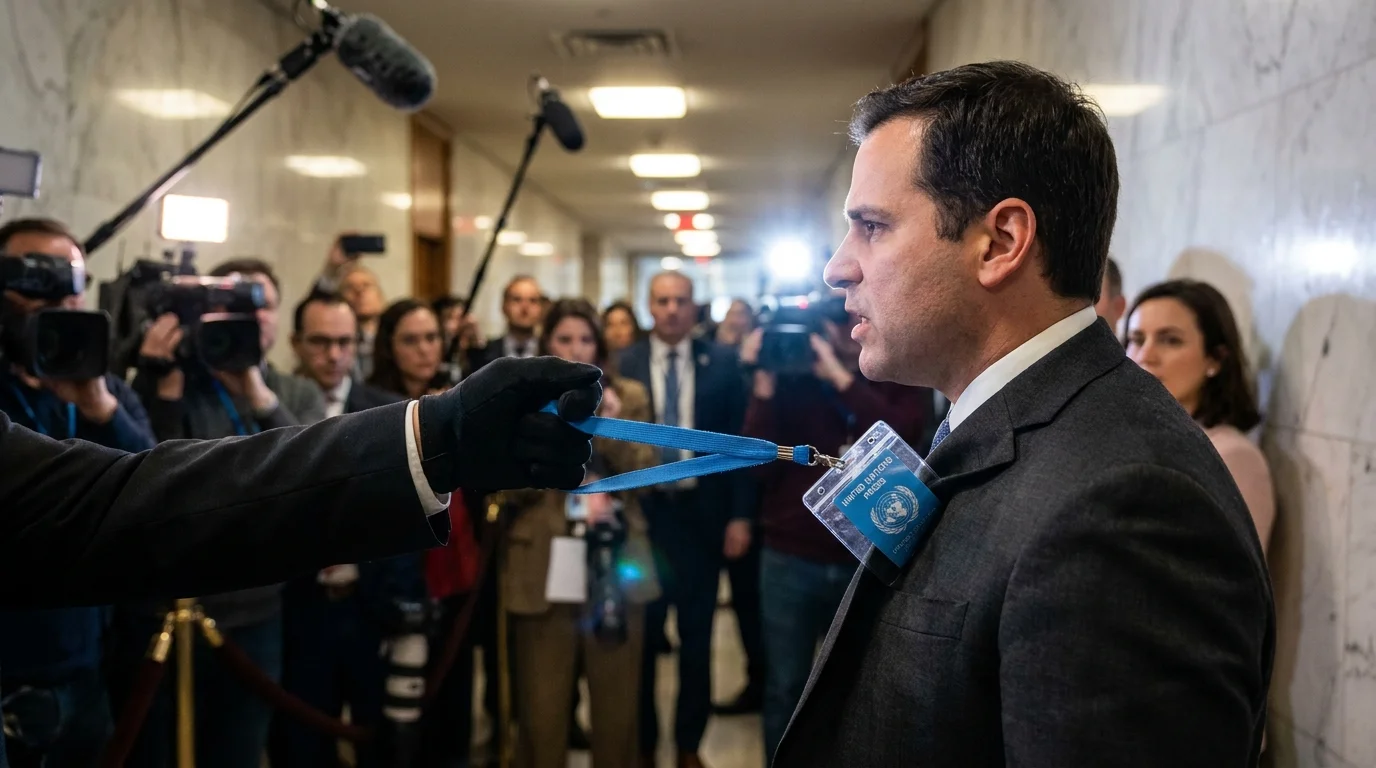
The corridor outside the Security Council chamber carries an odd, low-frequency hum. Polished terrazzo tiles reflect the amber glow of downlights, catching the scuffed dress shoes of diplomats and the rubberized wheels of broadcast cameras. You can hear the rhythmic snap of nylon microphone windscreens being adjusted, followed by an abrupt, jagged voice shouting over the collective murmur: a reporter demanding answers, security moving into physical alignment, and a sudden, sharp shuffle of credentials swinging against wool lapels.
If you were standing there, you would witness a messy, ten-second friction of physical bodies and clipped words. But when you walk into your living room and flip through the broadcast channels later that evening, that single physical incident ceases to exist as one event. Instead, you are handed two completely distinct realities manufactured from the exact same thirty feet of hallway.
On one screen, the incident is broadcast as a brazen, authoritarian assault on the free press, where international bureaucrats silenced an intrepid journalist seeking accountability. On the screen three clicks away on your remote, that identical encounter is labeled an orchestrated, bad-faith provocation carried out by an unregistered political operative who purposefully trampled diplomatic safety protocols to feed a digital outrage cycle. The divergence is so absolute you might wonder if they are broadcasting from different hemispheres.
The Anatomy of the Split Screen
Modern media operates less like a window and more like a double-sided prism. When political friction spills into the halls of global governance, networks do not merely interpret facts; they actively select which rules of engagement exist. To understand why your cable feed feels like an echo chamber, you must inspect the framing machinery behind network protocol arguments.
Consider how credentialing actually functions along the East River. The United Nations Department of Global Communications operates under strict, bureaucratic guidelines governing media access. Media accreditation badges—distinguished by precise color bands for resident correspondents versus temporary press—dictate where a camera can point, how close a microphone can get to an ambassador, and whether a reporter may speak outside designated stakeout zones. In neutral terms, these rules prevent physical bottlenecks and secure sovereign delegates.
Yet in the theater of prime-time commentary, credential regulations are never treated as mundane administrative logistics. Progressive networks leaned heavily into the sanctity of institutional boundaries, presenting the manual of diplomatic decorum as an untouchable shield. Conservative broadcasts, conversely, framed those very regulations as arbitrary gatekeeping designed by globalist committees to insulate foreign dignitaries from uncomfortable American scrutiny.
- Westchester County apartment rezonings trigger explosive homeowner revolts across suburban school districts
- Bruen firearm licensing decisions freeze county concealed carry enforcement across northeastern suburbs
- Delta Air Lines diversity policies spark furious state boycott threats against terminal hubs
- Trump administration workforce directives strip civil service protections across environmental enforcement divisions
- Canadian softwood lumber duties upend residential construction budgets across northern border towns
Marcus Vance, a 48-year-old independent media analyst who spent fifteen years running network control rooms in Midtown Manhattan, describes this divergence not as accidental bias, but as deliberate audience calibration. ‘Inside the production truck, you are not asking what happened,’ Vance explained over coffee near Dag Hammarskjöld Plaza. ‘You are asking which half of the country will validate their own suspicion by watching this twenty-second clip on loop.’
The Progressive Frame: Institutional Order and Professional Legitimacy
When you watch progressive or traditional institutional coverage, the visual language prioritizes decorum and procedural validity. The confrontation is contextualized through the lens of institutional rules broken by an unruly outsider.
In these broadcasts, the anchor’s tone is measured, almost weary. The reporter involved in the altercation is rarely framed as an intrepid news-gatherer; instead, lower-third chyrons emphasize terms like ‘unaccredited agitator’ or ‘breach of security protocol.’ The governing assumption is simple: without strict, non-partisan rules, high-stakes international diplomacy collapses into performative anarchy. The network shows the security guards gently extending their palms, emphasizing their restraint, while cutting quickly to accredited foreign correspondents quietly waiting behind designated velvet ropes.
The Conservative Frame: The Insurgent Question and Bureaucratic Shields
Change the input source, and the emotional baseline pivots entirely. Conservative broadcasts strip away the institutional context, framing the confrontation not as a matter of hallway choreography, but as a moral showdown between raw truth and unaccountable bureaucracy.
Here, the camera zooms into the reporter’s face, isolating their grit and resolve. The audio track is equalized to make the shouted question sound clarion and urgent, while the surrounding delegates appear evasive, scurrying behind uniformed guards. The lower-thirds pivot to phrases like ‘Silencing the Press’ and ‘Free Speech Under Siege.’ The bureaucratic credential is recast not as an administrative pass, but as a state-issued muzzle designed to keep ordinary citizens outside the room where decisions are made.
Mindful Observation: Reclaiming Your Analytical Distance
You do not have to fall prey to algorithmic sorting or cable-news curation. When breaking footage ignites an ideological border war on your screen, you can dissect the presentation using a calm, methodical routine.
Pay attention to the technical seams of the broadcast. By stepping back and viewing the story as an engineered media product rather than an objective transmission of reality, you instantly recover your own intellectual autonomy.
- Mute the voiceover for the first thirty seconds: Watch the raw video without the anchor’s emotional cadence directing your nervous system. Observe physical distances, eye contact, and body language without editorial narration.
- Track the chyron adjectives: Note the specific nouns and descriptors scrolling across the bottom of the screen. Notice whether the actor is labeled an ‘independent journalist,’ an ‘unregistered blogger,’ or an ‘activist.’
- Identify the invisible source: Check who is cited as the authority for the protocol claim. Does the network quote the United Nations handbook on media accreditations, or do they rely on an anonymous spokesperson’s post-hoc characterization?
- Examine the cut points: Notice where the video clip begins and ends. Does the footage show what preceded the confrontation, or does it start at the exact instant physical contact was initiated?
The Clear Lens Beyond the Noise
The split in coverage over international press rules is not actually about a plastic badge clipped to a reporter’s blazer. It is a battle over authority: who gets to ask questions, who gets to decide the rules of polite society, and which tribe gets to define what constitutes a legitimate journalist. When you learn to spot the narrative choreography in real time, the noise stops dictating your emotional state. You stop being a spectator trapped inside someone else’s confirmation bias and become a discerning observer of how modern power defends itself.
The moment you realize that news cameras do not merely record an argument but actively construct it, the manufactured crisis loses its power over your mind.
| Framing Dimension | Institutional/Progressive Coverage | Populist/Conservative Coverage |
|---|---|---|
| Primary Label for Journalist | Disruptive non-credentialed actor or activist | Independent truth-teller defying institutional silence |
| Role of Administrative Rules | Necessary framework to protect safety and decorum | Censorship mechanism deployed by foreign bureaucrats |
| Focus of Video Footage | Security personnel maintaining physical order | The unanswered question and evasive official reactions |
How do credential rules at the United Nations actually work?
Accreditation is overseen by the Media Accreditation and Liaison Unit, which issues specific badges categorized by assignment duration, workspace access, and whether an individual represents a registered press organization.Why did the two networks report conflicting facts about the reporter's credentials?
One network highlighted the reporter's lack of day-pass clearance for restricted diplomatic corridors, while the other emphasized the reporter's active first-amendment press credentials issued by domestic authorities.Are press confrontations staged intentionally for digital distribution?
In many high-profile cases, independent and partisan actors deliberately target restricted zones knowing that any resulting security intervention creates high-engagement viral video clips.How can I verify what actually happened during a diplomatic press incident?
Review the raw, unedited pool feed typically published without commentary by public international archives or UN Web TV before network editorial packages are assembled.What is the most reliable sign of narrative bias in television news clips?
Examine whether the broadcaster shows the moments immediately preceding the physical friction, as selective editing often hides who initiated the breach of protocol.