A winter draft creeps beneath a wooden front door in Manchester, New Hampshire, mingling with the scent of damp wool coats piled high on a banister. Inside, thirty neighbors balance ceramic mugs on their knees, shoulder-to-shoulder on mismatched chairs hauled up from the basement. In the center of the rug stands a candidate whose super PAC has already spent forty million dollars on polished television commercials across three media markets.
None of those glossy thirty-second spots matter right now. Steaming mugs of diner coffee sit on shaky folding tables by the radiator, rattling softly every time someone shifts weight on the floorboards. There is no podium, no flattering key light, and no teleprompter scrolling curated talking points at eye level.
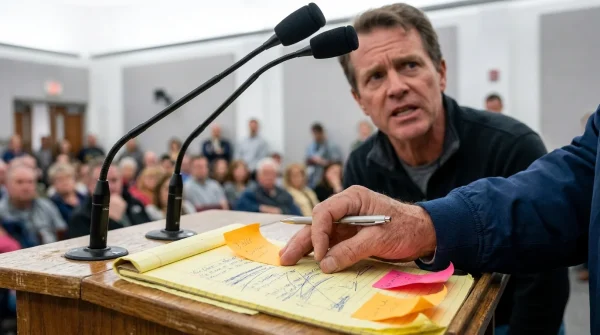
You are watching the most brutal filter in American politics do its quiet work. When a retired school librarian sitting four feet away asks an unscripted question about local water testing standards, the entire campaign apparatus vanishes. The candidate either possesses genuine fluency, or the room watches them freeze in real time.
The Living Room Crucible: Why Airwaves Lie
Modern campaigns love scale because scale offers insulation. A twenty-million-dollar broadcast buy allows political consultants to polish every syllable, color-grade every frame, and engineer a synthetic sense of momentum. Yet when candidates enter the early primary gauntlet, they trade that protective shell for the claustrophobia of a stranger’s parlor.
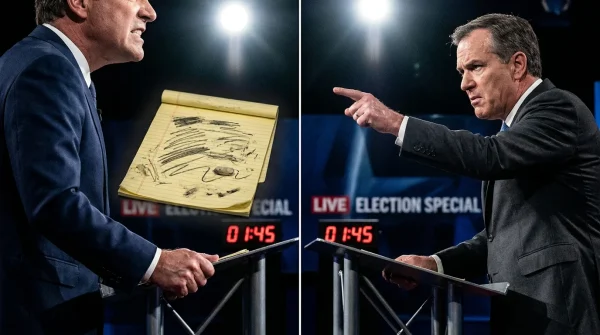
Think of retail politics not as an old-fashioned tradition, but as high-stakes behavioral stress testing. Under studio lights, trained political figures rely on muscle memory and rhythm. In an overcrowded living room where you can hear the hum of a refrigerator, those rhythmic cadences sound hollow and absurdly performative.
Early voting states hold outsized influence precisely because their voters refuse to be an audience. They act as cross-examiners. When a voter detects a rehearsed deflection delivered across a coffee table, the illusion breaks immediately, sparking quiet whisper networks that national polling fails to capture until weeks later.
- Peer-to-peer political texts demand instant credit card swipes with urgent simulated typing bubbles
- War Powers Resolution notifications block presidential troop deployments using sixty-day statutory countdowns
- Farm Bill markup amendments switch crop subsidy payouts through rushed midnight margin scrawls
- Teleprompter glass screens trap nervous candidates through reflective studio beam angles
- Cell phone voter surveys strip rural turnout estimates through noisy background audio filters
The Field Secret: The Kitchen Counter Test
Consider Marcus Lindell, a 52-year-old precinct organizer in Des Moines who has hosted candidates in his four-bedroom home across four presidential cycles. Lindell keeps a mental tally of how long it takes a national figure to stop scanning the room for television cameras and actually look a resident in the eyes.
During a blizzard three years ago, a polished frontrunner arrived forty minutes late with an entourage of six aides. Instead of taking off his heavy overcoat and pulling up a chair, he remained standing near the foyer, launching into a stump speech suited for a convention arena. Within ten minutes, Lindell noticed the room go completely cold; neighbors stopped taking notes and began checking their watches. The candidate dropped twelve points in that county two weeks later.
Breaking Down the Living Room Exposure Points
The living room setting creates distinct structural vulnerabilities that scripted media operations cannot solve. Understanding these dynamics reveals why seemingly unstoppable frontrunners suddenly collapse before Super Tuesday.
1. The Proximity Trap
When an audience sits within arm’s reach, nonverbal micro-expressions become visible. Voters notice the tight jaw, the nervous foot tapping, or the subtle glance at a campaign manager when a question veers off script. Authentic poise under physical proximity cannot be fanned into existence by consultants.
2. The Specificity Check
National stump speeches rely on broad thematic strokes that sound inspiring from a distance. In a living room coffee clutch, questions center on county road repairs, regional hospital closures, or specific property tax burdens. Pivoting to a canned national slogan sounds like an insult to the person sitting three feet away.
3. The Peer Influence Multiplier
Unlike digital ads consumed in private isolation, house parties generate collective consensus in real time. If two respected community leaders in the room shake their heads at an evasive answer, the entire room takes note. That shared skepticism travels down neighborhood text chains before the candidate’s motorcade reaches the highway.
Mindful Observation: How to Spot the Cracks
You can evaluate a candidate’s genuine political endurance by tracking how they navigate small, unscripted spaces. Look past the curated debate highlights and watch long-form, unedited footage from retail living room stops.
- Watch the posture when an unexpected question lands: Do their shoulders tense, or do they lean in closer?
- Notice the transition language: Are they using standard pivot phrases, or addressing the actual data point raised?
- Track eye contact during long inquiries: Do they stay engaged with the speaker, or scan the room for an exit cue?
- Listen to tone modulation: Does their voice stay at a conversational volume, or do they project as if addressing a stadium?
These subtle behavioral indicators reveal whether a political figure has internalized their platform or simply memorized an issue brief during the flight over.
The Power of the Human Scale
In an era dominated by algorithmic outreach, micro-targeted digital ad spend, and artificial talking points, the living room coffee clutch remains a remarkably grounded democratic equalizer. It forces powerful figures to sit in humble chairs, drink lukewarm coffee from mismatched mugs, and explain their decisions without a script.
When you watch politics through the lens of this intimate friction, the noise of national polling clears away. True leadership rarely reveals itself on the stage; it shows up in how someone handles a tough question across a crowded, carpeted room.
The sharpest candidate is not the one with the loudest microphone, but the one who can sit in your kitchen and speak without a script.
| Setting Layer | Campaign Illusion | Retail Reality |
|---|---|---|
| Physical Space | Controlled stage lighting and set angles | Unflattering parlor light inches from voters |
| Message Delivery | Polished, teleprompted national soundbites | Spontaneous answers to hyper-local concerns |
| Voter Dynamic | Passive broadcast viewer at home | Direct cross-examiner shaping community consensus |
Frequently Asked Questions
Why do early state living room visits still matter in the digital era?
They serve as behavioral stress tests that expose whether a candidate can think on their feet without digital aids or stage control.How do house parties shift voter sentiment so quickly?
Attendees are typically high-engagement local influencers whose direct impressions ripple rapidly across local civic networks.Can high ad spend overcome poor retail performance?
Ads build initial name recognition, but sustained voter trust in early primary states almost always requires genuine personal interaction.What is the biggest mistake candidates make in small rooms?
Projecting a loud, arena-style stump speech instead of engaging in an authentic, conversational dialogue.How can voters spot a rehearsed answer during retail stops?
Listen for abrupt topic pivots that avoid specific local details in favor of broad, generic slogans.