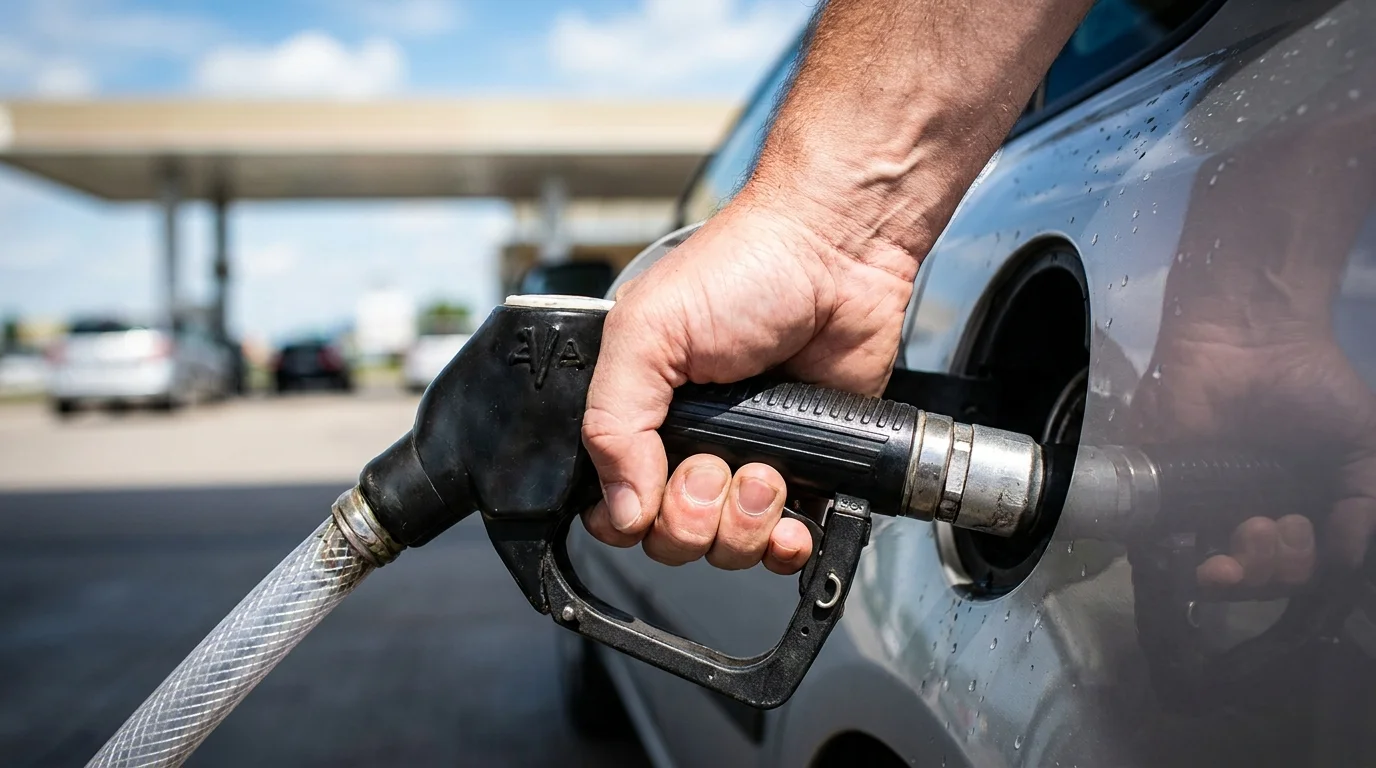
The pre-dawn hum of Interstate 80 cuts through the crisp autumn mist as you pull your vehicle beneath the humming fluorescent canopy of a county-line filling station. The sharp bite of evaporated petroleum hangs cold in the air, mixing with the damp chill rising off fresh asphalt. You slide your card through the weathered brass reader, listening to the metallic thrum of the subterranean pump gear engage deep beneath your boots, expecting the regular baseline digits you saw just five days ago.
Instead, the counter resets and starts spinning with dizzying speed, vaulting past four dollars a gallon before your tank is even a third full. You watch the digital readout tick upward, feeling that familiar, tight knot settle at the base of your throat as you calculate what this forty-mile commute is going to demand from your monthly budget. It feels like an arbitrary penalty, a random storm cloud that decided to park directly over the heartland while morning news anchors casually mention national crude surpluses.
The common assumption is that crude scarcity dictates pump misery—that when oil wells run dry or foreign cartels tighten the spigot, retail prices surge. Yet across the hardscrabble scrubland of West Texas and southeastern New Mexico, the Permian Basin is producing crude at near-historic volumes, extracting millions of barrels every single day. The crude exists in staggering abundance, but an invisible iron ceiling sits between those sun-scorched wellheads and your morning commute.
The friction does not originate at the drill bit; it festers inside the midstream choke points that carry raw crude north. When regional pipeline networks hit maximum hydraulic throughput, the fluid arithmetic of fuel distribution shatters, leaving Midwest refiners bidding against one another for dwindling feeds while you pay for the logjam at the dispenser nozzle.
The Hydraulic Bottleneck Behind the Price Tag
To understand why your fuel costs spiked over forty-eight hours, you have to picture the continental fuel grid not as an open ocean of supply, but as a system of hyper-pressurized straw conduits. Imagine trying to empty a five-gallon bucket through three soda straws: no matter how much water sits waiting, the flow rate is hostage to the diameter of the plastic. The Permian Basin is that overflowing bucket, and the Midwest pipeline network has run out of physical diameter.
For years, energy conglomerates focused capital expenditure on export infrastructure pointed toward the Gulf Coast, racing to load supertankers bound for international markets. That strategic pivot left the northward corridors—the vital steel arteries supplying processing facilities in Illinois, Indiana, and Ohio—operating with razor-thin spare capacity. When a single pumping station undergoes unplanned maintenance or a pipeline operator reduces line pressure to inspect anomalous weld fatigue, the entire domestic delivery schedule stalls instantly.
Regional refineries depend on steady, predictable crude arrivals to maintain continuous catalytic cracking. When Permian shipments slow to a trickle, refiners cannot simply turn off their multi-billion-dollar towers without incurring catastrophic restarting costs. Instead, they pivot to expensive emergency rail shipments, bid up alternative Canadian heavy crude, and burn high-cost inventory reserves to keep their units running hot. That immediate operational friction bypasses wholesale markets entirely and drops straight onto the retail pump price in your neighborhood within forty-eight hours.
- National Archives records reveal secret Cold War intelligence directives overriding congressional oversight
- Fox News broadcast segments split partisan viewers over high-stakes diplomatic talks with Iran
- Loudoun County zoning boards block massive suburban apartment developments after fierce homeowner revolts
- Susan Sarandon rally transcripts trigger online bot campaigns amplifying fabricated speech quotes
- Masoud Pezeshkian interview remarks spark furious Tehran backlash forcing rapid diplomatic walkbacks
The Refinery Floor: What Happens When Allocations Drop
Dan Vance, a 52-year-old midstream scheduler based out of Tulsa, spends his twelve-hour shifts staring at digital pipeline manifold pressures and shipping nominations that reveal this mechanical squeeze long before it hits local radio stations. “People think retail gas spikes come from overseas wars or political press conferences, but usually it is just private pipeline operators declaring prorationing,” Vance explains over a dispatch console. “When a pipeline hits capacity, operators declare ‘proration,’ meaning every refinery gets cut back by fifteen or twenty percent of their requested volume. The moment a refiner in Illinois loses twenty thousand barrels of daily pipeline allocation, they have to scramble on the open spot market to replace it before sundown, paying an exorbitant premium that gets passed down to local tanker truck distributors by midnight.”
This scramble triggers a violent regional price decoupling. While national headlines might report stable or falling global benchmark crude, local rack prices—the cost wholesale fuel haulers pay at regional distribution terminals—spike aggressively. Refineries are forced to adjust their production slates, often scaling back finished motor gasoline output to protect their diesel runs, shrinking regional retail inventory just as commuter demand peaks.
Anatomy of the Heartland Pinch: Commuter, Farmer, and Freight Layers
The downstream shockwave of a pipeline throughput cap does not distribute itself equally. It fractures across specific geographic corridors and lifestyle realities, demanding distinct financial adaptations depending on how you rely on regional fuel grids.
For the Long-Haul Interstate Commuter
If your daily routine involves forty or fifty miles of interstate highway travel between suburban developments and city centers, you absorb the pure brunt of retail price volatility. Service stations situated along high-traffic commuter ribbons like I-65, I-70, and I-80 adjust their electronic signs dynamically to reflect immediate replacement costs. Because highway-adjacent stations cycle through their fuel storage tanks every twenty-four to thirty-six hours, they pass terminal rack price increases to your credit card immediately, long before municipal grocery store stations even receive their next tanker delivery.
For the Heartland Agricultural Operator
For farm operations managing spring planting or autumn harvests across the Corn Belt, the squeeze hits through off-road red diesel and bulk transport fuel. Bulk fuel distributors facing allocation cuts prioritize municipal contracts and emergency services first. Independent farm accounts face steep delivery surcharges and fluctuating spot prices that make seasonal field-cost budgeting nearly impossible. When midstream transport lines bind up, the farmer pays not only for the diesel in the tractor tank, but also a secondary logistics premium to get bulk trucks dispatched down rural gravel routes.
For the Small-Fleet Regional Carrier
Owner-operators and local freight outfits running day-cab routes across the Midwest exist on razor-thin operating margins. Pipeline restrictions disrupt regional terminal inventories, forcing transport drivers to wait hours at crowded fuel racks or divert thirty miles out of their route to find active terminals. This terminal congestion costs valuable drive-time hours, forcing carriers to slap emergency fuel surcharges onto localized freight bills, which quietly inflates the cost of groceries and building supplies delivered across your county.
Insulating Your Household Ledger from the Midstream Spread
You cannot personally reopen pipeline valves or expand line capacity between Midland and Chicago, but you can build tactical defenses that keep sudden regional spikes from derailing your checking account. Managing this volatility requires shifting your mindset from reactive tank-filling to calculated, anticipatory consumption.
Track the weekly wholesale rack margins rather than the national news. When regional refinery inventories fall below their five-year averages in the Energy Information Administration’s weekly petroleum reports, a retail price leap is usually three to five days away.
- Map independent off-corridor fuel points: Avoid filling up at high-turnover interstate exits during supply pinches; hyper-local municipal co-ops and neighborhood grocers often lag forty-eight hours behind regional terminal price adjustments.
- Time your refills around refinery rack cycles: Regional fuel terminals typically publish new wholesale price postings in the late afternoon; filling your tank on Tuesday or Wednesday mornings regularly catches retail pumps before mid-week logistical markups take effect.
- Monitor regional refinery turnaround schedules: Major facilities in Whiting, Indiana, or Joliet, Illinois, publish scheduled maintenance outages months in advance; whenever a turnaround overlaps with pipeline pipeline allocations, top off your tanks before the shutdown date.
Your tactical toolkit should include direct visibility into wholesale fuel movements. Bookmark regional terminal pricing trackers, use fleet-oriented crowd-sourced fuel maps that report diesel and premium volatility in real time, and keep your vehicle’s tires inflated precisely to door-jamb specifications to mitigate the three-to-five-percent fuel burn drag that quietly bleeds your cash reserves.
Reclaiming Predictability in a Volatile Energy Landscape
Watching the mechanical counter on a fuel pump spin uncontrollably often feels like an exercise in profound powerlessness. It can seem as though distant corporate entities and hidden market mechanisms are extracting wealth directly from your pocket with complete impunity. But understanding the physical architecture of the system removes the mystery from the injury.
When you recognize that these price shocks are the predictable friction of physical pipelines meeting structural limits, the frustration gives way to clear-eyed strategy. You no longer get blindsided by sudden forty-cent price leaps on a Thursday afternoon; you see the pressure building in the system days ahead of time and adjust your logistics before the shockwave hits the register. That quiet foresight restores your agency, allowing you to navigate an increasingly strained domestic energy grid with confidence, patience, and control.
“Gasoline prices do not jump because oil vanished; they jump because the steel pipe carrying it ran out of room to breathe.”
| Key Point | Detail | Added Value for the Reader |
|---|---|---|
| Midstream Bottlenecks | Permian Basin extraction outpaces northern takeaway pipeline volume. | Explains why abundant Texas crude does not translate into cheap Midwest gasoline. |
| Refinery Prorationing | Pipeline operators enforce capacity quotas, starving Midwest catalytic crackers. | Reveals why regional refineries must source expensive substitute inputs on spot markets. |
| Commuter Corridor Premiums | Interstate-adjacent stations cycle underground storage faster than rural outlets. | Provides a clear tactical reason to fill up away from major highway intersections during spikes. |
| Logistical Ripple Effects | Secondary freight and agricultural diesel absorb spot surcharges first. | Helps small business owners and families forecast incoming household grocery inflation. |
Frequently Asked Questions
Why are Midwest gas prices spiking when US crude production is breaking records?
Crude oil volume at the wellhead means nothing if it cannot reach refining centers. Permian Basin production has overwhelmed the capacity of pipelines running north, forcing regional refineries to bid high for alternative crude inputs or slow their processing rates.How long do pipeline bottleneck price spikes typically last?
These spikes generally persist for two to six weeks, depending on whether the constraint is caused by routine pipeline maintenance, unexpected mechanical proration, or seasonal refinery maintenance turnarounds that distort local supply.Why do highway gas stations raise prices faster than neighborhood stations?
High-volume highway stations deplete their underground storage tanks every one to two days. Because they must constantly purchase replacement fuel at the current, higher rack price, their street signs reflect market spikes almost immediately.Can the government release oil from the Strategic Petroleum Reserve to fix this?
Releasing crude reserves rarely resolves regional midstream pinches. The issue is not an aggregate absence of crude oil in storage, but a lack of physical pipeline capacity to transport additional liquid barrels directly to landlocked Midwestern refineries.What is the single most effective way to protect my budget from these sudden spikes?
Shift your fill-up routine away from major highway corridors toward high-volume municipal or regional club retailers, and top off early in the week before late-week wholesale terminal price hikes hit retail boards.