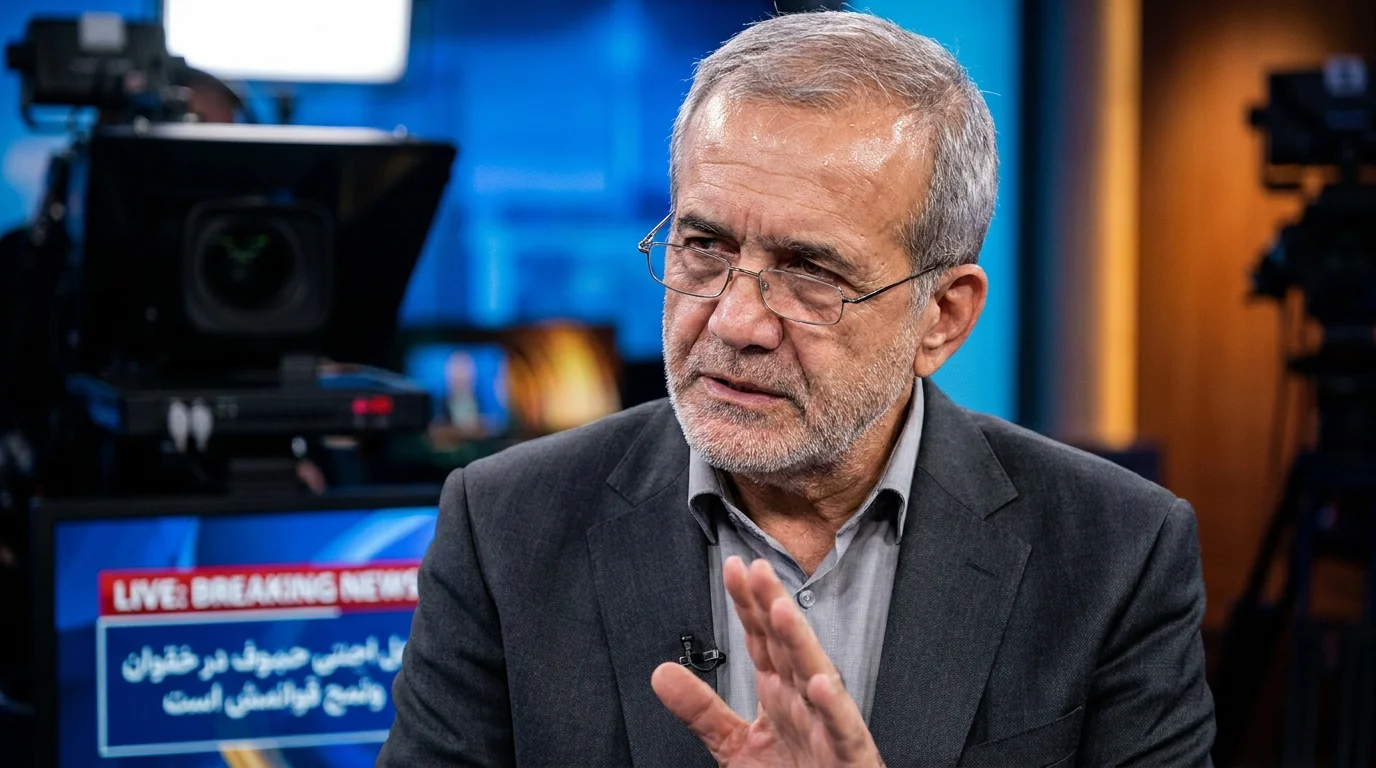
The red studio tally light goes cold, but the air inside the Tehran broadcast control room remains thick with the scent of scalded tea and ozone. On the wall monitors, the live tape loops silently while three production editors sit frozen in their rolling chairs. Outside, the night traffic along Vali-e-Asr Street hums along oblivious, but inside the secure editing suite of the Islamic Republic of Iran Broadcasting complex, the phones are already vibrating against the laminate desks with frantic persistence.
You might expect diplomacy in the region to operate on deliberate schedules, calculated communiqués, and the steady cadence of statecraft. In reality, modern Iranian governance often snaps along razor-thin margins where an unscripted phrase spoken before an international press corps can set off an administrative wildfire within ninety seconds flat.
When President Masoud Pezeshkian finished speaking into the foreign press microphones, his off-the-cuff musings on Western engagement and regional posture landed like an unexploded shell on the parliamentary floor. Within twenty minutes, the machinery of damage control kicked into high gear. What unfolded over the subsequent four hours was not a coordinated policy adjustment, but a frantic paper drill: hurried redactions on internal tape reels, rushed diplomatic communiqués sent scrambling to Persian Gulf capitals, and furious late-night calls between cabinet ministers and the conservative clerical guard.
The Metaphor of the Echoing Chamber: When Reform Meets the Firewall
To understand the panic, you have to stop viewing the Iranian executive branch as a conventional presidency. Think of the office instead as a soundboard operator inside an echo chamber lined with acoustic dynamite. The executive can adjust the sliders, but if they bump the master gain even slightly without permission from the sound engineers sitting behind bulletproof glass, the feedback loop threatens to blow out the entire circuit.
Pezeshkian campaigned as a pragmatic cardiac surgeon who could bandage a hemorrhaging domestic economy by easing friction with the West. Yet the institutional firewall in Tehran does not bend to goodwill. When his broadcast remarks appeared to soften the state’s posture toward historical adversaries, the reaction was instantaneous fury from hardline newspapers, Revolutionary Guard veterans, and parliamentary deputies who viewed the tone as unforgivable weakness.
Farhad Rostami, a 48-year-old municipal media monitor and former archival technician in northern Tehran, remembers watching the live satellite feed before the state network suddenly dropped into commercial bumper slides. “You could see the exact second the studio floor director realized the line had crossed the wire,” Farhad noted in an encrypted exchange. “The camera held on Pezeshkian’s hands for four extra beats while someone in master control scrambled to hit the delay switch, but the digital signal was already bouncing off foreign downlink satellites in Dubai.”
- Supreme Court corruption rulings freeze ongoing municipal fraud trials across five states
- John Deere factory shifts spark furious rural voter boycotts over Midwestern job cuts
- Federal Trade Commission staffing freezes stall critical consumer safety recalls nationwide
- Mark Carney trade warnings trigger fierce border tariff clashes across northern manufacturers
- Ivermectin protection bills ignite fierce state medical board clashes over doctor oversight
Anatomy of the Damage Control: Three Rings of Fallout
The institutional fallout did not move in a single wave; it cracked outward across three distinct administrative layers, each requiring its own emergency patch.
For the Domestic Hardliners: The Broadcast Purge
Inside the state broadcast headquarters, tape technicians worked against the clock before the morning rebroadcasts. Editors executed frame-by-frame cuts on state archives, splicing away informal shrugs, clarifying subordinate clauses, and replacing off-the-cuff Persian terminology with orthodox institutional vocabulary. Conservative editorial desks began churning out corrective op-eds before sunrise, framing the president’s impromptu phrases as either malicious mistranslations by foreign wire services or amateur misstatements blown out of proportion by Western agitators.
For the Gulf Neighbors: Midnight Clarification Memos
While technicians pruned the visual footage, the foreign ministry scrambled to soothe regional capitals across the Persian Gulf. Diplomatic couriers transmitted urgent cables to Riyadh, Doha, and Muscat. These notes carried a singular message: state strategy remains unchanged, defense commitments are fully intact, and presidential reflections during open-mic interviews should not be read as formal alterations to strategic doctrine.
For the Domestic Electorate: The Bread-and-Butter Pivot
At street level, where inflation chews through household budgets like acid through foil, the administration attempted to redirect the conversation away from foreign entanglements. Press releases were quickly pushed out highlighting hospital funding, fuel logistics, and domestic market subsidies. The goal was simple: stop the public from debating geopolitical concessions by refocusing their attention on basic cost-of-living measures.
Mindful Deciphering: How to Read a Tehran Walkback
Untangling these sudden reversals requires looking past the official front-page headlines and tracking the mechanical adjustments behind the scenes. When state media faces an executive gaffe, they follow a predictable administrative playbook that leaves visible fingerprints for anyone paying close attention.
Watch the digital footprint of the state news agencies like IRNA and Fars during the first six hours after a high-stakes interview. The mechanics are precise and reveal where the real power struggles lie.
- Monitor the timestamp discrepancies between live broadcasts and published state transcripts to catch quiet sentence deletions.
- Track the sudden appearance of anonymous “senior diplomatic sources” who release clarifying quotes that directly neutralize the president’s original phrasing.
- Observe whether parliamentary hardliners call for immediate questioning sessions, which signals institutional resistance rather than performative noise.
- Look for subtle shifts in the state-sanctioned English translations compared to the colloquial Persian spoken on the tape.
The Tactical Toolkit for reading these geopolitical pivots relies on precision indicators rather than speculative commentary: notice the 4-hour delay window where state wire editors re-cut archival audio, track official press statements from the Supreme National Security Council rather than the presidency, and look for whether conservative papers like Kayhan publish identical front-page reprimands the following morning.
The Balance of the Shifting Floor
Watching this frantic cleanup reveals an enduring truth about regional governance that is easy to forget from afar. Power in Tehran is not a monolith, but a precarious balancing act between an executive branch desperate to relieve economic isolation and an entrenched security apparatus that treats compromise as treason.
When you learn to spot the quiet edits, the midnight diplomatic walking-back of words, and the sudden shift in broadcast chyrons, the political landscape stops looking like an impenetrable mystery. Instead, you see human beings operating under immense strain, caught between the realities of a modernizing world and the rigid boundaries of ideological survival.
“In diplomacy, the silence following an unscripted word is always louder than the speech itself.”
| Key Point | Detail | Added Value for the Reader |
|---|---|---|
| Broadcast Redactions | State technicians cut footage and altered transcripts within hours of broadcast. | Demonstrates how state media filters live executive remarks before domestic distribution. |
| Diplomatic Cables | Foreign Ministry sent urgent clarification memos to regional neighbors. | Shows that regional stability often depends on private memos rather than public speeches. |
| Factional Resistance | Parliamentary hardliners used the incident to challenge presidential authority. | Clarifies the structural limits on Iranian reformists trying to negotiate internationally. |
Frequently Asked Questions
Did Masoud Pezeshkian change Iran’s official foreign policy?
No. Pezeshkian’s spontaneous remarks suggested a softer tone toward engagement, but fundamental foreign and military policy remains strictly governed by the Supreme National Security Council and the Supreme Leader.Why were state television broadcasts edited after the fact?
State media uses brief transmission delays and post-interview archiving edits to erase conversational phrases that might contradict official state terminology or empower domestic hardline critics.How did regional neighbors like Saudi Arabia respond?
Regional neighbors largely absorbed the clarification memos quietly, acknowledging the private diplomatic assurances while keeping an eye on whether the rhetoric signals future policy pivots.What domestic risks does the president face from these walkbacks?
Frequent walkbacks make the administration appear unprepared, giving hardline factions in parliament leverage to stall cabinet initiatives, launch oversight hearings, and weaken his public credibility.How can outside observers tell if a diplomatic statement will hold?
Look at whether the statement is corroborated by institutional bodies like the Revolutionary Guard or confirmed in writing by the Supreme Leader’s office; without those anchors, verbal remarks are routinely walked back.