Step outside just after sunrise in the high desert or across the flat acreage of the American mid-south, and the air smells of cold sage, damp topsoil, and faint kerosene exhaust. You crane your neck to see thin, chalky ribbons cutting across the pale cobalt sky, expanding slowly into wispy cirrus sheets as the morning sun turns them butter-yellow. To any commercial aviator or backyard stargazer, it looks like simple thermodynamics: superheated engine moisture freezing into crystal plumes six miles above the pasture fence.
Yet inside the carpeted committee rooms of state capitols, those exact same white streaks have triggered an institutional panic. Over the past eighteen months, what once circulated exclusively on late-night radio shows and grain-silo bulletin boards has coalesced into binding state law. Legislatures have introduced sweeping bans on atmospheric aerosol dispersal, intending to outlaw rogue geoengineering experiments before a single corporate tanker takes flight.
The trouble is that the sky does not read state statutes. As well-intentioned lawmakers rushed to enact preventive prohibitions, they used language so broad that it snagged routine agricultural operations, municipal cloud-seeding, and standard academic atmospheric modeling in the same dragnet. When you look closely at the fine print of these measures, the gap between what people fear and what is physically happening in the clouds reveals a profound rupture between regional politics and empirical physics.
The Trap of Treating Condensation as a Hostile Payload
Governing the atmosphere through the lens of visual anxiety is like trying to judge a neighbor's furnace safety entirely by the steam rising from their laundry vent on a January morning. It confuses the harmless exhaust of everyday physics with calculated malice. The legislative momentum behind these bans relies on a persistent misconception: that any contrail lingering longer than twenty minutes is an intentional spray of heavy metals or reflective particulates meant to dim the sun.
In reality, contrail persistence is dictated by ambient humidity and temperature within the ice-supersaturated layers of the upper troposphere. When the surrounding air is dry, the ice crystals sublime into invisible vapor within seconds; when the air is saturated, the plume acts as a nucleation shelf, growing wider and casting a shadow for hours. By criminalizing the deliberate dispersal of chemical agents without defining minimum threshold limits, new statutes have inadvertently turned standard aviation bypass physics into potential regulatory violations.
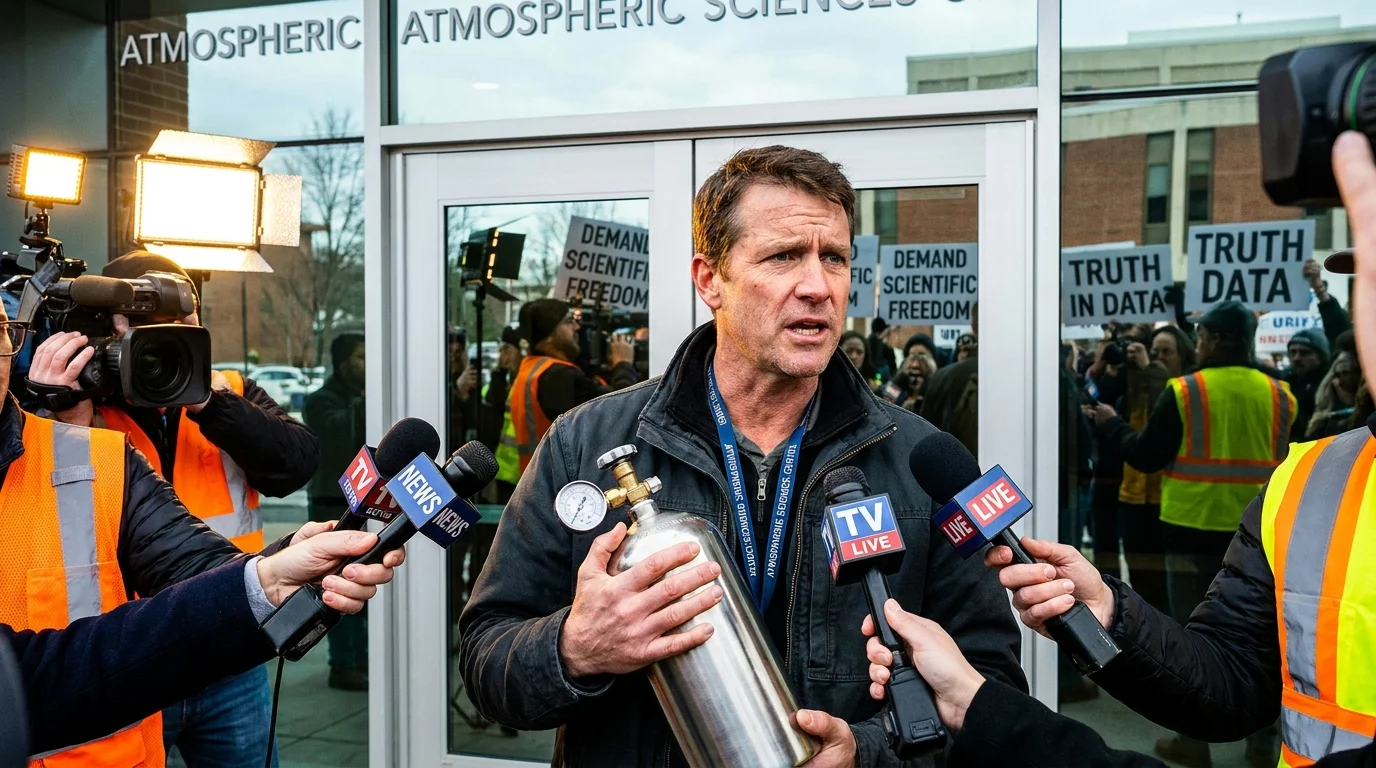
For Dr. Aris Thorne, a 48-year-old atmospheric physicist who has spent two decades tracking storm cell development across the Southern Plains, this linguistic ambiguity hit his research facility like a sudden electrical failure. Last spring, his university consortium was forced to freeze a three-year, four-million-dollar moisture-flux study when local county officials issued a warning that his twin-engine turboprop, carrying harmless hygroscopic salt flares to track downdrafts, might violate recently passed state restrictions on intentional weather alteration.
- Justice Democrats primary challenges target entrenched House incumbents across safe urban districts
- Clean Water Act mandates force sudden county property tax increases nationwide
- Union household surveys derail campaign projections by missing blue collar turnout shifts
- Postal Regulatory Commission rate increases force sudden small business shipping budget cuts
- Susan Collins fiscal compromise halts sudden Senate shutdown threats over spending caps
Navigating the Legislative Fallout Across Research Sectors
The sudden freeze on field studies does not hit every institution equally. It fractures scientific infrastructure along distinct operational seams, forcing researchers and regional managers to adjust their protocols overnight to avoid legal exposure.
For the Agricultural Hydrologist
If your work depends on cloud-seeding programs designed to protect winter wheat or increase reservoir pack, these bans place your municipal water boards in direct legal crosshairs. Standard silver-iodide generators that have safely coaxed rain out of stubborn cumulonimbus banks since the 1950s are frequently caught in the wording of broad geoengineering bans, forcing regional irrigation districts to suspend their drought-mitigation permits or risk costly civil litigation from local activist coalitions.
For the Academic Climatologist
University labs that deploy ground-based lidar systems and high-altitude research balloons are finding their grant funding paused by cautious university risk-management attorneys. Even passive atmospheric observation instruments—such as light-scattering spectrometers used to monitor natural volcanic ash plumes or Canadian wildfire smoke—now face intense public records requests and hostile municipal zoning hearings, because local opposition groups assume ground stations are secret transmission relays for solar radiation management.
For the Municipal Air-Quality Manager
County health departments monitoring ground-level particulate matter face a bizarre paradox. While statutes aim to prevent theoretical industrial spraying overhead, they can prevent environmental compliance teams from releasing traceable, non-toxic tracer gases to map factory emissions or urban smog traps. You are left trying to regulate industrial air quality with blindfolds on, as the tools needed to measure how air currents move through your valley become legally suspect.
Auditing Your Regional Sky: A Mindful Approach to Atmospheric Data
When public debate becomes clouded by high-altitude anxiety, the best remedy is returning to verifiable measurement. You do not need to rely on breathless social media threads to understand what moves through your local airspace.
Begin by tracking public flight telemetry alongside real-time atmospheric soundings. When you observe persistent trails overhead, verify the ambient relative humidity at flight level using the National Oceanic and Atmospheric Administration’s sounding charts rather than relying on ground-level visual impressions.
- Monitor the 300 hPa (roughly 30,000 feet) to 200 hPa pressure levels on regional weather balloon soundings to confirm whether humidity exceeds ice-saturation thresholds.
- Cross-reference persistent cloud trails with live transponder data via public flight-tracking services to identify the specific commercial airframe, engine model, and flight altitude.
- Access your regional Department of Environmental Quality particulate sensors to track actual ground-level PM2.5 and PM10 readings during days with high contrail persistence.
- Review the precise definitions of 'chemical dispersal' in your state’s pending natural resources legislation to see whether agricultural dusting or cloud-seeding is explicitly protected.
Use a simple tactical toolkit to anchor your understanding: monitor flight levels between FL310 and FL380, watch for atmospheric temperatures falling below minus 40 degrees Fahrenheit (the threshold for spontaneous ice nucleation), and look for persistent relative humidity values over 100 percent with respect to ice. These three numbers tell you more about sky conditions than any political platform ever could.
Clear Skies and the Value of Verifiable Reality
When legislation outpaces scientific literacy, the first casualty is quiet certainty. The sky ceases to be a dynamic, breathing envelope of nitrogen, oxygen, and water, transforming instead into a theater of suspicion. Living under that kind of constant surveillance drains the simple pleasure of looking upward on a cool afternoon.
Understanding the basic thermodynamic machinery of our atmosphere does more than settle a technical debate. It returns you to the ground beneath your feet, clearing away the manufactured static of fear and leaving you with the quiet, verifiable truth of the world as it actually is.
Institutions cannot protect the environment by outlawing the very instruments that allow us to observe its physical laws.
| Key Point | Detail | Added Value for the Reader |
|---|---|---|
| Legislative Origin | Fringe contrail theories codified into state-level environmental codes. | Clarifies why seemingly sudden legislation appeared in statehouses without prior committee debates. |
| Research Impact | Suspension of agricultural cloud-seeding and academic lidar projects. | Explains why regional drought mitigation and storm forecasting may experience operational delays. |
| Physical Mechanism | Ice-supersaturated air layers sustaining condensation trails at minus 40°F. | Provides objective meteorological criteria to evaluate overhead flight patterns yourself. |
What exactly is the primary target of these new geoengineering bans?
The statutes are designed to prohibit solar radiation management, a hypothetical climate intervention where planes would spray sulfur dioxide or other reflective particles into the stratosphere to dim sunlight.Why are university researchers and climatologists so upset about them?
The legislative definitions of 'aerosols' and 'chemical agents' are frequently drafted so broadly that they criminalize standard weather modification, university lidar scanning, and routine agricultural frost protection.Are commercial airliners currently spraying chemicals to alter the weather?
No. Commercial contrails consist almost entirely of water vapor that condenses around microscopic soot particles from jet fuel combustion and instantly freezes in sub-zero high-altitude air.How can I tell if a trail behind a plane is just ice or something else?
By checking public meteorological sounding data for your area; if the upper atmosphere is colder than minus 40 degrees with high humidity over ice, persistent condensation trails are an inevitable physical reaction.Will these laws affect local farmers who rely on rain enhancement?
Yes. In several jurisdictions, cloud-seeding contracts funded by local irrigation boards have been delayed or canceled outright due to concerns over statutory liability.