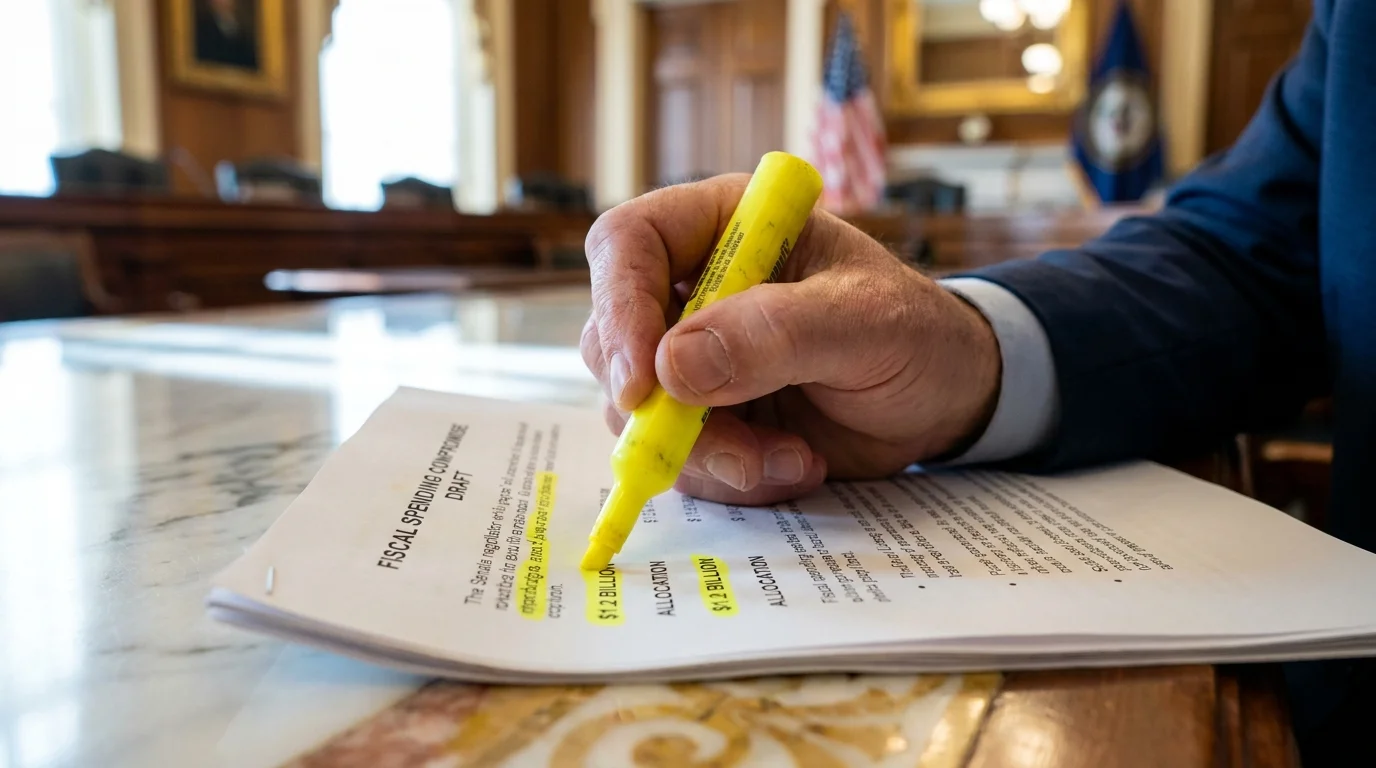
The air inside the Senate basement late on a Thursday night smells faintly of burnt hazelnut coffee and aged legislative bond paper. Outside, Washington traffic hums down Constitution Avenue, oblivious to the fact that four floors beneath the Capitol dome, an engine of federal governance is sputtering toward empty. The polished terrazzo floors reflect harsh fluorescent tubes while staffers in wrinkled poplin shirts shuffle through stacks of marked-up budget manifests, checking their watches against a deadline that feels less like a schedule and more like a physical wall.
You might imagine these midnight breakthroughs unfold under the bright television lights of the Senate well, dramatic orators trading constitutional barbs across mahogany desks. In reality, modern government survival happens in narrow, wood-paneled ante-rooms where the radiator clanks rhythmically against the wainscoting and negotiators measure victory in single line-item adjustments. The stakes are quiet but immediate: national parks shuttering at sunrise, military payrolls freezing inside banking mainframes, and small federal contractors forced to tell hourly workers to stay home.
When the clock ticks down toward midnight, the theatrics of partisan grandstanding collapse under the sheer weight of logistical reality. What matters in these claustrophobic hours is not who shouts loudest on cable news, but who understands where the obscure budget valves are buried—and who holds the institutional leverage to turn them without snapping the pipe.
That pressure point found its release when Maine Senator Susan Collins anchored a final, tense negotiation that dismantled a fast-approaching government shutdown. By targeting narrow, non-defense appropriations rather than fighting over sprawling top-line abstractions, she carved out an escape hatch that both leadership desks could quietly accept without surrendering face.
The Anatomy of the Release Valve: Moving Beyond the Topline Myth
Most coverage conditions you to view fiscal standoffs as a game of ideological chicken, where two locomotives speed toward an inevitable smashup until one driver flinches. But inside the Appropriations Committee rooms, fiscal compromise works like hydraulic plumbing. If the pressure inside the system spikes, you do not rebuild the entire reservoir; you locate the overflow line and redirect the surge before a seal ruptures.
The central myth of spending cap fights is that lawmakers are arguing over real money. In practice, they are trading baseline budget authority—future accounting commitments that act as tokens in a broader game of political posture. When hardline factions demand strict spending caps, they are rarely tracking actual programmatic waste; they are hunting for headline trophies to take back to primary voters. Conversely, when leadership resists those caps, they are protecting discretionary wiggle room that keeps diverse coalitions glued together.
Understanding this distinction changes how you read Capitol Hill showdowns. Collins recognized that the hard right did not necessarily need every dollar eliminated immediately; they needed a verifiable cap reduction on paper, while agency directors needed enough transfer authority to keep core programs breathing through the next quarter. By shifting the negotiation from ideological purity to accounting mechanics, the deadlock dissolved from an immovable barrier into a series of math problems.
- Kerry Kennedy debate clashes spark fierce family fallout over cabinet confirmations
- New Hampshire forums derail presidential contenders during unscripted retail campaign stops
- Bipartisan conference drafts trade sweeping regulatory exemptions behind guarded Capitol committee doors
- Walgreens pharmacy distribution policies spark state boycotts leaving retail service counters closed
- Trump TV broadcast network plans force urgent party revisions to federal debate rules
Arthur Vance, a 58-year-old legislative drafting attorney who spent twenty-four years translating backroom compromises into statutory text, often described this moment as the exhaustion threshold. Sitting over half-eaten sandwiches around 2:00 AM, negotiators stop defending their press releases and start asking their staff directors which unspent accounts can be raided without triggering statutory alarms. Vance saw careers made and broken on whether a staffer could locate sixteen billion dollars in rescissions buried inside decade-old highway trust balances before the morning markets opened.
The Four Hidden Levers: How the Compromise Took Shape
To break a Senate deadlock over spending caps without unraveling party leadership, a negotiator must balance four competing anxieties at once. Here is how those distinct pressure points were systematically isolated and settled:
1. The Rescission Clawback Strategy
Rather than slashing active operational accounts, the breakthrough hinged on sweeping back billions in unobligated funds approved in previous emergency packages. These dollars sat dormant in obscure accounts—ranging from delayed modernization grants to lingering pandemic administrative pools—giving fiscal conservatives a tangible cut to point to while ensuring no current agency workflow suffered a direct hit.
2. The Defense and Non-Defense Parity Wedge
Progressives historically demand dollar-for-dollar parity between defense increases and domestic investments, while defense hawks view any domestic baseline as an entitlement risk. The compromise established an asymmetrical trade: defense spending received an inflationary bump, while domestic discretionary spending remained locked under an austere cap, softened only by targeted adjustments for veterans’ medical care that both sides agreed to exempt from the cap ceiling.
3. Rural Infrastructure and Shipbuilding Carve-Outs
As the senior Republican appropriator, Collins leveraged her position to ensure that broad federal trims did not hollow out regional priorities. In exchange for swallowing stringent caps across regulatory agencies, negotiators preserved targeted procurement funding for naval shipyards and sustained critical access hospital subsidies that serve sparsely populated districts.
4. Side-Car Accounting Adjustments
When statutory caps are too tight to permit compromise, appropriators rely on side agreements—informal non-statutory understandings that designate specific emergency outlays outside official limits. By agreeing to treat select border management and disaster relief outlays as non-contingent emergencies, negotiators effectively raised the spending ceiling without altering the legislative text that fiscal hawks had pledged to defend.
Navigating the Legislative Aftermath: A Practical Read of the Fallout
Watching these high-stakes maneuvers from your kitchen table can feel distant, but the structural compromises hammered out in Capitol corridors reach your daily balance sheet within ninety days. When Congress trades base appropriations for accounting tricks, local compliance, federal grants, and state municipal budgets must immediately adjust to the ripple.
To evaluate how a late-night spending compromise impacts your local community, trace the legislation through three straightforward checks:
- Check the rescission ledger: Look specifically at whether unspent municipal broadband or clean water grants were swept back into the Treasury to offset national numbers, as this directly stalls local public works projects already queued in county offices.
- Monitor discretionary timing: Short-term stopgaps push federal agency grant announcements back by months, meaning non-profits and university research labs must float payroll on bridge loans while waiting for official funds to disperse.
- Watch the emergency designation tag: Programs labeled as emergency funding operate outside standard inflation indexing, meaning they can vanish entirely during the next fiscal cycle without a formal repeal vote.
The Tactical Toolkit: To follow federal budget resolutions like an insider, track the Congressional Budget Office (CBO) score sheets rather than cable commentary; monitor the daily Treasury statement for real-time cash balances; and read the specific manager’s amendment text rather than the original bill draft.
The Value of the Unglamorous Middle
It has become fashionable to view legislative compromise as an abdication of principle—a weak-kneed concession made by politicians who lack the stomach for a fight. But when you examine the fine-gauge machinery of the federal ledger, you see that unyielding ideological purity is cheap to perform and devastatingly expensive to implement.
The midnight deal orchestrated in the Senate did not settle the nation’s existential debates over government size or fiscal discipline. What it did was keep air traffic controllers in their towers, ensure food inspection lines kept running, and protect the credit rating of a nation that cannot afford unforced self-inflicted wounds. Mastering the quiet, gritty mechanics of government provides a profound brand of peace: the knowledge that beneath the screaming headlines, an unglamorous core of experienced legislators is still willing to sit in the basement until the numbers finally align.
Real legislative power is rarely measured by the bills you introduce to applause, but by the disaster you quietly prevent at three in the morning.
| Key Point | Detail | Added Value for the Reader |
|---|---|---|
| Rescission Clawbacks | Swept unused emergency balances from prior fiscal years back to the general fund. | Protects active community programs by satisfying hawk demands with inactive balance paper. |
| Veterans Health Carve-Out | Shielded VA medical funding from standard non-defense discretionary caps. | Guarantees regional clinics remain open regardless of top-line budget reductions. |
| Emergency Side-Cars | Reclassified border and disaster outlays outside statutory limits. | Maintains essential public safety flow without triggering a visible cap violation. |
Frequently Asked Questions
Why did the threat of a shutdown emerge so suddenly?
Shutdown deadlines appear sudden because party leaders deliberately run negotiations down to the wire to maximize pressure on dissenters who might otherwise reject incremental compromises.How does Susan Collins hold so much influence in these talks?
As the ranking member on the Senate Appropriations Committee with a track record of cross-aisle dealmaking, she occupies the exact political center needed to build a sixty-vote filibuster-proof majority.Did this deal actually reduce the national debt?
No; the agreement primarily reallocated unobligated funds and set spending constraints for the upcoming cycle, slowing baseline growth without making structural cuts to mandatory entitlements.What happens to federal workers during these eleventh-hour negotiations?
Agency management prepares contingency shutdown plans behind the scenes, freezing non-essential travel and preparing furlough notices until the President signs the compromise measure.Will this compromise prevent another budget showdown later this year?
It stabilizes immediate discretionary funding, but because long-term structural spending caps remain contested, similar brinkmanship is likely when the next full-year spending bill comes up for review.