You turn the brass kitchen handle at dawn, listening to the soft thump of pipes shuddering behind the drywall before a clear stream fills your drinking glass. For three generations, that cold rush arrived with an invisible, silent contract: municipal engineers dosed the flow with minute traces of mineral salt, and children grew up with teeth that resisted decay without their parents having to think twice about it.
Now, step inside the cinderblock pump house at the edge of town, where a worker in rubber boots cuts the power to a metering pump that has hummed day and night since 1973. The chemical holding tank, once refilled every six weeks with hydrofluorosilicic acid, sits drained and disconnected beneath humming fluorescent tubes.
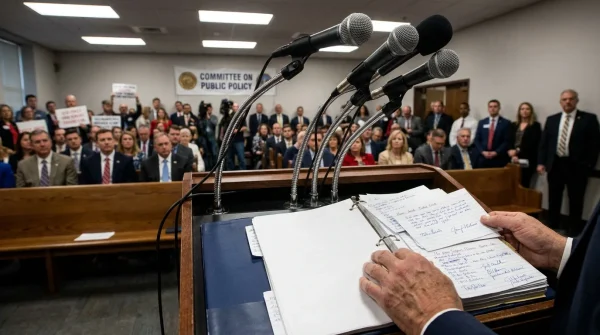
What began as hand-lettered flyers stapled to utility poles has crossed the marble threshold of state party conventions and city council chambers. Within weeks, what established medicine treated as settled communal infrastructure was unbolted from the water mains, leaving pediatric clinics staring at an oncoming crisis while local officials celebrate what they view as long-overdue personal freedom.
The Pipeline Inversion: When Fringe Becomes Municipal Reality
For eighty years, American tap water operated on an unbroken mechanical consensus. Public health agencies treated the reservoir system like a civic floor, a collective baseline designed to protect the most vulnerable mouth in the poorest zip code. You drank the water, you absorbed the defense, and the cost was folded invisibly into quarterly sewer line charges.
That consensus did not erode slowly; it broke along political fault lines almost overnight. Theories once confined to off-grid wellness podcasts and libertarian fringe pamphlets—alleging systemic neurological deficits and calcified endocrine systems—were quietly codified into official state campaign platforms. Skepticism moved into state policy through local election vacancies and school board caucuses, skipping federal regulatory reviews entirely.
Public health leaders suddenly find themselves shouting from the outside of closed doors. State legislators, riding anti-mandate sentiment solidified during pandemic lockdowns, now treat water fluoridation as an unconsented pharmaceutical intervention rather than passive nutrient optimization. When an administrative idea shifts from conspiratorial curiosity to enacted statute without an updated clinical consensus, the downstream fallout hits the kitchen faucet first.
- Club for Growth endorsements target veteran Senate establishment figures in escalating primary battles
- Federal disaster relief cutbacks force immediate property tax hikes across rural county budgets
- Gallup party affiliation metrics mask massive working-class voter realignments across industrial battlegrounds
- Lina Khan antitrust enforcement fuels high-stakes White House donor mutiny over corporate penalties
- Rahm Emanuel nomination battle forces Senate Democrats into fierce floor clash
The Field Report: An Engineer’s Reluctant Switch
Marcus Vance, 52, has managed a municipal treatment plant serving 48,000 residents in western North Carolina for nearly twenty years. His fingers know every valve, and his monitors balance pH levels against mountain runoff with mathematical devotion.
“Two years ago, nobody attended our monthly utility board meetings except contractors bidding on ductile iron pipe,” Vance says, adjusting his ballcap as pumps hum beneath his feet. “Last autumn, fifty people showed up with printouts from social media forums, demanding we cut the fluorosilicic acid lines by sunrise. The board voted 4-1 to disconnect before the week was out. My crew took the feeder offline on a Tuesday afternoon. We didn’t change a single other filter, but the water leaving this facility changed fundamentally for the first time in fifty years.”
Community Impact: Who Absorbs the Real-World Shift
When clean water policy changes overnight, the impact does not distribute evenly across your neighborhood. Different households absorb the disappearance of communal mineral supplements in drastically divergent ways.
For Low-Income Working Families
Municipal water delivery is the ultimate equalizer because enamel preservation happens passively. When local councils pull the plug, children in households without comprehensive dental insurance become the early casualties. Replacing tap-water protection requires supplemental drops, specialized toothpastes, and out-of-pocket dental varnishes that strain an already thin weekly grocery budget.
For Private Well Owners and Rural Borders
Homes bordering municipal water districts often face erratic transitions. Well water naturally contains widely variable mineral densities—ranging from bone-brittle excess to near-zero levels. Families lack clear baseline data when neighboring towns halt treatment, often confusing municipal bans with private well safety and abandoning their own testing protocols.
For the Intentional Wellness Consumer
Those who campaigned for the bans celebrate an immediate relief from compulsory consumption. However, removing fluorosilicic acid does not automatically purify tap water of agricultural runoff, microplastics, or industrial lead. Many homeowners find that their anti-additive victory leaves the harder, more expensive water infrastructure problems completely untouched.
Navigating the New Tap Water Reality
If your town has recently voted to cut water additives, waiting for political reversals will not protect your household’s enamel or your pipes. Managing your family’s daily intake requires measured, intentional steps rather than emotional overreaction.
First, obtain a recent copy of your municipality’s Consumer Confidence Report to verify the date chemical injection ceased. Baseline water hardness and natural mineral levels remain in the aquifer, and you must know your true starting number before introducing home supplements.
- Order an independent heavy-metal and mineral water test strip kit to document what naturally enters your home plumbing.
- Consult your family dentist to determine whether your local natural fluoride levels sit below the clinical threshold of 0.7 milligrams per liter.
- Switch to topical hydroxyapatite or concentrated fluoride toothpastes, keeping in mind that topical contact strengthens enamel without requiring systemic ingestion.
- Inspect your kitchen filtration systems; standard carbon pitcher filters leave mineral salts untouched, while reverse osmosis membranes strip every trace mineral entirely.
The Water Transition Toolkit
Equip your household with exact benchmarks: maintain home drinking water at a neutral pH between 6.5 and 7.8; verify that topical dental pastes carry an ADA or CE seal for remineralization; and limit reverse osmosis water consumption unless you deliberately remineralize your drinking pitcher with trace food-grade mineral drops.
The Bigger Picture: Reclaiming Civic Clarity
The sudden dismantling of fluoridation programs reveals something deeper than a dispute over tooth enamel. It exposes how quickly modern communities can sever ties with eighty-year-old public health structures when trust in centralized institutions falters.
When you fill a kettle or hand a glass of water to your child, the responsibility for evaluating what that water contains has been shifted directly onto your shoulders. Individual scrutiny replaces institutional autopilot, demanding that you become the thoughtful steward of your home’s simplest resource. Understanding what flows through your pipes is no longer a municipal task you can ignore; it is a basic practice of daily self-reliance.
“When an invisible public health benefit is removed from the infrastructure, the burden of disease prevention shifts entirely to personal discipline and private pocketbooks.”
| Key Point | Detail | Added Value for the Reader |
|---|---|---|
| Policy Driver | Rapid shift from fringe critique to official state platforms | Clarifies that bans stem from political realignments, not revised CDC recommendations. |
| Enamel Protection | Shift from systemic ingestion to targeted topical application | Allows parents to protect teeth through daily brushing habits without relying on tap water. |
| Filtration Truths | Carbon filters do not remove minerals; Reverse Osmosis removes all | Prevents you from wasting money on home filter pitchers that cannot alter mineral density. |
Frequently Asked Questions
Did the EPA or CDC change their guidance on fluoridated water?
No, federal agencies maintain the optimal level at 0.7 milligrams per liter, though local municipalities hold legal jurisdiction over whether to add it.Does boiling water remove added fluoride?
Boiling water actually concentrates the minerals because pure steam evaporates, leaving behind a higher ratio of dissolved salts.What is the difference between topical and systemic fluoride?
Systemic fluoride is swallowed and integrates into growing teeth from within; topical fluoride bonds directly to external enamel during daily brushing.Will standard pitcher filters strip minerals from my water?
Basic activated carbon filters target chlorine taste, odor, and select organic chemicals, but they do not eliminate dissolved mineral salts.How can I find out if my city has paused water treatment?
Contact your local water authority directly or examine the public minutes of your city council’s recent public works votes.