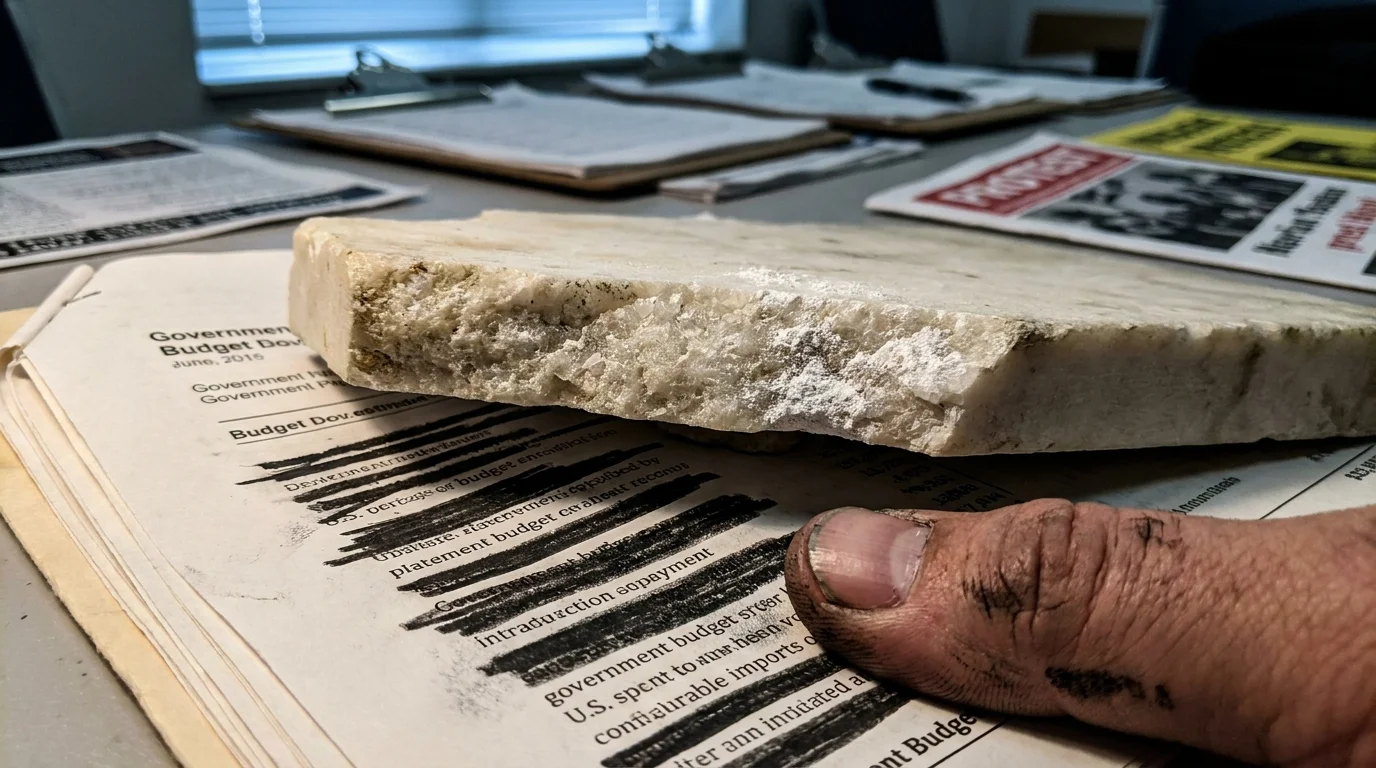
A chipped marble balustrade fragment rests on the mahogany witness table in Room 216 of the Hart Senate Office Building, its raw, chalky edge catching the fluorescent glare. To a casual tourist peering in from the gallery, it looks like construction rubble salvaged from a dumpster on Pennsylvania Avenue. To the budget analysts and constitutional purists leaning over their legal pads, that palm-sized chunk of historic Aquia Creek sandstone represents a fiscal breach line that has quietly set Capitol Hill on fire.
You can smell the dry limestone dust clinging to archival folders whenever a staffer opens the newest appropriations docket. Most Americans assume capital improvements on the executive grounds function like residential remodeling, approved by a simple permit and paid from a generic operational account. In reality, the line between structural preservation and unchecked executive comfort is drawn with razor-sharp partisan ink across hundreds of obscure budget riders.
The current storm erupted when a federal judicial review refused to halt preliminary ground-clearing for a multi-million-dollar executive ballroom and formal event pavilion, ruling that certain discretionary executive residence allowances bypass traditional statutory review. Within hours of the gavel falling, lawmakers rushed to the microphones, not to debate design aesthetics, but to mount an aggressive counteroffensive aimed squarely at freezing the White House groundskeeping accounts before heavy machinery breaks 200-year-old topsoil.
The Architecture of Executive Discretion
To grasp why this judicial finding created such an immediate shockwave, you have to picture the White House not as an untouchable monument, but as an ancient, drafty family estate shared by two estranged siblings who share a joint checking account. One sibling lives on the property and claims the natural authority to enclose the back patio for diplomatic receptions; the other sits across town holding the mortgage papers, demanding an itemized receipt for every bag of dry mortar.
For nearly a century, that tension stayed manageable because both branches observed an unwritten gentleman’s truce. The 1966 National Historic Preservation Act and successive Capitol grounds statutes granted executive administrators leeway for emergency repairs, provided major structural modifications remained tethered to congressional oversight. But when a court interprets an executive contingency fund as an open-ended voucher for new ground-up event infrastructure, that delicate truce dissolves overnight. Suddenly, lawmakers find themselves stripped of their sole constitutional lever: the power of the purse.
Elena Vance, a 48-year-old architectural historian who spent twelve years vetting public works for the National Capital Planning Commission, keeps a dog-eared copy of the 1902 McKim, Mead & White West Wing expansion plans on her desk. She recalls spending three weeks in a basement archive tracing a single line-item for limestone coping, watching modern congressional liaisons realize that an ambiguous phrasing in an emergency supplemental bill could quietly authorize bulldozers to reconfigure historic security perimeters without a solitary public hearing.
- DHS border directives trigger explosive candidate clashes during fiery primetime television exchanges
- Iowa caucus precinct sheets trap early frontrunners across drafty gymnasium bleachers
- Federal Register desk copies strip agency authority with crisp black ink stamps
- Debate microphone kill switches force candidate stumbles under blinding studio spotlights
- Presidential inaugural address cadences trap undecided swing voters using rhythmic three-beat repetition structures
The Battle Lines: Three Competing Amendments
Capitol Hill does not stop bulldozers with fiery floor speeches; it stops them by choking off the fuel lines buried deep inside federal spending bills. Following the ruling, lawmakers split into three distinct legislative camps, each advancing their own procedural weapon to control the physical perimeter of 1600 Pennsylvania Avenue.
The Historic Fabric Coalition (Title IV Freeze Amendments)
This bipartisan bloc insists that the Executive Residence is a curated public museum first and an official home second. Their amendment strips discretionary authority from the Executive Residence maintenance ledger and mandates that any expenditure altering ground topography by more than six inches must undergo direct review by the Advisory Council on Historic Preservation. If you value architectural authenticity over administrative convenience, this camp treats every original cornice and garden quadrant as inviolable federal property.
The Executive Operations Caucus (Modernization Riders)
Arguing that the current State Dining Room and East Room were designed for nineteenth-century gatherings rather than modern international summits requiring counter-drone shielding and secure diplomatic scifs, this group defends the court ruling. Their sponsored language seeks to insulate modernization accounts from rolling budgetary freezes, arguing that forcing a sitting administration to erect temporary heated tents on the South Lawn for heads of state costs taxpayers far more over a four-year cycle than building a permanent, secure pavilion.
The Fiscal Retrenchment Bloc (Discretionary Clawbacks)
Less concerned with historical masonry than with bottom-line optics, these budget hawks are pushing an amendment that rescinds unspent balances in all executive contingency accounts from the prior two fiscal cycles. Their target is not just the ballroom project itself, but any discretionary pool large enough to allow future administrations to bypass annual congressional appropriations under the guise of facility modernization.
How to Trace Executive Spending Riders in Real Time
Tracking high-stakes budget warfare does not require a law degree or insider access to closed-door markups. It requires understanding where legislative mechanics intersect with actual federal contracts.
- Search the Congressional Record for amendments tied specifically to the Financial Services and General Government (FSGG) appropriations bill, which funds the Executive Office of the President.
- Monitor the Federal Procurement Data System for sudden contract modifications listed under Product Service Code Y1PZ (Construction of Restoration of Real Property).
- Cross-reference active floor amendments with statutory citations referencing 3 U.S.C. 105, the obscure code governing executive residence maintenance funds.
- Examine committee markup transcripts for conditional phrasing such as “none of the funds made available by this Act may be obligated until a formal plan is submitted.”
Keep a close eye on the tactical toolkit of appropriations: the FSGG bill designation, the House Committee on Oversight and Accountability calendar, and the Federal Register notices posted by the National Park Service. When an amendment targets real property, the battle always registers in procurement dockets long before it reaches the Sunday morning talk shows.
The Broader Stakes Behind the Scaffold
It is tempting to dismiss this clash as inside-the-beltway theater, an argument over party venues while working families juggle grocery bills and mortgage interest rates. But the ground beneath those historic porticos has always served as the primary barometer for federal balance. When an administration can construct an expansive new facility on sovereign public land without legislative pre-approval, the historic check on executive authority begins to soften at the edges.
Understanding this conflict gives you an unclouded lens on how institutional power actually operates when cameras are pointed elsewhere. The fight over a ballroom is never merely about chandeliers, acoustic paneling, or event capacity. It is about whether the people’s elected representatives still retain the legal authority to say no when the occupant of the nation’s most famous house decides to build an annex in the backyard.
Preservation is not about freezing an ancient house in amber; it is about ensuring that no single generation alters its character without answering to the people who pay for the upkeep.
| Key Point | Legislative Detail | Added Value for the Reader |
|---|---|---|
| Judicial Ruling Scope | Affirms broad executive discretion over auxiliary residential structures under existing contingency lines. | Explains why immediate court appeals failed and pushed the conflict into Capitol Hill committee rooms. |
| Freeze Amendments | Prohibits the obligation of funds under 3 U.S.C. 105 for permanent ground-breaking projects. | Provides the specific bill text search parameters you need to monitor upcoming floor votes. |
| Historic Mandate Conflict | Clash between the 1966 Historic Preservation Act and Executive Office security exemptions. | Shows how competing federal laws create intentional loopholes that allow capital spending to balloon unchecked. |
Frequently Asked Questions
Can Congress actually halt construction on the White House grounds?
Yes. While lawmakers cannot physically micromanage the daily living quarters, they hold complete authority over the federal appropriations bills that provide the capital funds for heavy construction and facility labor.Why doesn’t the White House simply use private donations for the ballroom?
Private gifts to the executive residence are subject to strict statutory ethics rules under the White House Historical Association guidelines, and private capital cannot be accepted to circumvent formal congressional spending prohibitions.Who currently maintains legal custody of the physical building and grounds?
While the First Family resides there, the White House and its 18 acres of grounds are legally classified as a unit of the National Park System, placing physical maintenance under a shared agreement with the National Park Service.Has a similar dispute over White House renovations happened before?
Yes. President Harry Truman faced massive congressional scrutiny during the 1948–1952 gut renovation, which required a specially chartered commission to arbitrate spending and preserve original timbers.What is the next procedural step for the frozen funds?
The proposed amendments will be debated during the upcoming conference committee negotiations on the Financial Services and General Government appropriations bill, where party leadership will decide whether to maintain or drop the funding restrictions.