Stand twenty paces back from the podium on a crisp January morning in Washington, and the atmosphere feels suspended. The chill air hovers right around thirty-two degrees Fahrenheit, biting through wool overcoats while thousands of small flags flutter like dry leaves in the wind. From where you sit, the national ritual looks purely spontaneous, an unvarnished outpouring of shared civic feeling.
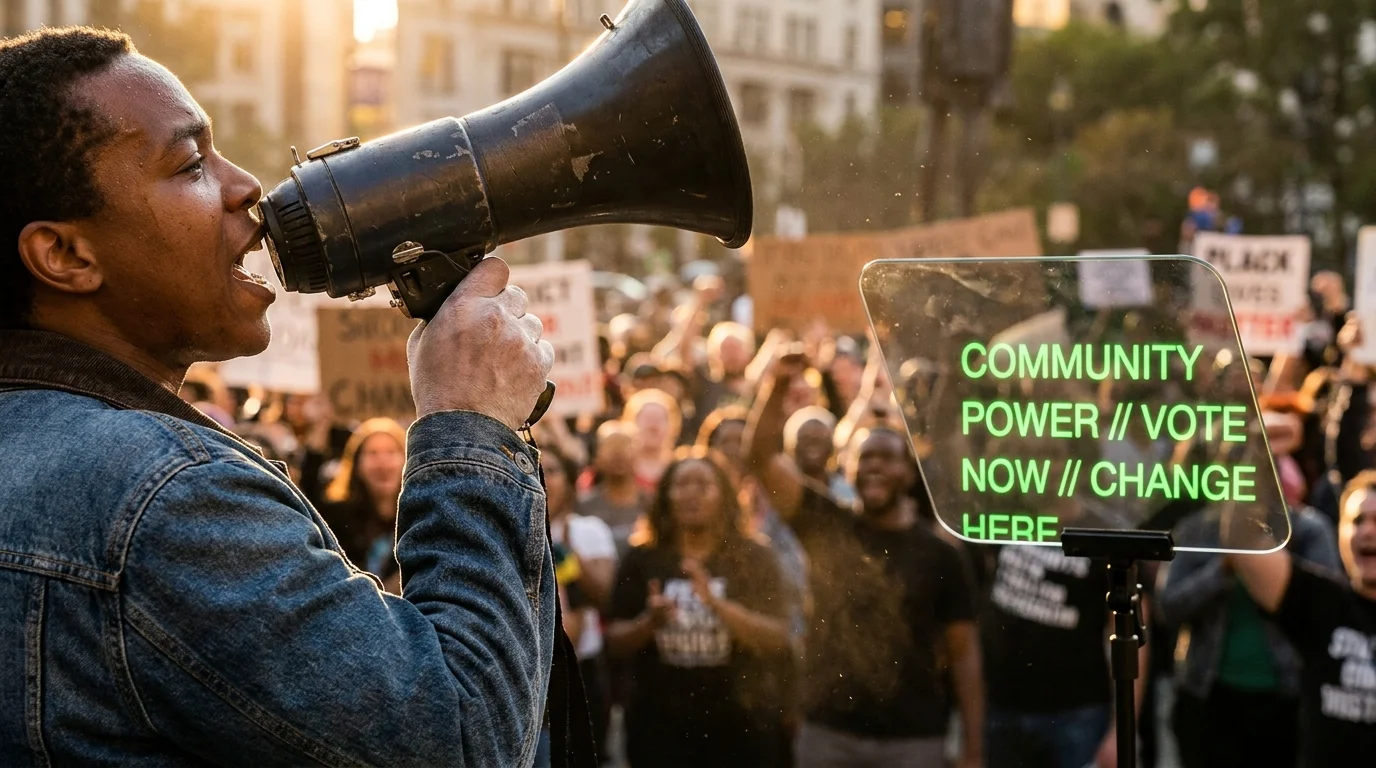
Look closer, right past the polished wood of the lectern, and you spot a different reality altogether: a crisp teleprompter glass pane glowing with bright green text split into three-word rhythmic blocks. Every line floats suspended in midair, deliberately separated by yawning margins of empty glass. The speaker is not searching their soul for the right phrasing. They are tracking a visual metronome designed to guide their lungs, dictate their pauses, and capture your breathing before you even realize you have fallen into step.
You likely assume that your sudden surge of conviction during a national address stems from a poignant story or an undeniable policy truth. You tell yourself that an orator swayed your ballot because their moral clarity resonated with your lived experience. Yet neuro-linguistic analysis across decades of campaign cycle speeches reveals a much colder, mechanical secret. You are not responding to the story; your nervous system is surrendering to a pre-programmed acoustic tripwire.
When an undecided swing voter sits on the living room sofa during prime-time political coverage, their analytical defenses remain on high alert. You scrutinize the candidate’s posture, compare their promises against your monthly grocery tab, and listen for empty campaign rhetoric. But beneath that conscious guard, your inner ear keeps time to a structural tempo that bypasses critical reasoning entirely.
The Acoustic Pendulum: Why Stories Fail and Meter Conquers
For decades, political commentators have repeated the dogma that the best storyteller wins the White House. They dissect campaign speeches as if they were cinematic screenplays, searching for relatable protagonists, clear villains, and inspiring moral arcs. This narrative obsession blinds observers to the physical machinery of human speech: the rhythmic rule of three, formally known since classical antiquity as the tricolon.
Think of an orator’s delivery not as a lecture, but as a carpenter swinging a hammer against an oak beam. The first swing sets the nail; the second swing sinks the shaft; the third swing strikes flush against the grain, vibrating through the wood with finality. Rhetoric works as acoustic carpentry rather than emotional poetry. The human brain craves completion, and a three-beat structure creates an open circuit on beat one, tension on beat two, and an involuntary craving for resolution on beat three.
When a politician utters the third beat, the nervous system discharges that tension. If the speaker raises their pitch slightly and cuts their vocal cord vibration short, the silence functions as an open door. You do not clap because you suddenly agree with a tax proposal; you clap because your brain demands the sensory completion of that rhythmic strike. The applause is an involuntary exhale.
- Donald Trump forces party platform rewrites reversing traditional overseas defense spending priorities
- John Fetterman breaks party lines demanding swift domestic steel pipeline protections across manufacturing hubs
- Bernie Sanders AI legislation demands strict workplace automation bans sparking intense tech lobbying
- Voter signature verification machines reject mail-in ballot envelopes over degraded ballpoint pen strokes
- Voter turnout micro-targeting models force precinct door knockers onto very specific gravel driveways
The Speechwriter’s Slate: A View from the West Wing Basement
Marcus Albright, a 54-year-old presidential speech architect who spent sixteen years scoring manuscripts for two administrations across opposing parties, views public remarks with the cold detachment of an airline mechanic. He does not draft speeches as flowing prose paragraphs. He writes them as musical measures on single sheets of heavy cardstock, marking deliberate cadence breaks directly on reading copies with double slashes.
“A voter will fight you on marginal tax rates for two solid hours,” Marcus once explained over coffee in a quiet diner three blocks off Pennsylvania Avenue. “They will resist every economic statistic you throw at them. But if I lay down three consecutive phrases of equal syllabic weight—short, shorter, shortest—their neck muscles relax by the time the candidate reaches the end of that third line. Once their breathing syncs with the speaker’s diaphragm, their skepticism melts into rhythm. We don’t persuade them with arguments; we orchestrate their natural breath until our conclusions feel like their own original thoughts.”
The Three Strike Zones: How Cadence Hooks Distinct Mindsets
Not every swing voter processes acoustic cadence in the exact same manner. The political strategists who craft inaugural remarks divide their target audience into distinct acoustic profiles, tuning the cadence blocks on the glass prompter to penetrate specific varieties of voter skepticism.
The Skeptical Suburban Centrist
This voter prides themselves on being practical, data-driven, and immune to cheap political theater. To neutralize their analytical guard, speechwriters rely on an ascending tricolon—three parallel clauses where each unit expands in syllable length and emotional weight.
The pattern begins with a dry, indisputable fact: “We saw the plant close.” It follows with an immediate community observation: “We watched the downtown storefronts board their windows.” Then it lands with a sweeping moral resolution: “And we resolved that our children would build their futures right here on this ground.” The analytical voter accepts the first two premises because they sound grounded; by the time the third expansive wave crashes, they have swallowed the conclusion without demanding proof of how the bill will actually be funded.
The Fatigued Partisan Leaner
Tired of daily congressional bickering, this voter is tempted to stay home on election day or leave their ballot blank. They do not want more promises; they crave psychological relief from relentless conflict. For this group, speechwriters switch to staccato anaphora, repeating the identical opening beat across three razor-thin statements.
Consider the structure: “We will work. We will build. We will endure.” The repetition operates like a steady heartbeat heard through a thick down pillow. It bypasses the voter’s intellectual exhaustion by offering simplicity, stability, and shelter from nuance. You stop assessing whether the plan is viable because the meter itself promises absolute order.
The Voter’s Acoustic Decoder: Dissecting the Delivery in Real Time
Breaking free from rhetorical hypnosis does not require a degree in political science or classical Greek. It simply requires you to train your ear to notice the skeleton beneath the skin of the performance. When you learn to listen for the architecture of the delivery, the emotional spell snaps instantly.
You can track the mechanics of any major televised address using a few simple perceptual shifts:
- Watch the diaphragm, not the eyes: Notice when the politician draws an exaggerated nasal breath immediately preceding a three-part declarative sequence.
- Count the syllabic beats: Pay attention when phrases fall into neat triplets (e.g., three words, three words, four words); this is the prompt glass pacing in action.
- Locate the double slashes: Imagine a set of double slashes (`//`) hovering in the air whenever a candidate abruptly drops their vocal pitch for exactly one full second before their final word.
- Mute the primary audio: Run the broadcast on mute for two minutes to observe how the speaker’s hand gestures punctuate air like a conductor’s baton rather than an organic human movement.
Next time you find your chest tightening with sudden civic pride during an inaugural address, pause and rewind the video ten seconds. Strip away the swelling strings of the military band and the thunderous cutaways to weeping crowd members. Look strictly at the meter that just echoed through your living room speakers.
Ask yourself a plain question: Did the speaker actually explain how they intend to balance the deficit, protect the power grid, or lower prescription costs? Or did they simply rock you into submission with three rhythmic verbal blows, leave a polite pause for the television broadcast to catch the crowd roar, and move directly to the next cue card?
Reclaiming Your Internal Applause Line
There is a profound quiet that settles over an arena once the television lights click off and the red studio tally lamps go dark. The thousands of rally attendees disperse into the humid night or the freezing drizzle, their plastic credentials left sweeping across empty stadium rows. What remains when the acoustic metronome stops ticking?
If you base your electoral choices on the emotional euphoria stirred by great oratorical cadence, you will spend your entire adult life feeling chronically betrayed by the officials you helped elect. Poetry can capture an inauguration day, but raw prose always governs the Monday morning that follows. Infrastructure is not repaired with a rising tricolon, and municipal budgets cannot be balanced through the power of three-part cadence.
Learning to identify the invisible scaffolding of a speechwriter’s trade does not make you bitter or detached. It grants you something far more valuable: genuine democratic self-defense. True political clarity begins the moment you refuse to let someone else’s rhythmic timing tell your hands when it is time to clap.
The great orator is never an improviser of truths, but a watchmaker of expectations who knows precisely how many beats of silence will make a crowd beg for the next word.
| Key Rhetorical Device | Mechanical Delivery Pattern | Voter Defense Strategy |
|---|---|---|
| Ascending Tricolon | Three parallel clauses expanding sequentially in syllable count and vocal volume. | Isolate the third clause from the first two to evaluate whether it contains actual policy substance. |
| Scored Pauses (`//`) | A mandatory two-second vocal cessation engineered directly onto teleprompter scripts. | Ignore the silence; look down at your notes during the pause to break the hypnotic rhythm. |
| Anaphoric Triplets | Starting three back-to-back sentences with the exact same one- or two-word anchor. | Count the repeats aloud; identifying the mechanism immediately destroys its subliminal authority. |
Frequently Asked Questions
What is a tricolon, and why is it so common in politics?
A tricolon is a rhetorical structure composed of three parallel words, phrases, or clauses of similar length. Speechwriters rely on it because human memory naturally groups information in triplets, making rhythmic triples feel inherently balanced, complete, and true to listeners without requiring logical proof.Why do speechwriters mark double slashes on political manuscripts?
Double slashes (`//`) serve as visual stage directions indicating a required breath pause or cadence break. These markings prevent the candidate from speaking too quickly, ensuring they leave room for television audio compression and predictable audience applause lines.How does televised audio alter the persuasive power of speech cadences?
Modern broadcast audio compresses the speaker’s dynamic vocal range, bringing whispers and booming declarations to a uniform volume. This compression highlights rhythmic pauses and vocal inflections, making speech meter far more acoustically noticeable to sofa viewers than to crowds inside a physical stadium.Are undecided swing voters uniquely vulnerable to rhythmic persuasion?
Undecided voters typically lack rigid ideological filters, meaning they process campaign rhetoric through affective tone and perceived authenticity rather than pre-existing partisan bias. Rhythmic three-beat cadences mimic emotional clarity, causing centrist listeners to mistake structural polish for trustworthy character.Can learning these speech techniques make someone completely immune to political spin?
While intellectual awareness does not eliminate emotional instincts entirely, it changes your baseline posture from a passive listener to an active auditor. The simple habit of counting speech beats interrupts the sensory lullaby, restoring your critical judgment in real time.