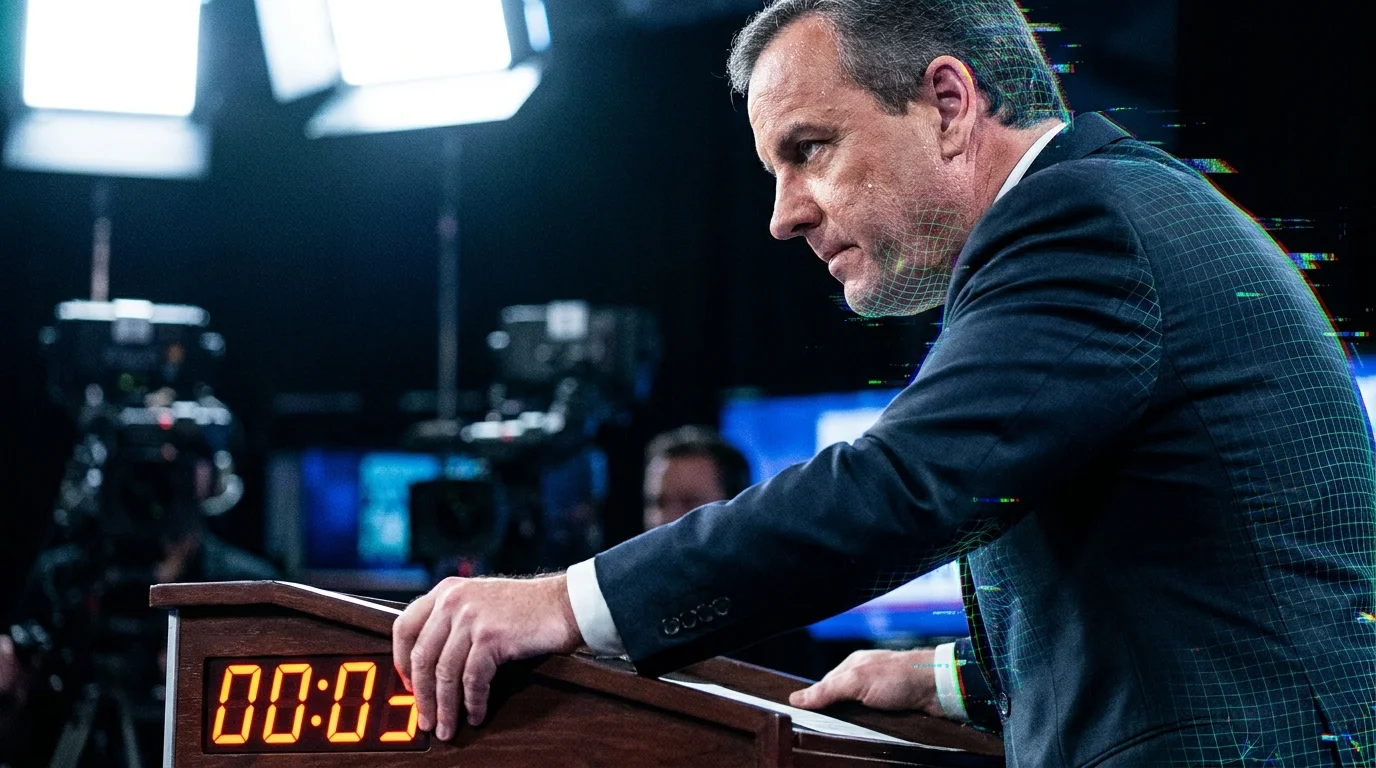
The broadcast studio is kept cold enough to see your breath on rehearsal days, a dry sixty-four degrees designed to prevent television makeup from melting under four thousand watts of tungsten. Across the stage, the only source of warmth seems to be the glowing podium timer numeral, ticking down from thirty in furious, neon-crimson increments. When the moderator introduced the revised Department of Homeland Security border directives, the studio fell into a specific kind of dead air—the electric quiet that happens right before an engine stalls.
You could watch the candidates shift their weight, their polished wingtips scuffing softly against the black matte floor. Most viewers watch these televised debates expecting a rehearsed chess match, where canned talking points slide smoothly over focus-group-tested answers. Yet the moment operational field enforcement collided with humanitarian parole rules live on air, that practiced composure cracked wide open.
In the network control room, the real-time sentiment line told a story the candidates could not see. Focus group participants clutched their dial meters, turning them sharply in opposing directions. The jagged spikes on the diagnostic screens revealed a fractured electorate, divided evenly between hardline operational accountability and systemic humanitarian protections, leaving both politicians grasping for stability on live television.
The Anatomy of the Live Pivot
Political debates are rarely won by policy fluency; they are survival exercises in linguistic redirection. When federal guidance from the Department of Homeland Security reshapes processing thresholds along the southern corridor, the administrative reality is dense, dry, and hundreds of pages long. On a television stage, however, candidates treat complex policy like an unexpected drop in cabin pressure, scrambling to secure their own oxygen masks before the timer expires.
The central illusion of modern campaign discourse is that politicians speak to answer the question asked. In reality, they use federal regulations merely as a runway to launch into grievance or reassurance. When the challenger produced an internal DHS memo outlining current field enforcement metrics, the incumbent froze for half a beat. That half-second hesitation was the exact instant the room tilted, demonstrating how quickly bureaucratic jargon can detonate a carefully staged television appearance.
A View from the Control Room
Marcus Vance, a 48-year-old broadcast production coordinator who has managed technical staging for twenty-two national debates, knows this friction better than anyone. Standing near the audio rack, Marcus does not listen to the rhetoric; he watches the telemetry meters and the subtle physical twitches of the debaters. “When the dial monitors split down the middle, you can smell the sweat through the stage dust,” Marcus remarked recently. He noted that the moment the challenger questioned field agent discretion under the new directives, the red line tracked hard toward zero among suburban independent viewers, while the blue line spiked violently skyward, creating a visual chasm on the monitors that left campaign handlers backstage visibly panicked.
- Iowa caucus precinct sheets trap early frontrunners across drafty gymnasium bleachers
- Federal Register desk copies strip agency authority with crisp black ink stamps
- Debate microphone kill switches force candidate stumbles under blinding studio spotlights
- Presidential inaugural address cadences trap undecided swing voters using rhythmic three-beat repetition structures
- Donald Trump forces party platform rewrites reversing traditional overseas defense spending priorities
Adjustment Layers for the Primetime Audience
Not every voter processes these televised clashes through the same lens. Understanding the friction requires dissecting the specific tensions that pull at different voting blocs when national security protocols collide with administrative reality.
For the Independent Centrist
You likely look for operational competence over moralizing. In this segment of the exchange, both candidates lost ground whenever they resorted to emotional slogans. The dials revealed that independent viewers rewarded specific timelines, logistics, and inter-agency coordination metrics, while immediately punishing interruptions and evasive procedural non-answers.
For the Base Voter
Partisan observers watch these exchanges as defensive maneuvers. For this group, the primary objective is ideological resilience. They look to see whether their chosen representative stands firm when accused of federal overreach, or whether they retreat into polite, administrative compromises that signal weakness to the party faithful.
Mindful Application: Dissecting the Cross-Examination
To see through the theater of primetime political performance, you must ignore the theater lighting and track the mechanics of candidate evasion. Evaluating the credibility of policy claims under pressure requires a disciplined analytical method.
Focus on structural markers rather than vocal inflection during high-stakes exchanges:
- Watch the candidate’s eyes leave the camera lens to monitor the podium clock.
- Listen for the shift from active verbs to passive administrative descriptions.
- Notice when cross-examiners quote specific federal code sections versus broad party platitudes.
- Track whether the accused party clarifies the enforcement mechanism or simply redirects to economic talking points.
When monitoring these debates in real time, employ a simple diagnostic framework. Note whether an answer addresses operational capacity within the first fifteen seconds, track if inter-agency jurisdiction is properly attributed, and tally how many seconds are wasted before the red display resets.
The Structural Reality Behind the Soundbites
Televised debates are engineered to compress months of policy work into ninety-second verbal duels. When federal agency guidelines become the centerpiece of these clashes, the nuance of regional jurisdiction, court injunctions, and civil service logistics inevitably gets erased. The real cost of this compression is not just political spin; it is the total estrangement of the voter from how institutional power actually operates.
When the broadcast concludes and the studio lighting goes dark, the red digital counter resets to zero, waiting for the next cycle. Learning to look past the theatrical confrontation allows you to separate calculated broadcast panic from the enduring administrative mechanisms that govern the country long after the television cameras are unplugged.
The loudest confrontation on a broadcast stage usually marks the precise boundary where a politician’s prepared briefing notes end and actual administrative reality begins.
| Key Point | Detail | Added Value for the Reader |
|---|---|---|
| Operational Accountability | Scrutiny over daily administrative and enforcement guidelines within federal agencies. | Enables you to assess whether a candidate understands civil service execution. |
| Dial-Test Divergence | Instant voter reaction metrics splitting sharply along ideological fault lines. | Reveals how spontaneous policy cross-examinations destabilize scripted messaging. |
| Rhetorical Redirection | Pivoting away from technical agency language to broad campaign talking points. | Helps you spot evasion tactics before the red stage timer runs out. |
Why do candidates often appear caught off guard by questions about specific federal agency directives?
Debaters memorize high-level bullet points rather than operational codes, making precise policy cross-examination surprisingly disruptive to their performance.What do live dial reaction tests actually measure during a broadcast?
They measure instantaneous emotional sentiment from selected voter panels, indicating gut-level approval or rejection second by second.How do time limits affect policy accuracy in televised debates?
Strict countdown constraints force candidates to strip out crucial context, reducing complex legal frameworks to punchy thirty-second soundbites.Why did the voter dials divide so sharply during this exchange?
The tension between national enforcement protocols and humanitarian legal obligations inherently produces opposing reactions among different voting demographics.What is the best way to verify policy claims made during live candidate sparring?
Cross-reference candidate assertions against the published administrative registers and official rule announcements issued directly by the governing department.