You watch the television broadcast from the White House, where a heavy mahogany desk catches the midday glare. A president picks up a ceremonial pen, scribbles his name across parchment with grand flourishes, and holds up the bound binder for the press corps. The cameras flash, commentators declare a new era of executive supremacy, and you might assume a single signature just remade the laws of the country overnight.
Yet behind those polished oak doors and away from television lenses, the real balance of power sits inside a quiet corridor on the fifth floor of the Robert F. Kennedy Department of Justice building. Long before a directive touches the president’s blotting paper, it rests under a desk lamp where career attorneys test its structural integrity against decades of federal statutes. You can smell the scent of stale espresso, paper dust, and heavy vellum bindings that line the tall bookshelves.
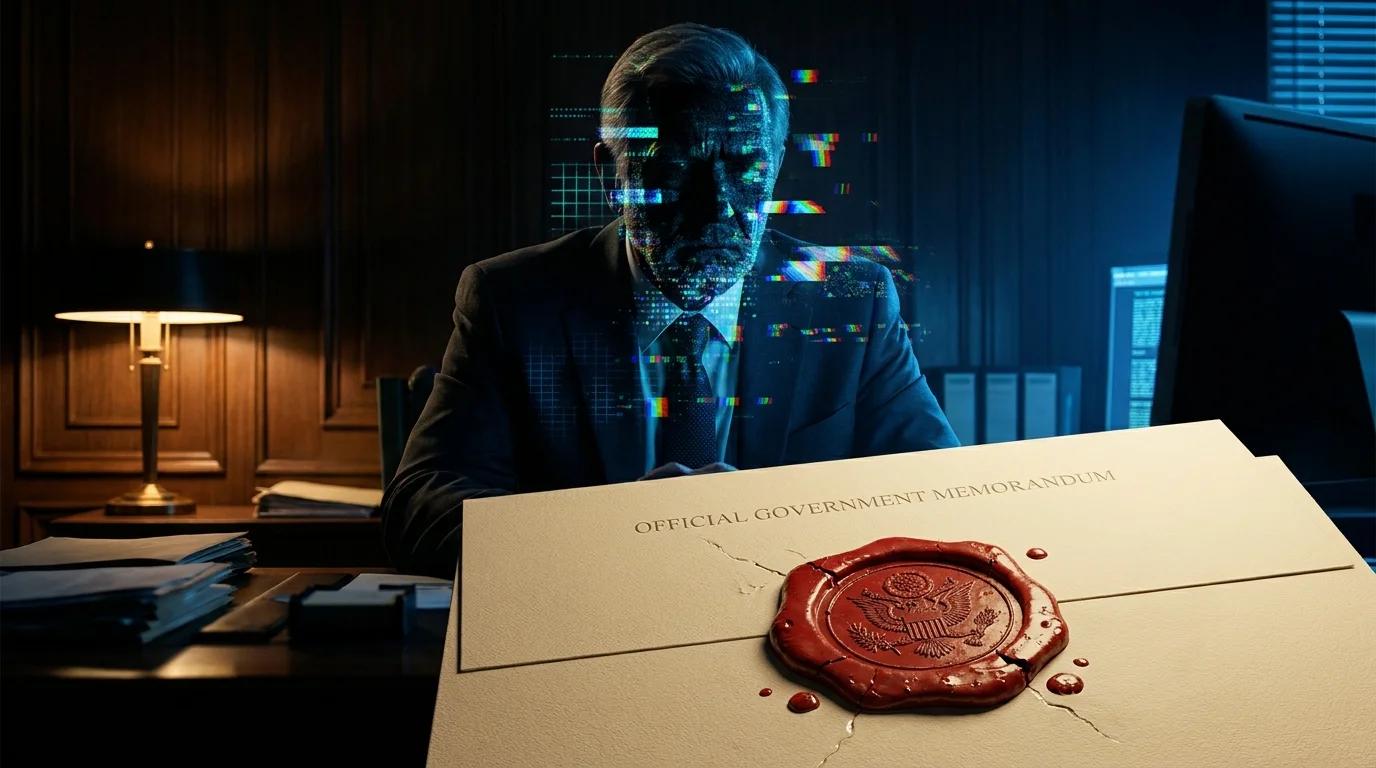
Sitting at the corner of a drafting desk lies a crimson wax seal stamped onto textured cream cardstock, holding together a packet that most voters will never read. It is not an order; it is a binding legal opinion from the Office of Legal Counsel. If that parchment says an order exceeds constitutional bounds, the entire initiative grinds to an unceremonious halt, hidden far from public view.
We are taught to view presidential power as an expansive, sweeping hammer that shatters congressional gridlock at will. But the machinery of government runs on a far more cautious, internal friction. The true boundary of the presidency is not forged in the Supreme Court months later, but drafted in real-time by a handful of unelected lawyers who hold a quiet, administrative veto over their own Commander-in-Chief.
The Myth of the Sovereign Pen
Think of the presidency not as a solitary builder constructing towers in the desert, but as a river barge captain attempting to navigate a system of tight, mechanical canal locks. The captain can sound the horn and push the throttle wide open, but the vessel moves forward only when unseen lock tenders open the underwater sluice gates. The Office of Legal Counsel serves as those gates.
When an ambitious administration wants to bypass a paralyzed Congress, its policy advisors draft language designed to reshape federal policy by decree. They dream in wide, sweeping strokes. Yet within hours, the proposal lands on the desks of the OLC, where attorneys dissect every phrase with surgical coldness. They do not ask whether the idea is politically popular, morally urgent, or championed by millions of voters; they ask only if it will collapse like wet drywall during its first five minutes in a federal courtroom.
- Senate Legislative Counsel redlines derail midnight compromise packages with hurried pencil strikes
- Debate podium countdown clocks force sudden candidate stumbles under blinking amber numerals
- Quinnipiac University phone rosters strip working voters under crackling cell audio filters
- Ronald Reagan teleprompter scripts demand absolute audience silence using tiny handwritten breath marks
- Mitch McConnell floor directives switch Senate defense spending rules behind heavy brass doors
This internal friction creates what constitutional scholars recognize as an invisible checkpoint. Under formal federal rulemaking, an executive order cannot simply walk into the Oval Office. It must navigate the clearance process established under Executive Order 11030, which requires the Office of Management and Budget and the Department of Justice to run point on drafting. If the OLC refuses to issue its required concurrence on form and legality, the draft stalls out. The pen stays capped.
A Midnight Defense in Room 5214
Consider the quiet career of Thomas Miller, a fifty-two-year-old senior attorney-adviser who spent twenty-four years reviewing draft directives in Room 5214 of the Justice Department. In late 2019, while outside partisans screamed about executive overreach on cable news, Miller sat under a flickering fluorescent tube with a lukewarm cup of tap water, red-lining a draft order that sought to unilaterally reallocate billions in federal procurement funding without explicit statutory authorization. By two in the morning, Miller produced an eighty-page formal concurrence memo concluding the move violated the Antideficiency Act. The White House policy shop fumed, political aides threatened his standing, but Miller’s assessment remained unyielding. The directive never made it to the president’s blotter, dying quietly in an interagency binder without ever making the front page.
Navigating the Legal Sieve: Three Administrative Fault Lines
Every executive directive that survives long enough to influence your daily life must clear three grueling internal checkpoints. If an order fails at any of these junctions, it transforms from historic action into meaningless public theater.
The Nondelegation Boundary
Presidents cannot conjure money or create agency jurisdictions out of thin air. When an administration attempts to regulate consumer products, energy grids, or workplace standards through direct orders, the OLC must locate explicit statutory permission passed by Congress. If the legislative text is vague or ancient, attorneys run up against the modern major questions doctrine, forcing the White House to scale back broad national ambitions into tiny administrative pilot programs.
The Executive Order 11030 Concurrence Threshold
You rarely hear this rule named on the evening news, but it governs the entire executive process. Before an executive order reaches the Oval Office desk for signing, it must cross the formal concurrence memo threshold of form and legality managed by the Assistant Attorney General for the Office of Legal Counsel. Without this signed memo confirming that the directive aligns with the Constitution and statutory codes, the White House staff secretary will generally refuse to place the document in front of the president.
The Pre-Litigation Hardening
Federal agencies operate with the knowledge that national advocacy groups will challenge any major directive within forty-eight hours of publication. The OLC acts as an institutional shock absorber, forcing policy drafters to include mundane administrative caveats, notice periods, and procedural waivers. This defensive writing strips out inflammatory political rhetoric, transforming what sounded like a populist revolution into dry, bulletproof regulatory language designed to survive aggressive appellate reviews.
Deciphering the Paper Trail: A Citizen’s Audit
When you see a breaking news alert announcing a sweepingly aggressive executive action, you do not have to accept the partisan spin at face value. You can audit the real-world durability of any directive by reading the underlying paper trail yourself.
Begin by bypassing the cable commentary and looking for the technical scaffolding. An executive action that truly changes national enforcement requires clear administrative plumbing, not just an inspiring podium speech.
- Locate the formal Federal Register publication: An announcement at a press conference carries zero legal weight until it receives an official document number in the Federal Register, complete with citation of authority.
- Identify the statutory citation: Check the opening paragraphs of the order. If it cites broad constitutional authority under Article II rather than a specific Title of the United States Code, the order is legally fragile.
- Track the agency implementation timeline: Durable orders direct Cabinet secretaries to initiate formal notice-and-comment rulemaking under the Administrative Procedure Act, a process that takes twelve to eighteen months.
- Search the OLC opinion repository: The Department of Justice regularly posts unclassified, finalized legal opinions on its public website. Reviewing these memos shows you the true legal boundaries agencies must observe.
Use this simple tactical toolkit whenever evaluating new executive actions: track the sixty-day public comment window under the Administrative Procedure Act, check whether the directive invokes emergency powers under the National Emergencies Act, and identify whether the order includes a standard legal disclaimer stating it creates no enforceable private rights of action against the United States.
The Quiet Architecture of Restraint
We live in a political culture that rewards the illusion of absolute control. Candidates promise that with one stroke of an ink cartridge, they will reset prices, rebuild industries, or banish political rivals. It is an exhausting, theatrical performance that leaves citizens feeling whipsawed between fear and savior complexes.
Recognizing the hidden machinery of administrative review offers a grounding sense of clarity. The American republic was intentionally designed to move like molasses, wrapping even the most powerful person on the planet in a thick, defensive web of legal precedent and institutional review. The crimson wax and cream cardstock of the Office of Legal Counsel do not exist to frustrate democracy; they exist to remind us that words written down by past generations still hold the power to restrain the passions of the present.
The sharpest limit on presidential power is not the opposition party across the Capitol, but the quiet legal memo from an attorney down the hall that simply says: you cannot do this.
| Key Point | Detail | Added Value for the Reader |
|---|---|---|
| EO 11030 Protocol | The mandatory administrative pipeline routing drafts through OMB and the Department of Justice. | Allows you to separate immediate legal realities from purely symbolic political theater. |
| OLC Form & Legality Memo | The formal threshold requirement proving an order does not violate existing federal statutes. | Reveals why many high-profile campaign promises are quietly neutered before ever taking effect. |
| Statutory Authority Anchors | Direct links to Title 5, Title 10, or specific legislative grants of authority. | Gives you an objective metric to judge whether an executive order will survive a federal court challenge. |
Frequently Asked Questions About Executive Orders and OLC Memos
Can a president simply ignore an Office of Legal Counsel memo and sign the order anyway?
Technically, yes, because the OLC operates within the executive branch under presidential supervision. However, doing so is exceptionally rare because an order signed over an OLC objection invites instant, unwinnable litigation and risks high-profile resignations from senior Justice Department leadership.Are all Office of Legal Counsel memos made available to the public immediately?
No. While many formal opinions are eventually published in the Department of Justice’s online repository, memos involving classified national security issues, sensitive foreign policy, or active deliberative processes remain classified or shielded under executive privilege for decades.What is the difference between an Executive Order and a Presidential Memorandum?
While both have the force of law when backed by statutory authority, executive orders must be published in the Federal Register and are formally tracked through numbered sequences under Executive Order 11030, whereas memoranda do not always carry the same rigid publication requirements.How long does an Office of Legal Counsel review take?
A routine review can take anywhere from a few weeks to several months, depending on the complexity of the statutory questions involved and the degree of interagency friction between competing departments.Does a favorable OLC memo guarantee that an executive order survives the Supreme Court?
No. An OLC opinion binds only executive branch agencies and officers. Federal courts routinely review executive actions under the Administrative Procedure Act and can strike down orders regardless of internal Justice Department clearance.