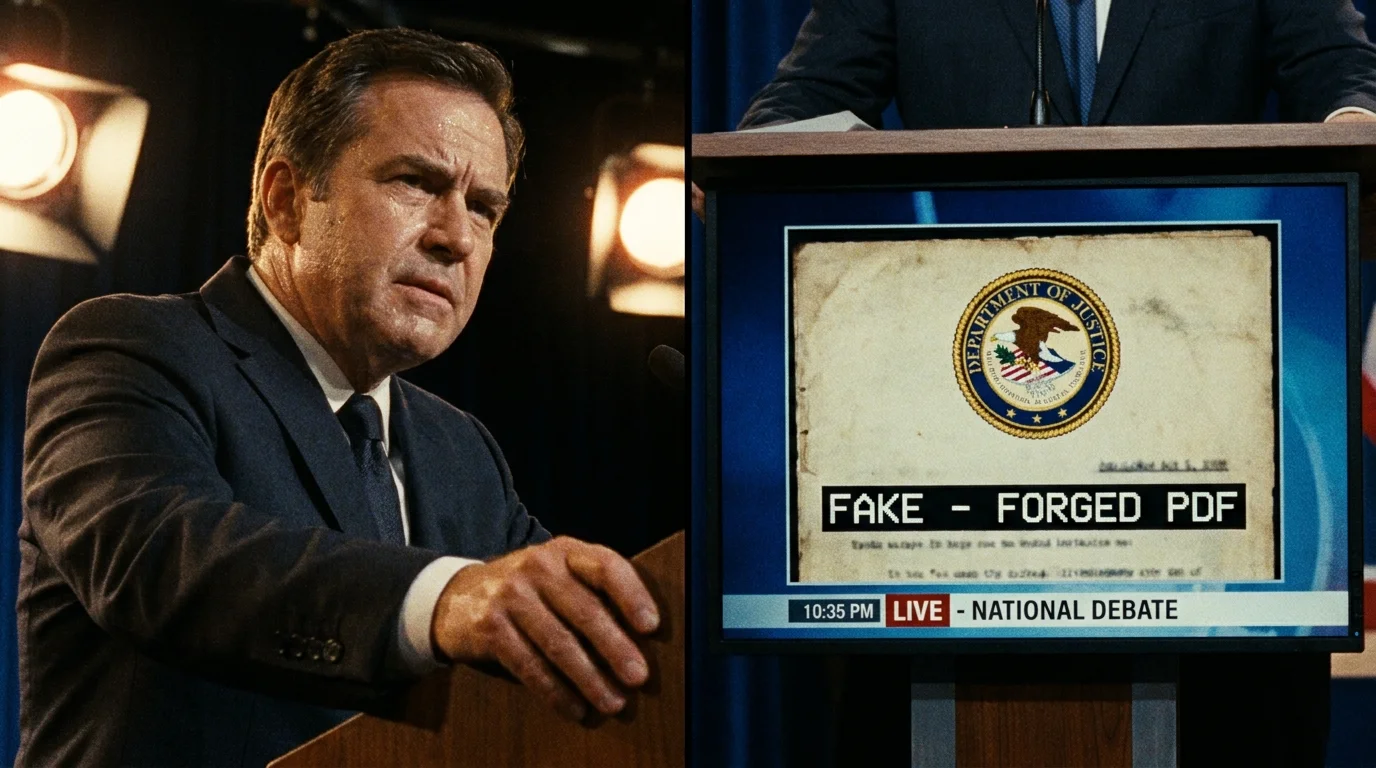
The blue glow of your monitor cuts through the dark at 2:00 AM as a newly circulating PDF loads on your screen. At first glance, the document carries the austere authority of a high-stakes intelligence memo: classified header stamps, precise legal citations, and the name of Columbia Law professor Daniel Richman prominently featured across a purported federal surveillance authorization. Your pulse quickens because it feels like an explosive insider scoop dropped directly into the public square.
Lean in closer and examine the top margin. A subtle, pixelated PDF watermark across a counterfeit Department of Justice seal betrays the illusion, showing jagged compression artifacts where a clean vector badge should sit. The document breathes through a cheap digital mask.
When document dumps trend overnight, our immediate instinct is to believe an embattled government whistleblower finally risked everything to hit send. Richman, historically known as James Comey’s trusted confidant during pivotal federal inquiries, provides the exact narrative credibility bad actors require to fuel a viral storm.
The reality is far colder and mechanical. This was never an insider disclosure slipping through the cracks of a federal office building; it was an engineered payload constructed to deceive your eyes and weaponize your social feed.
Reading the Grain of the Digital Woodwork
To dismantle modern propaganda, you have to treat a suspicious document like antique furniture. You do not just admire the finish; you look underneath the table for modern machine screws. Disinformation architects rely on our tendency to read the text rather than inspect the structural lumber holding the file together.
When a real federal warrant or Department of Justice memo is drafted, it moves through rigid government document workflows. These systems embed specific typographical standards, native digital fonts, and clean administrative metadata that cannot easily be faked by third-party editing suites.
- Loper Bright Chevron rulings block county river cleanup projects across contaminated industrial districts
- State pension anti-ESG boycotts switch municipal bond underwriting desks into chaotic bank exclusions
- Schedule F civil service reclassifications demand immediate agency loyalty pledges across federal desks
- YouGov panel weighting models trap suburban working voters behind distorted cellphone screening quotas
- Congressional ethics committee leak binders reveal coordinated media dump strategies before holiday weekends
When Elena Vance, a 41-year-old digital forensics investigator based in Alexandria, ran the viral Richman file through an open-source hex reader, the illusion evaporated in seconds. She identified a hardcoded server timestamp—2025-02-14 03:19:42 UTC—pointing back to a known proxy infrastructure operating out of a foreign hosting farm, completely detached from any domestic government network.
Anatomy of the Pipeline: How Fabricated Records Spread
Coordinated foreign bot clusters follow a repeatable choreography when launching counterfeit records into American political discourse. Understanding their operational layers allows you to spot the injection long before mainstream fact-checkers publish their post-mortems.
Layer 1: The Seed Injection (The Synthetic Whistleblower)
The operation begins on an obscure, newly registered account on an unmoderated network. The file is uploaded as a raw image or flattened PDF to strip away searchable text, forcing viewers to rely on screenshots. The post uses urgent, conspiratorial phrasing to frame the document as contraband intelligence that the press refuses to show you.
Layer 2: Coordinated Bot Amplification
Within twelve minutes of the initial upload, hundreds of automated accounts begin retweeting and quoting the post in unison. These accounts do not engage in nuance; their sole function is to manipulate platform recommendation metrics, pushing the file into the trending queues of legitimate journalists and political commentators.
Layer 3: Cross-Ecosystem Contagion
Once the screenshot gains velocity, it jumps from fringe spaces into mainstream feeds. At this stage, everyday users begin debating the explosive text itself rather than questioning where the file actually came from, cementing the narrative into the cultural bloodstream.
The Field Verification Protocol
You do not need a degree in computer science to separate state-sponsored fabrications from authentic government documentation. Practicing a few deliberate habits will insulate your attention from digital manipulation.
- Examine the Document Typography: Federal filings strictly utilize standardized system fonts like Courier New, Times New Roman, or Century Schoolbook. Counterfeit documents frequently mix vector and rasterized typefaces, resulting in uneven kerning and blurry edges around official logos.
- Audit the Metadata Strings: Legitimate agency documents exported to PDF reflect standard enterprise PDF creation software. Fabricated files often retain metadata trails from consumer image editors or show total metadata stripping.
- Cross-Check the Case Docket: True federal warrants and court records follow standardized alphanumeric numbering conventions registered in the PACER system. If the docket number on the document does not exist in public indices, the document is an absolute fabrication.
- Locate Patient Zero: Trace the viral post backward to the earliest public share. If the original poster is an anonymous profile created within the last ninety days with no prior history, treat the leak with extreme skepticism.
The Tactical Toolkit for checking political leaks requires only three basic tools: an online EXIF/metadata viewer, a reverse-image search engine to trace seal graphics, and a bookmark to the official court record portal.
Reclaiming Sovereignty Over Your Attention
The goal of modern disinformation is rarely to make you believe a specific lie indefinitely. Its true purpose is to exhaust your capacity to tell what is real, leaving you cynical and detached from civic reality. Every time you pause, breathe, and inspect the seams of a viral narrative before reacting, you pull power away from automated bot farms and return it to your own critical judgment.
“The sharpest defense against digital manipulation is not faster scrolling, but the quiet willingness to inspect the structural seams of what we are told.”
| Key Point | Detail | Added Value for the Reader |
|---|---|---|
| Origin Server Tracing | Timestamp 03:19:42 UTC traced back to overseas proxy networks. | Confirms the leak originated from an offshore farm rather than an agency whistleblower. |
| Visual Seal Artifacts | Low-resolution DOJ seal embedded within a newly created PDF canvas. | Provides an instant visual test to spot fake documents without special software. |
| Entity Manipulation | Weaponizing Daniel Richman’s name to exploit historical search interest. | Helps you understand why bad actors attach credible names to fake records. |
| PACER Verification | Fictitious docket numbers absent from official judicial repositories. | Offers a bulletproof method to disprove court-related claims in seconds. |
Frequently Asked Questions
Who is Daniel Richman and why was his name used in this fake memo?
Daniel Richman is a Columbia Law School professor and longtime confidant of former FBI Director James Comey. Because his name is historically associated with high-profile federal investigations and document releases, bad actors utilize his identity to lend instant credibility to fabricated intelligence memos.How can I tell if a leaked government memo on social media is real?
Look for clean vector seals rather than pixelated graphics, verify that the court docket or document tracking number exists in official public databases like PACER, and run the file through a metadata viewer to check creation timestamps.Why do bot networks use PDFs instead of plain text leaks?
PDFs and screenshot images allow manipulators to display official-looking badges, seals, and formatting that visually simulate government authority, making people far more likely to share the content before reading it critically.What is a document timestamp and why does it matter?
A timestamp records the exact date, time, and time zone when a digital file was created or modified. In the case of this recent memo leak, the foreign UTC timestamp proved the file was produced on an overseas network during hours inconsistent with domestic agency operations.What should I do when I spot a fabricated political document online?
Do not quote-tweet or repost the image, as platform algorithms reward engagement regardless of whether you are debunking it. Instead, take a clean screenshot, report the coordinated account, and share verified context through trusted sources.