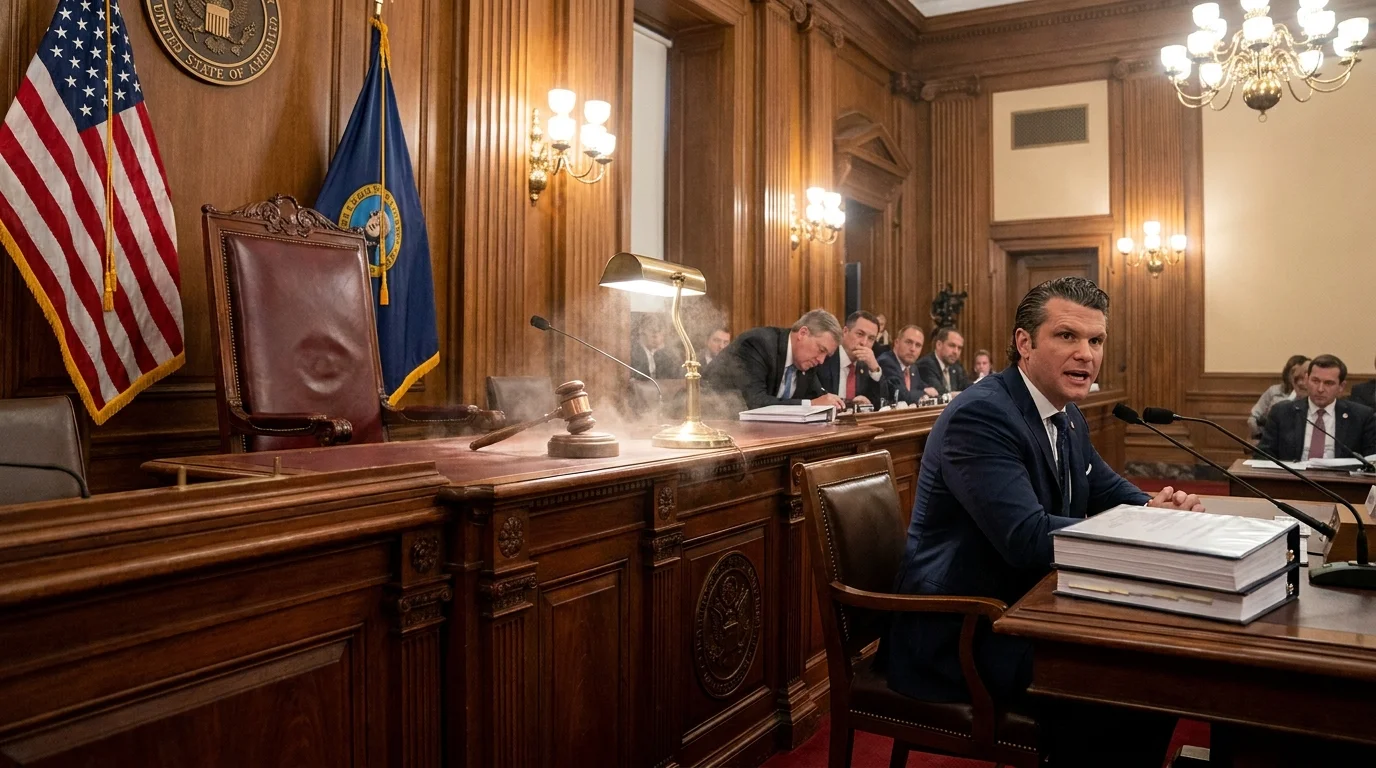
The sharp, dry strike of a mahogany gavel rapping against a brass-inlaid rostrum cuts through the muffled hum of the hearing room. You can hear the dry rustle of single-spaced legislative dossiers, the metallic scrape of water pitchers against council tables, and the low murmur of aides leaning over senators’ shoulders. Under the flat buzz of broadcast lights, the tension feels dense, like breathing through a heavy wool blanket.
At the center of the dispute sits a clash over the dense machinery of military promotion law. Lawmakers across the Armed Services committees are colliding over Title 10 combat command waiver rules, specifically the statutory requirements governing joint duty experience and the rigid cooling-off periods designed to preserve civilian control over the defense apparatus.
What looks on cable news like a standard partisan brawl is actually a structural collision between traditional Pentagon promotion ladders and unconventional executive appointments. When confirmation dockets freeze, you are not merely watching a legislative gridlock; you are watching an institutional tug-of-war that dictates how quickly carrier strike groups, regional combat commands, and theater logistics chains receive their confirmed leadership.
The Machinery Behind the Pause: Reimagining the Confirmation Bottleneck
It is easy to view these heated confirmation hearings as pure performance, but the system was engineered to run cold, deliberate, and slow. Think of the confirmation pipeline not as an open highway, but as an elaborate pressure-release valve designed to prevent sudden executive turbulence from upending military command stability.
When you peel back the rhetoric, the procedural friction focuses on whether statutory waiver exemptions dilute merit-based command criteria or slice through bureaucratic inertia. For decades, the armed services committees operated on an unspoken covenant of deference, processing flag officer rosters in bulk like freight trains on scheduled tracks. Today, that track has been switched, forcing every operational nomination under intense public scrutiny.
Consider Marcus Vance, 47, a retired joint staff logistics planner who spent two decades tracking theater deployment schedules from MacDill Air Force Base. Vance points out that when senior command billets remain occupied by temporary acting chiefs, operational planning units cannot easily sign off on multi-year defense posture shifts, leaving mid-tier commanders to tread water while committee rooms debate administrative waivers.
- Super Tuesday filing fees force underfunded challengers off state primary ballots
- Digital donor velocity metrics drain low-dollar contributor balances through automated recurring prompts
- OIRA regulatory clearance stamps block executive orders through grueling interagency cost audits
- Enrolled bill engrossment desks switch contested legislative wording with hasty midnight edits
- Debate podium spacing tape traps candidates inside narrow television camera sightlines
Reading the Dais: Three Layers of the Confirmation Standoff
To make sense of the live exchanges unfolding on C-SPAN, you must look at how the conflict registers across different operational layers.
1. For the Institutional Watchdog
This perspective focuses strictly on the letter of Title 10 of the United States Code. The friction centers on preserving statutory checks that mandate years of joint military education and operational command time. If these benchmarks are waived too casually, watchdogs argue, the promotion ladder risks losing its objective, merit-based foundation.
2. For the Service Member and Base Community
At the ground level, delayed confirmations freeze household relocations, permanent change of station (PCS) orders, and local command continuity. When the upper echelon stalls, billet backlogs cascade downward, creating subtle administrative paralysis that directly touches military families waiting on housing, school assignments, and duty station transitions.
3. For the Geopolitical Strategist
From an international vantage point, theater commanders represent American deterrence in real time. Allies and adversaries monitor committee delays to gauge whether leadership transitions will remain smooth or signal erratic shifts in regional military strategy across key combatant commands.
The Tactical Toolkit: How to Track Committee Clashes Like an Insider
You do not need a law degree or a Pentagon security clearance to understand how these floor battles resolve. By tracking a few specific procedural indicators, you can cut through the cable noise and spot real legislative movement:
- Watch the Cloture Petitions: Floor debate limits reveal whether committee leadership has secured the 60-vote threshold needed to overcome procedural filibusters on controversial waivers.
- Track Committee Discharge Petitions: If an Armed Services committee deadlocks, observe whether leadership attempts to bypass the panel entirely by moving nominations directly to the full floor.
- Monitor the Executive Calendar: Pay attention to non-controversial flag lists grouped below headline disputes; whether they move by unanimous consent reveals the true temperature of backroom negotiations.
By following these mechanical levers, you strip away the partisan spin and evaluate nominations based on operational realities and constitutional checks.
Reclaiming Clarity in the Fog of Capitol Hill
When high-stakes political disputes dominate the headlines, it is easy to feel overwhelmed by the sheer volume of partisan posturing. Yet understanding the structural mechanics of congressional oversight restores your clarity. It turns what seems like chaotic theater into a readable exercise in American governance.
By understanding the precise rules, waiver requirements, and administrative stakes behind these Armed Services clashes, you become an informed observer rather than a passive consumer of political outrage. That quiet mastery is where true civic confidence begins.
True civilian oversight does not exist to rubber-stamp authority; it exists to ensure that every star pinned to a uniform carries the full weight of constitutional consent.
| Key Point | Detail | Added Value for the Reader |
|---|---|---|
| Title 10 Waivers | Statutory exemptions required for non-traditional or accelerated appointees. | Helps you identify whether debate is ideological or purely procedural. |
| Chain-of-Command Delays | Temporary ‘acting’ designations hold billets without long-term authority. | Explains the real-world operational slowdowns affecting military families. |
| Floor Cloture Votes | Procedural hurdle requiring 60 votes to end debate on stalled nominations. | Gives you a reliable predictor of when a final vote will actually take place. |
Frequently Asked Questions
What exactly are combat command waiver rules?
These are legal exemptions under federal law (Title 10) that allow individuals who do not meet standard statutory criteria—such as minimum time-in-grade or specific joint duty qualifications—to be appointed to senior leadership posts.Why do committee confirmation hearings take so long?
Armed Services committees must thoroughly vet financial disclosures, background checks, and career records while balancing procedural tools like holds and extended questioning used by the minority party.What happens to military operations when leadership appointments are delayed?
Interim or ‘acting’ officers fill the roles; while routine operations continue, major strategic decisions, budgeting overhauls, and permanent personnel assignments are often frozen.Can the Senate leadership bypass the Armed Services committee?
Yes, through procedural tools like discharge motions, though leadership rarely uses them because doing so disrupts established committee tradition and bipartisan workflows.How can I tell if a hearing clash is serious or just political theater?
Look at the roll call votes on procedural motions. If members cross party lines on waiver votes or quorum calls, the dispute reflects deep structural division rather than televised grandstanding.