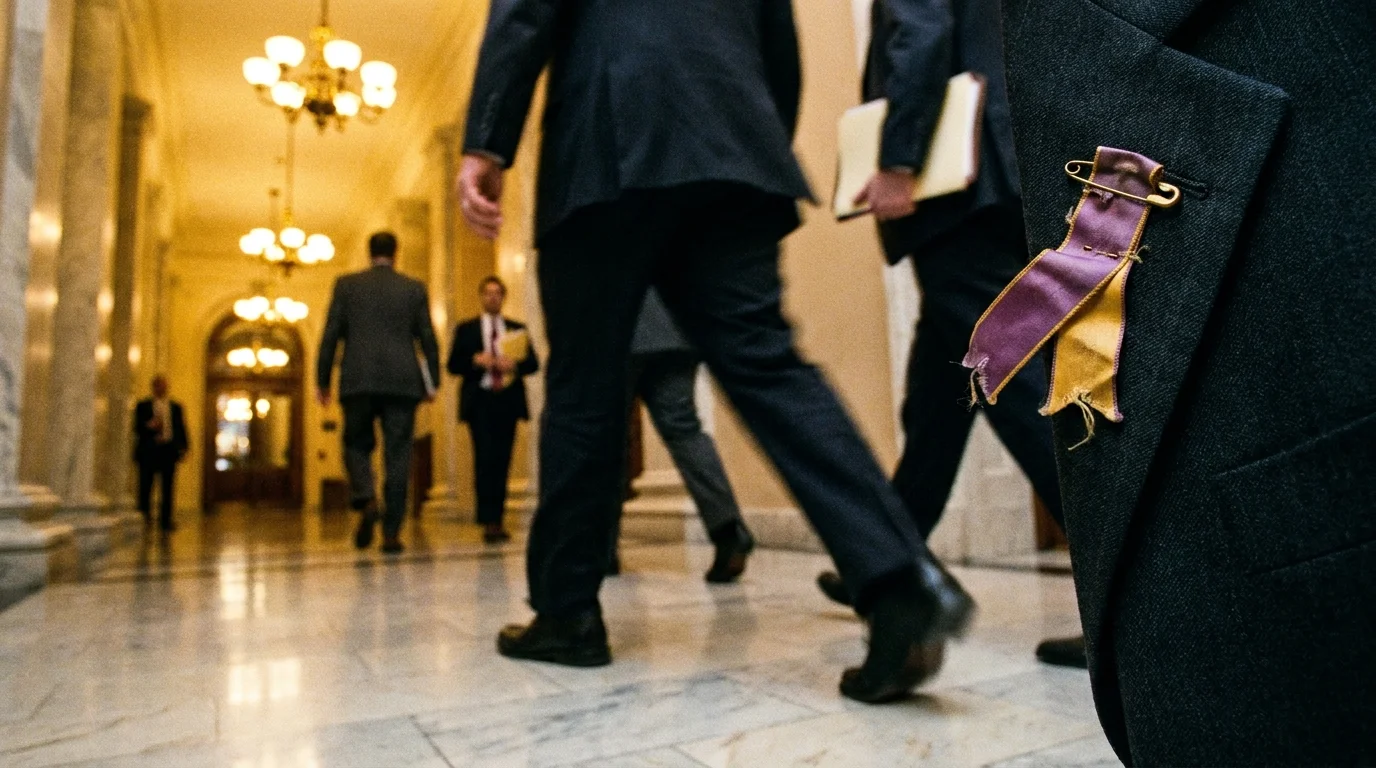
A winter draft cuts through the heavy brass doors of a Midwest state capitol, carrying the scent of floor wax, wet wool coats, and overheated radiator steam. In the rotunda, where marble stairs echo with the hurried footsteps of staff aides and lobbyists, small fragments of history often hide in plain sight. If you look closely into archival storage boxes in Springfield, Des Moines, or Lansing, you will find cardboard flats filled with frayed purple and gold satin ribbon pins, their fabric soft at the edges and their brass safety backs darkened by fifty years of oxidation.
You might easily mistake these badges for simple commemorative souvenirs from a past era. Yet when Congress sent the Equal Rights Amendment to the states in March 1972, these strips of dyed ribbon were not passive keepsakes. They were precision tactical instruments of political visibility designed to solve a very specific legislative problem: how to hold elected officials accountable in hallways where official votes were routinely buried without a public roll call.
Today, as state legislatures across the country re-examine equal rights amendments and modern constitutional measures, the tactics that defined those early Midwest ratification fights have resurfaced. The friction you see in modern committee rooms mirrors the exact strategic blueprint forged five decades ago by grassroots volunteers who understood that political change happens long before a bill reaches the governor’s desk.
The Acoustic Chamber of State Politics
Most people imagine that major political shifts happen through sweeping national speeches and historic Supreme Court rulings. In reality, the American legislative process operates like an acoustic chamber where unrecorded friction dictates the outcome. When a major constitutional amendment enters state dockets, the true contest is rarely about grand ideology; it is about local procedural leverage.
During the early 1970s, state legislative committees possessed enormous latitude to kill bills in total obscurity. Voice votes allowed lawmakers to signal loyalty to leadership while telling constituents back home that they supported the measure. Organizers quickly realized that unrecorded committee maneuvers required visible counters to break through the silence. The lapel ribbon was engineered to pierce that opacity. By pinning bright satin to hundreds of citizen coats filling committee benches, organizers turned passive observers into an unmistakable tally of constituent oversight.
This dynamic reveals a fundamental truth about statehouses: politicians respond far more acutely to physical, localized presence than to distant institutional pressure. The ribbon was not an appeal to a politician’s conscience; it was a physical reminder that every movement inside that chamber was being tracked and carried back to voting districts.
- Congressional Record roll call transcripts expose altered floor speeches through bracketed revision text
- Residential heat pump rebate forms strip homeowner savings with fine print electrical panel mandates
- Lake Ontario water management treaties trigger fierce Capitol Hill clashes over boundary rights
- Donald Trump approval rating trendlines expose sudden voting shifts across rust belt suburbs
- White House bunker security protocols spark heated televised debates over emergency continuity powers
Consider the work of Clara Mendenhall, a fifty-two-year-old community organizer from central Illinois who spent three consecutive winters patrolling the statehouse corridors in Springfield. Armed with a yellow legal pad and pockets full of freshly cut purple and gold ribbons, Clara kept detailed index cards on every swing-district senator. She did not waste energy debating hardened opponents; instead, she coordinated carpools of local teachers, nurses, and small-business owners from specific legislative districts to stand outside closed-door caucus meetings. When those senators walked out into the corridor, they were met by neighbors wearing identical pins, silently noting who entered which office.
Tactical Anatomy of the 1970s Lobby Playbook
The state-level battles of the 1970s were won or lost based on how effectively local networks could adapt to distinct legislative environments. The organizers divided their approach into three distinct operational layers.
1. The Corridor Presence
This layer targeted the physical choke points between committee rooms and chamber floors. Organizers mapped out the daily transit routes of uncommitted lawmakers, ensuring that every hallway turn brought them face-to-face with voters wearing designated district markers. This removed the comfort of anonymity.
2. The Kitchen-Table Canvass
Before a ribbon ever appeared on a lapel in the capitol rotunda, volunteers walked suburban subdivisions and rural main streets. They collected handwritten postcards from constituents, linking support for the amendment directly to regional concerns such as widow property rights, credit access, and state tax classifications. These postcards were hand-delivered in bundles directly to lawmakers during morning floor calls.
3. The Procedural Watchdog Unit
A specialized team monitored parliamentary maneuvers. They sat in the front rows of gallery seating, recording gavel times, quorum counts, and proxy votes on paper ledgers. This real-time documentation prevented committee chairs from quietly adjourning hearings before a quorum could force a recorded tally.
Mindful Application for Modern Civic Action
Whether you are tracking constitutional initiatives, tax reform, or local zoning battles today, the mechanical realities of state governance remain unchanged. Translating your priorities into meaningful legislative movement requires discipline, localized focus, and strategic clarity.
- Audit the District Math: Focus your direct energy on the specific legislative committee members who control the calendar, particularly those in moderate or split districts where margins are thin.
- Establish Physical Presence: Digital messages can be filtered by automated software, but a coordinated physical presence in a committee room permanently alters the room’s temperature.
- Track Procedural Choke Points: Learn your state legislature’s rules on discharge petitions, committee deadlines, and voice-vote thresholds so you know exactly when an unrecorded action is taking place.
- Unify Visual Signifiers: Use simple, consistent, and respectful physical markers during hearings to communicate broad coalition unity without violating decorum rules.
Your legislative toolkit should be built for durability rather than spectacle. Focus on three core assets:
- A verified roster of district voters who can arrive at the statehouse on a two-hour notice.
- A clear, one-page brief showing how the proposed policy directly affects state revenue and local households.
- A consistent, disciplined communication loop that reports every lawmaker action directly back to local civic groups.
The Durability of Quiet Pressure
The weathered satin pins resting in Midwest archives remind us that democratic institutions are fundamentally human environments. They are sensitive to local presence, persistent scrutiny, and the steady courage of people who show up when floor debates are dry and the galleries are empty.
Understanding how past generations shaped policy through direct, quiet discipline gives you a grounded framework for engaging with today’s debates. When you recognize that genuine legislative progress is built through consistent, organized local witness, the process stops feeling remote and returns to where it belongs: in the hands of informed, engaged citizens.
“True legislative accountability is never granted by the institution; it is quietly insisted upon by citizens who refuse to leave the corridor.”
| Key Point | Detail | Added Value for the Reader |
|---|---|---|
| Grassroots Choke Points | Unrecorded committee votes were targeted with visible physical identifiers. | Shows how to identify where real procedural power sits in state chambers. |
| District-Focused Mobilization | Organizers brought direct constituents from swing districts to hearings. | Demonstrates why localized pressure always outperforms broad national noise. |
| Procedural Documentation | Volunteers logged gavel times, quorum counts, and voice votes manually. | Provides a clear blueprint for holding public officials accountable today. |
Frequently Asked Questions
Why were purple and gold chosen for the 1970s ratification pins?
The colors paid direct homage to the early twentieth-century American suffrage movement, symbolizing legal equality and purposeful civic dedication.How did unrecorded votes work during that era?
Committees frequently used quick voice votes or standing counts without logging individual names in the official journal, shielding lawmakers from public scrutiny.Why were Midwest state capitols central to the debate?
Midwestern states held key moderate legislative delegations that served as crucial bellwethers for national constitutional ratification thresholds.Can physical presence still influence modern digital statehouses?
Yes. While digital communication is ubiquitous, state lawmakers still prioritize face-to-face interactions with actual voting constituents from their home districts.What is the most effective way to engage with a legislative committee today?
Attend public hearings in person, submit concise written testimony before filing deadlines, and coordinate directly with local community members to show unified district concern.