You can smell the ozone from the heavy-duty laser printers before you even step into the basement corridors of the Capitol. It is two in the morning, and the marble hallways that echo with tourist chatter by day have gone dead quiet, save for the rhythmic metallic snap of heavy three-ring binders. Inside cramped conference rooms, paper cups of lukewarm black coffee crowd around stacks of legal pads where blue ink bleeds quietly through thin, lined paper margins.
On television, lawmaking looks like grand speeches delivered to empty mahogany desks, framed by polished brass microphones and gavel strikes. But when multi-billion-dollar policy actually takes its final form, the theater falls away completely. You are looking at tired committee staffers in rolled-up shirtsleeves, swapping contested phrases across a laminate table while the rest of the country sleeps.
This is where statutory compromises survive or die: inside the thick, tabbed conference binders that reconcile two entirely different pieces of legislation passed by the House and the Senate. Every discretionary dollar, regulatory carve-out, and sunset provision comes down to a quiet conversation between legislative counsels working out whether a single modal verb should read “may” or “shall.”
The Architecture of the Midnight Margin
To make sense of how power moves through Washington, you have to discard the high school civics metaphor of a clean assembly line. Think of a major conference committee less like a courtroom debate and more like two rival master carpenters trying to build a single load-bearing bridge using entirely different blueprints. They do not argue about abstract architectural philosophy; they sit side-by-side shaving millimeters off cedar beams until the joints finally interlock.
When a bill heads to conference, leadership appoints managers from both chambers to iron out the differences. The real labor, however, falls upon nonpartisan staff attorneys who carry the institutional memory of the tax code or the public health statutes. They track the negotiations on split-column spreadsheets, known colloquially as side-by-sides, where the House position sits on the left, the Senate position on the right, and the blank middle column waits for the fragile language of consensus.
- Presidential debate makeup brushes block forehead sweat glare under blistering studio lighting
- Likely voter survey algorithms strip working class responses across evening phone call windows
- Lyndon Johnson speech drafts enforce dramatic pauses using double typewriter spacing
- Donald Trump White House confidentiality rules enforce sweeping nondisclosure demands across executive branch aides
- Chris Van Hollen Meet the Press interview reveals growing Senate resistance to overseas defense aid
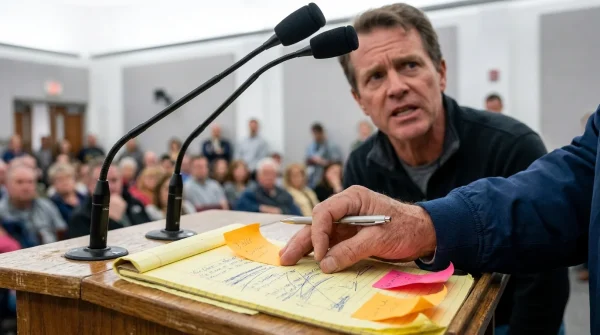
Marcus Vance, a 44-year-old veteran drafting counsel who spent fourteen years in the House Office of the Legislative Counsel, remembers the grueling final hours of a contentious agricultural reauthorization. Sitting in a windowless room beneath the Longworth building with a chewed blue pen, he spent five straight hours rewriting a single environmental compliance clause across three iterations of lined notebooks until both conservative committee aides and progressive policy analysts agreed that neither side had ceded constitutional ground.
Deconstructing the Conference Binder
When you look inside a working conference binder, you are not looking at clean legislation. You are looking at a living archaeological dig of political leverage, categorized into distinct operational layers.
The Side-by-Side Analysis (The Scorecard)
This is the baseline document. Every single section where the two chambers diverged is mapped out line by line. Staffers highlight disputed dollar figures in bright yellow and contested policy riders in pink. If a provision carries no color, it means the staff has already cleared the technical wording, leaving only the high-stakes political friction points for the elected members to settle.
The Bracketed Compromises (The Trade Space)
In legislative parlance, brackets indicate disagreement. When you see text encased in heavy square brackets on a staff draft, you are looking at the bargaining chips. One chamber agrees to remove brackets around a rural broadband grant only when the other side agrees to strike a contested permitting timeline in an unrelated title of the bill.
The Manager’s Mark (The Final Settlement)
Once the trade is made, the handwritten notes on legal pads are transformed into the formal conference report. This text replaces the original bills and cannot be amended on the floor of either chamber; it must be voted up or down in its entirety, which is why every single comma carries weight.
How to Read Between the Redlines
You do not need an active congressional badge to spot where the real negotiations occurred once a conference report becomes public. You simply need to know how to track the structural tells left behind by late-night drafting sessions.
- Check the Discretionary Modifiers: Search the text for shifts from mandatory commands (“the Secretary shall”) to permissive authority (“the Secretary may”). A shift to permissive language is almost always the scar tissue of a conference compromise where one side wanted an outright mandate and the other demanded administrative flexibility.
- Scan for Specific Reporting Deadlines: When lawmakers cannot agree on how to solve a problem, they compromise by mandating an agency report. If you see an agency directed to produce a study within 180 days instead of enacting immediate policy, that is where the conference committee hit a brick wall and chose to punt.
- Examine the Effective Date Clauses: Pushing a program’s start date past the next midterm election is the classic mechanism used to balance immediate fiscal scorekeeping against long-term political survival.
The Quiet Machinery of Consensus
It is easy to view closed-door conference negotiations with cynicism, imagining smoke-filled backrooms where public interests are bartered away. Yet when you examine the physical reality of the process—the worn legal pads, the ink stains, the meticulous line-by-line reconciliation of competing policy philosophies—a different truth emerges.
These late-night drafting sessions represent the rare space where partisan rhetoric must yield to the rigid realities of statutory construction. In those basement rooms, policy stops being a slogan and becomes an enforceable system that must govern real courts, real businesses, and real communities. Understanding how language shifts inside those binders gives you the power to see past the floor speeches and grasp how power truly operates.
“Legislation is never finished on the House floor; it is survived in the margins of a legal pad at three in the morning.”
| Negotiation Phase | Physical Document | Strategic Function |
|---|---|---|
| Initial Discrepancy | Side-by-Side Comparison | Maps the exact policy distance between House and Senate language. |
| Staff-Level Horse Trading | Lined Legal Pads & Redlines | Translates political compromises into legally binding statutory phrasing. |
| Final Agreement | The Conference Report Binder | Produces the unamendable, take-it-or-leave-it bill text for final passage. |
Frequently Asked Questions
What is the primary role of a conference committee?
A conference committee is a temporary joint panel created to resolve differences between House and Senate versions of major legislation before sending a single, identical bill to the President.Can amendments be added to a conference report on the floor?
No. Once a conference committee files its final report, both chambers must vote on the text as a complete package without any further amendments.Who actually writes the compromise language?
While elected members set the political parameters, nonpartisan attorneys from the Office of the Legislative Counsel draft the actual statutory text alongside senior committee staff.Why are legal pads and binders still used instead of purely digital tools?
Physical binders and handwritten notes allow rapid, secure version tracking during high-pressure, multi-party negotiations where network delays or digital confusion could introduce critical drafting errors.What happens if the conference committee fails to reach a deal?
If the conferees reach an impasse, the legislation dies for that congressional session, forcing lawmakers to restart the entire legislative process from scratch.