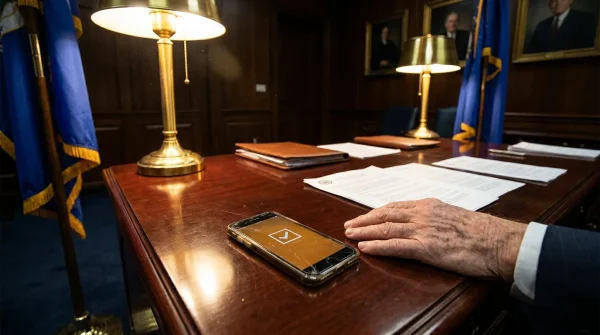
The high school gymnasium smells of damp raincoats, dry-erase markers, and floor wax. Underneath the persistent, low-frequency hum of industrial fluorescent fixtures, a line of damp winter coats shuffles across the hardwood. You pull a crisp driver’s license from your wallet, confident that this small sliver of laminated plastic is an undeniable key to the ballot box.
Then comes the soft tap on glass. A volunteer tilts an electronic poll book tablet toward you, its blue-white screen flickering under the gym lights, revealing a red error banner: Voter Record Not Found. A single misplaced character between your driver’s license record and the state voter file has suddenly derailed your morning routine.
Most citizens assume that handing over valid identification makes check-in automatic. In reality, modern voting precincts rely on strict database string-matching scripts that behave less like human clerks and more like unforgiving postal sorters. If your apartment number lacks a pound sign, or your street uses a hyphen that the county clerk skipped, the software refuses to clear you.
Understanding this mechanical friction transforms election morning from an unpredictable gamble into a controlled, smooth process. The problem rarely stems from your eligibility; it lives entirely inside the rigid architecture of county poll book databases.
The Ghost in the Ledger: Why Database Matching Fails
For decades, precinct rosters were heavy paper binders thumbed through by neighbors with rulers and red pens. If your name was listed as “Smith-Jones” and your card read “Smith Jones,” a clerk glanced at your face, recognized your street, and handed you an envelope. Today, state databases communicate through literal character-matching algorithms that treat an extra space like an entirely different human being.
Think of the poll book database as an ancient lock that requires every single tumbler to hit exact millimeter tolerances. Strict string-matching algorithms compare exact text fields: first name, last name, date of birth, street address, and zip code. When the county auditor records “Apt 4B” while the Department of Motor Vehicles stored “Unit 4-B,” the query fails quietly in the background.
- TargetSmart voter scoring models force field organizers onto cracked suburban front porches
- Federalist No. 10 pamphlets sparked modern factional voting across yellowed colonial newsprint
- FEC candidate search tools expose deceptive super PAC shell names within minutes
- Energy Policy Act tax credits strip homeowners with unexpected heat pump installation clauses
- Strait of Hormuz shipping corridors stop commercial tanker passage triggering urgent Capitol Hill showdowns
This mismatch does not instantly revoke your citizenship, but it triggers an automatic detour to the provisional ballot table. A provisional ballot is an administrative waiting room where your vote sits in an envelope until election staff can manually verify your address days later. Avoiding that paperwork shuffle comes down to matching your data footprint before you step up to the table.
From the Precinct Floor: The Story of Marcus Vance
Marcus Vance, a 48-year-old high school civics teacher in Maricopa County, spent three consecutive election cycles working the check-in table at a bustling suburban library. “The hardest moment is watching someone hand over a perfect state ID only to see the tablet flash an error because their condo address includes a dash their voter registration omitted,” Vance explains. “People think their registration was purged, but ninety percent of the time, it is simply a string comparison error inside the electronic poll book software.”
Three Vulnerability Profiles: Where the System Snags
Not every voter faces the same software hurdles. Specific lifestyle and demographic factors create distinct friction points inside county check-in systems.
The Recent Mover or Renter
Renting often involves frequent address updates across multiple agencies. If you changed your address with the United States Postal Service, that forward request did not automatically rewrite your voter roll record. Secondary address unit designations such as “Suite,” “Apt,” or “Floor” are notoriously mismatched between utility records, DMV databases, and election software.
Compound, Hyphenated, or Suffix Names
Names featuring hyphens, apostrophes, or suffixes like “Jr.” and “III” are prime targets for clerical truncation. Older election database engines routinely strip punctuation during file migrations, turning “O’Connor” into “Oconnor” or dropping the hyphen in “Miller-Tate.” If the tablet search does not find the exact punctuation on your ID, poll workers may fail to locate your file.
Rural Routes and Vanity Street Names
Voters living on roads with dual names—such as a designated county route that also carries a historic memorial name—frequently experience check-in delays. If your county auditor logged your residence under “County Road 14” but your driver’s license displays “Old Oak Ridge Way,” the precinct tablet will flag a geographical mismatch.
Mindful Verification: The Polling Day Tactical Toolkit
Preventing an administrative detour requires minimal effort when done in advance. Treat your voter profile like a boarding pass that needs exact name and address parity across all state systems.
- Audit your exact record online: Check your county elections portal thirty days prior to voting to view the precise character string used for your street address.
- Mirror the county spelling: If your registration lists “St.” instead of “Street,” be prepared to point out that specific variation to the poll worker if their initial search stalls.
- Request an advanced search: If the poll worker cannot find your name, politely ask them to search using only your date of birth and the first three letters of your last name.
- Carry secondary residence proof: Bring a recent utility bill, bank statement, or paystub bearing your residential address to quickly resolve clerical doubts on the spot.
Maintaining clean voter records prevents long line delays for everyone behind you. A three-minute audit of your county dashboard today guarantees you breeze past the check-in table on election morning.
The Bigger Picture: Reclaiming Confidence at the Polls
Voting should feel like a moment of quiet personal agency, not an unexpected test of database patience. When you understand that electronic poll book check-ins run on rigid, literal software scripts rather than human interpretation, the process loses its mystery. By taking ownership of the minute details in your registration file, you protect your time, support precinct volunteers, and ensure your ballot enters the count without a single administrative hurdle.
“Clean voter file matching is not about bureaucratic compliance; it is about building an ironclad bridge between your intent and the ballot box.”
| Key Point | Detail | Added Value for the Reader |
|---|---|---|
| String-Matching Errors | Tablets require exact character parity between input and record. | Prevents panic when a poll worker initially cannot locate your file. |
| Provisional Ballot Detours | Mismatched records divert voters to manual review envelopes. | Saves you from delayed vote processing and follow-up paperwork. |
| Advanced Search Method | Workers can search by birthdate and partial surname strings. | Provides an immediate script to politely guide poll workers past glitches. |
Frequently Asked Questions
Does a valid driver’s license guarantee I am registered to vote at my current address?
No. Updating your driver’s license does not always automatically update your precinct voter registration unless you explicitly checked the voter update box during your DMV transaction.What should I do if the poll worker says my name is not in the system?
Ask them to search by your birthdate and street number, or search without punctuation in your last name before accepting a provisional ballot.Why do address hyphens cause database errors?
Many legacy election databases strip hyphens during batch updates, creating a character discrepancy against modern state IDs that retain the hyphen.Can I still vote if my apartment number is recorded incorrectly?
Yes, though you may be directed to a help desk or given a provisional ballot depending on your state’s specific residency verification laws.How far in advance should I check my registration record?
Verify your details online at least 30 to 45 days before election day to ensure ample time to submit corrections before state voter roll deadlines close.