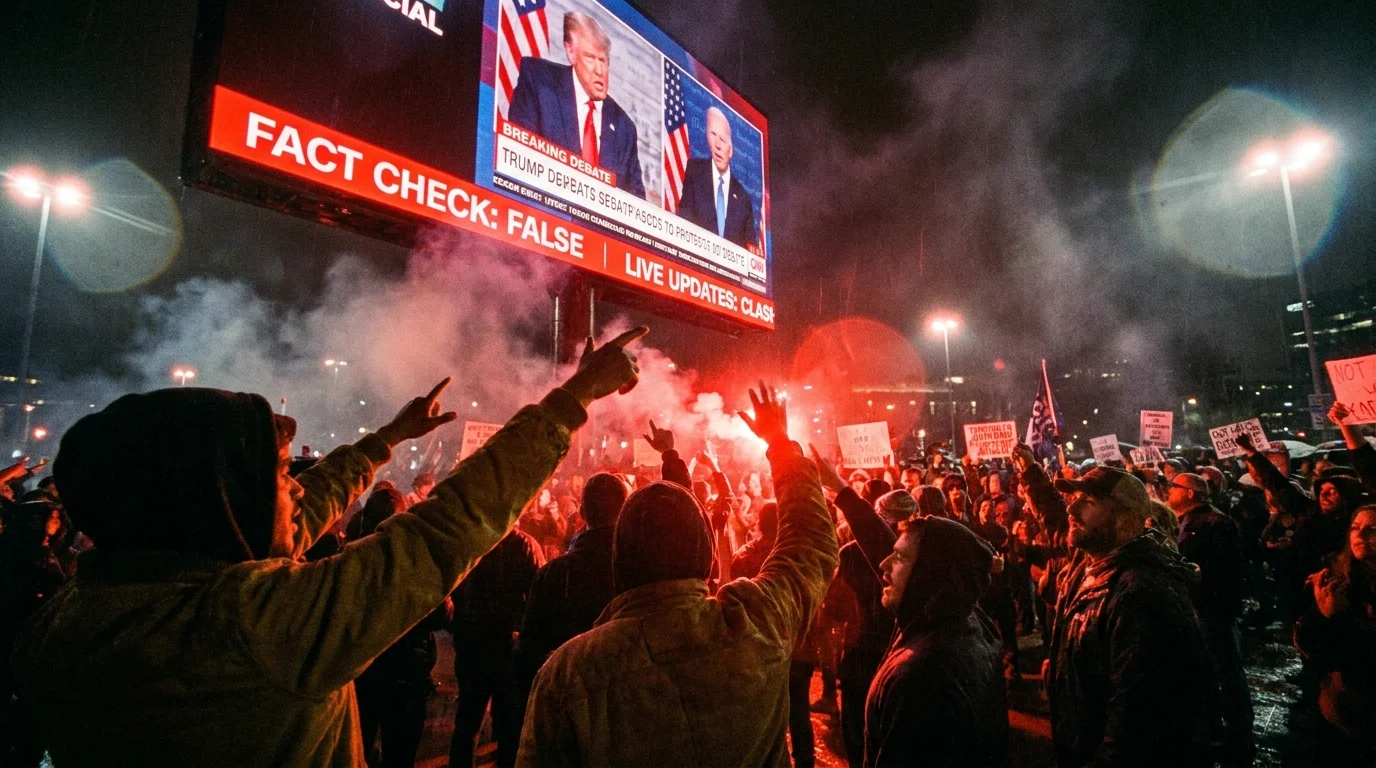
The living room glow feels different when ninety minutes of live political theater end not with candidate handshakes, but with a firestorm aimed straight at the anchor desk. You sit back on the couch, the hum of the television cooling down, while your phone lights up with rapid-fire alerts. Live updating red fact-check banners flash across digital dashboards, slicing through split-screen reactions and turning an evening meant for policy debate into an instant trial of the moderators themselves.
For decades, the post-debate ritual followed an understood choreography: pundits debated who landed the sharpest one-liner, focus groups shared their gut impressions, and campaigns spun small stumbles into major triumphs. Tonight, that playbook sits in shreds. The immediate fallout is no longer about which candidate won the stage, but whether the arbiters holding the microphones crossed the line from impartial referees to active participants.
When an authoritative institution publishes an exhaustive post-mortem within minutes of the closing statements, it does not just recap the evening—it defines the battlefield. You watch the discourse pivot on a dime as both sides stop debating healthcare or foreign policy and start waging war over split-second interruptions, asymmetrical scrutiny, and real-time corrections.
The Referee Paradox: When the Whistle Becomes the Story
Imagine watching a championship basketball game where every drive to the basket is halted by an official blowing a whistle to deliver a three-minute seminar on the physics of contact. Even if the foul occurred, the natural cadence of the contest vanishes, replaced by frustration from the stands. In modern political broadcasts, real-time intervention has created a similar dynamic: the mechanics of neutral moderation have collided directly with the raw theater of live campaign rhetoric.
The debate over standards boils down to an intractable tension between real-time accuracy and conversational flow. When moderators remain silent in the face of blatant falsehoods, critics accuse them of journalistic negligence. Yet, when they intervene selectively to correct a statistic or challenge a premise, they inadvertently turn themselves into lightning rods for partisan grievance.
This friction reveals an uncomfortable reality of contemporary media consumption: viewers rarely evaluate moderation through an objective lens. Instead, every intervention is cataloged as proof of institutional bias, transforming the newsroom’s internal editorial handbook into a public culture-war battlefield.
- Living room house parties derail national frontrunners through crowded winter living room coffee clutches
- Peer-to-peer political texts demand instant credit card swipes with urgent simulated typing bubbles
- War Powers Resolution notifications block presidential troop deployments using sixty-day statutory countdowns
- Farm Bill markup amendments switch crop subsidy payouts through rushed midnight margin scrawls
- Teleprompter glass screens trap nervous candidates through reflective studio beam angles
The Control Room Reality
Consider Elena Vance, a 44-year-old broadcast production coordinator who has spent fifteen years managing live election feeds inside network control trucks. She watches the audio levels bounce while a dedicated desk of researchers frantically cross-references claims against federal databases in ten-second windows. “The moment an anchor steps in to correct a candidate on live television, our switchboard explodes,” Elena notes. “You aren’t just adjusting a factual record in that second; you are intentionally shifting the psychological momentum of the stage, and there is zero margin for human error.”
Her perspective highlights the hidden friction behind the camera. What appears on your living room screen as an effortless, bolded correction banner is actually the result of intense, high-pressure editorial triaging carried out under blinding studio lights and unrelenting time constraints.
Dissecting the Dispute: Three Ways Voters Process the Call
How you interpret these high-stakes clashes often depends on what you expect a national debate to achieve in the first place.
For the Fact-Check Purist
If you belong to this camp, you view unchecked misinformation on a national stage as an existential threat to democratic decision-making. You expect moderators to act as aggressive gatekeepers, stopping false narratives in their tracks before they can take root in the public consciousness. For you, an intervention isn’t editorial bias—it is basic civic accountability.
For the Structural Skeptic
You view the moderators’ power with deep suspicion, arguing that selective fact-checking inherently distorts the contest. Unequal real-time pushback creates an uneven playing field, signaling to casual viewers that one candidate is inherently more untrustworthy than the other. From this viewpoint, candidate claims should be challenged by their opponent on stage, not by the journalist steering the clock.
For the Spectacle Cynic
You recognize that the outrage generated by debate moderation is often calculated political strategy rather than organic grievance. Campaign strategists know that attacking the press corps is one of the most effective fundraising and base-mobilizing tactics available, making the post-debate media critique just as valuable as winning the actual debate.
Navigating the Spin: A Mindful Reader’s Toolkit
Cutting through the noise of post-debate controversies requires a disciplined approach to consuming political analysis. Instead of letting outrage-driven headlines dictate your takeaway, you can dissect the coverage with intentional, methodical steps.
When a major analysis lands in your feed claiming a moderation failure, apply these practical filters before forming your verdict:
- Audit the Transcript Directly: Read the raw, unedited back-and-forth between the moderator and the candidate before reading commentary about the exchange.
- Time the Interventions: Note whether interruptions were balanced in duration and frequency across both podiums, or if one speaker faced significantly more procedural friction.
- Evaluate the Claim Type: Distinguish between hard factual disputes (dates, vote totals, budget figures) and subjective interpretations of future outcomes.
- Track the Post-Debate Pivot: Observe how quickly a campaign transitions from defending their policy statements to attacking the network hosting the event.
By slowing down your consumption, you step outside the reactive churn of social feeds and assess the performance on your own terms.
The Bigger Picture: Reclaiming Your Civic Focus
When political debates devolve into bitter arguments over media bias, everyday voters lose something valuable. The vital discussions about your community’s schools, your family’s cost of living, and your neighborhood’s safety get pushed aside to make room for endless arguments over anchor demeanor and chyron phrasing.
Recognizing the friction between broadcast rules and political gamesmanship gives you clarity. You no longer need to be swept away by the immediate wave of post-debate outrage. Instead, you can look past the blinking red graphics, evaluate the substance of the candidates’ platforms, and make informed choices rooted in your own priorities rather than the media’s self-referential battles.
“True clarity comes when you stop watching the referee’s whistle and start watching how the players actually navigate the court.”
| Key Point | Detail | Added Value for the Reader |
|---|---|---|
| Live Fact-Checking Burden | Split-second editorial calls carried out by control room research teams. | Helps you understand the logistical constraints behind instant broadcast corrections. |
| Asymmetrical Scrutiny Claims | Partisan friction sparked when one side receives more frequent interruptions. | Provides a clear framework for auditing whether moderation was procedurally fair. |
| Strategic Deflection | Campaigns weaponizing media critique to distract from policy vulnerabilities. | Allows you to separate genuine bias concerns from tactical campaign spin. |
Frequently Asked Questions
Why do post-debate discussions focus so heavily on the moderators instead of the candidates?
Campaigns often find it easier to unite their supporters by attacking media fairness rather than defending controversial or flawed debate answers.What is the difference between real-time fact-checking and post-debate analysis?
Real-time fact-checking happens during the broadcast via verbal interruptions or on-screen banners, while post-debate analysis allows journalists time to review complete transcripts and contextual nuances.Are debate moderators bound by specific legal standards during broadcasts?
No, debate moderation is governed by voluntary editorial agreements negotiated between networks, debate commissions, and campaign representatives rather than legal mandates.How can I tell if a moderator intervention was justified?
Check if the correction addressed an indisputable empirical error—such as an official statistic or documented vote—rather than an interpretation or prediction.Where can I find unedited debate footage without commentary?
Public broadcast archives and non-profit civic networks like C-SPAN offer complete, uninterrupted gavel-to-gavel coverage without graphics, commentary, or real-time banners.