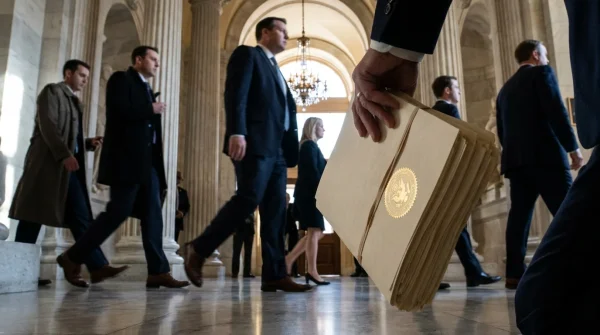
A courier steps past the heavy brass doors of the Capitol carrying an unadorned manila folder. Deep in the subterranean maze of the legislative clerk’s office, the room is quiet save for the rhythmic hum of an air handler and the muted rustle of classified dockets. The courier sets the document flat against the desk blotter, where a staff clerk brings down a heavy metal die: the embossed red time-stamp receipt stamps leave an indelible mark across the crisp white header. That single imprint registers the hour, minute, and date with mechanical finality.
You often watch world events unfold through cable news chyrons and think presidential command is absolute once troops leave American soil. The common assumption is that once an executive order sends carrier strike groups or airborne battalions into contested airspaces, civilian oversight vanishes into the fog of conflict. We imagine war as a purely unilateral switch flipped behind the heavy oak doors of the Situation Room, unconstrained by calendars or ledgers.
The institutional reality operates on a far more rigid, mechanical circuit. The moment that red stamp bites into the fiber of an executive notification under Section 4(a)(1) of the 1973 War Powers Resolution, an invisible mechanical clock begins winding down. It does not pause for political speeches, diplomatic summitry, or shifting news cycles.
That quiet time-stamp sets off a strict statutory countdown of exactly sixty days. Unless lawmakers actively vote to extend the operation or declare conflict, the entire deployment enters a legal dead zone where appropriations freeze, command authority fractures, and operational legality evaporates.
The Statutory Tripwire: Why Presidential Power Runs on an Egg Timer
Consider presidential authority not as a boundless reservoir, but as a battery with an automatic emergency discharge valve. When a foreign crisis erupts, the commander-in-chief holds the constitutional power to move forces swiftly to protect national interests. Yet the 1973 War Powers Resolution functions like an industrial circuit breaker bolted directly onto that power source. It requires the president to submit a written notification within 48 hours of introducing forces into hostile environments.
The system flips the burden of political inertia on its head. In standard legislative business, a bill dies if Congress does nothing. Under the statutory sixty-day trigger, the military operation itself dies if Congress takes no action. Silence acts as a veto, stripping the administration of lawful authority to keep boots on the ground once day sixty expires, granting only a thirty-day grace period for safe withdrawal.
- Farm Bill markup amendments switch crop subsidy payouts through rushed midnight margin scrawls
- Teleprompter glass screens trap nervous candidates through reflective studio beam angles
- Cell phone voter surveys strip rural turnout estimates through noisy background audio filters
- Franklin Roosevelt fireside scripts enforce dramatic voice drops with handwritten double underlines
- Congressional constituent office days shift lawmaker votes through coordinated local delegation visits
For decades, administrations of both parties have bristled against this constraint, arguing it infringes on Article II executive prerogatives. Yet every modern White House complies with the mechanical filing process. The risk of triggering an unauthorized conflict creates an acute vulnerability: commanders on the ground face personal legal jeopardy, and defense comptrollers cannot legally disburse operational funds for unauthorized actions.
The Clerk’s Log: Inside the Section 4 Filing Room
Arthur Vance, a 54-year-old senior national security counsel who spent two decades navigating legislative affairs for the House Foreign Affairs Committee, remembers the exact weight of those transmittal letters during late-night regional flare-ups. “When the courier delivers that formal report at 2:00 AM, the White House legal team isn’t thinking about soaring rhetoric,” Vance explains over black coffee. “They are counting every single tick of the calendar because every general officer in the chain of command knows that without statutory clearance, their logistical supply lines turn into fiscal violations overnight.”
Deployment Thresholds: How Different Military Actions Hit the Clock
Not every deployment sets the sixty-day countdown in motion. The statute recognizes subtle gradations of military presence, and executive lawyers spend hundreds of hours parsing deployment language to avoid the statutory tripwire.
Hostile Fire vs. Non-Combat Advisory Layers
When special operations units deploy alongside foreign partners, their official classification dictates whether the clock starts. If forces enter areas where imminent involvement in hostilities is clearly indicated by the circumstances, the sixty-day limit applies instantly. If the administration classifies the mission strictly as training or intelligence sharing, the reporting mandate shifts to routine semi-annual updates, bypassing the automatic termination clock.
Air Interdiction and Stand-off Kinetic Strikes
Precision missile strikes and unmanned aerial campaigns inhabit a fiercely contested middle ground. Executive branch legal advisors often argue that intermittent drone operations do not constitute “hostilities” because American personnel face no direct physical peril. However, congressional legal scholars maintain that any lethal kinetic engagement triggers the 48-hour notification rule, starting the statutory countdown regardless of whether pilots are physically in the cockpit or operating consoles in Nevada.
Maritime Escort and Freedom of Navigation
Naval patrols through contested straits occupy an active boundary layer. Routine transit does not trigger the resolution, but the moment a warship returns defensive fire against shore batteries or surface drones, the executive branch must transmit a formal report. That letter lands directly under the clerk’s red stamp, forcing lawmakers and defense planners into immediate legislative alignment.
Navigating the Legislative Clockwork
Tracking the statutory countdown requires monitoring three interconnected operational gates that determine whether an overseas deployment survives past its second month.
- The 48-Hour Transmittal Gate: The White House drafts the formal report detailing the circumstances, constitutional authority, and estimated scope of operations, delivering it to the Speaker of the House and the President pro tempore of the Senate.
- The Sixty-Day Automatic Sunset: Lawmakers must introduce a joint resolution of authorization. If this measure fails to pass both chambers, military leaders must initiate an orderly disengagement plan.
- The Thirty-Day Safe Harbor: The president can certify in writing that unavoidable military necessity respecting the safety of forces requires continued operation, granting an unextendable thirty-day window to pull personnel out.
Understanding these procedural gears allows you to see past political posturing and evaluate the real fiscal and logistical boundary lines that govern American foreign policy.
The Quiet Equilibrium of Civilian Command
The War Powers Resolution was never designed to prevent a president from responding to sudden danger. Its true purpose is structural discipline: preventing prolonged, unexamined foreign commitments from drifting forward through simple bureaucratic momentum. By tying military action to a hard statutory calendar, the system ensures that national defense remains tethered to democratic accountability.
When you hear talk of swift, decisive interventions, remember the quiet room in the Capitol basement and the embossed red stamp. Power in the American system does not rest entirely on the capability of advanced weapons or executive command, but on the delicate, unyielding gears of statutory law that quietly tick beneath every foreign crisis.
“Statutory clocks do not care about political momentum; they force the executive branch to justify every deployment under the cold light of civilian law.”
| Key Point | Detail | Added Value for the Reader |
|---|---|---|
| 48-Hour Notice Window | Formal written notification submitted directly to legislative leadership. | Reveals the exact legal threshold where military action becomes public record. |
| Sixty-Day Termination | Automatic sunset of deployment authority without express congressional approval. | Demonstrates how legislative inaction operates as an active constraint on warfare. |
| Funding Interruption Trigger | Antideficiency Act provisions prevent defense spending on unapproved actions. | Explains the practical fiscal mechanism that halts unapproved overseas missions. |
Frequently Asked Questions
Can a president simply ignore the sixty-day statutory countdown?
While administrations often dispute the constitutionality of the resolution, ignoring it risks severe domestic backlash, court challenges, and immediate legislative defunding under federal appropriations laws.Does a formal declaration of war reset the sixty-day clock?
Yes. An explicit declaration of war or a targeted Authorization for Use of Military Force (AUMF) supersedes the automatic sixty-day withdrawal timeline.What role does the Anti-Deficiency Act play in these deployments?
Federal law strictly prohibits executive agencies from spending funds that Congress has not authorized, making continued deployment past the sunset date a direct financial violation.How do advisory missions avoid triggering the notification timeline?
Legal counsels craft mission mandates to avoid formal ‘hostilities’ classifications, framing troop presence purely as logistics, training, or defensive capacity building.What is the thirty-day withdrawal extension used for?
The president can request an extra thirty days solely to protect American personnel and manage an orderly withdrawal from an active theater of operations.