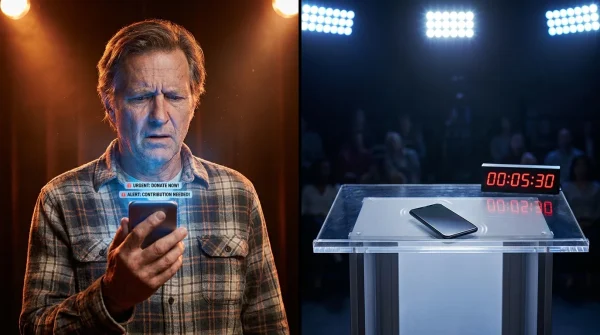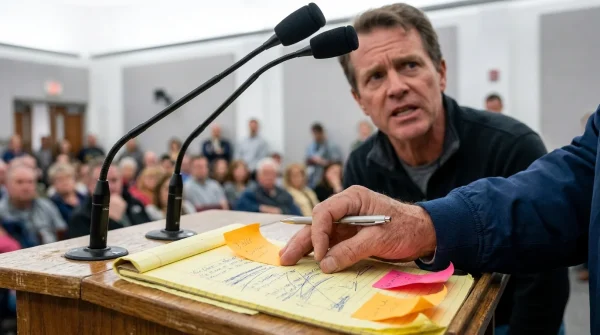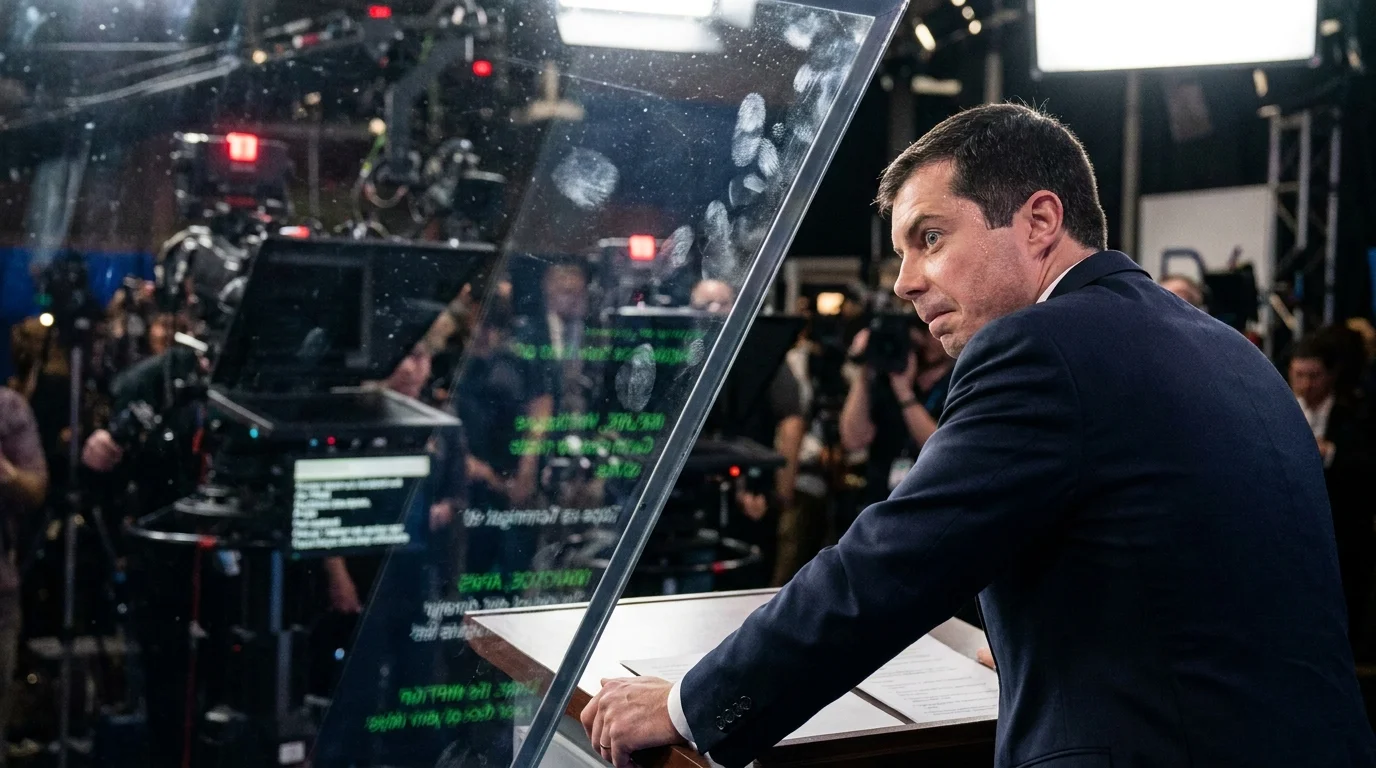
The studio floor hums with the dry, artificial chill of seventy tons of air conditioning battling five hundred studio lamps. Underneath your feet, heavy coaxial cables snake across black scuff-resistant paint, while the sweet scent of water-based fog machine fluid from a previous broadcast still lingers in the rafters. You step behind the podium, expecting the spoken arguments to carry the night. Instead, you look straight into two translucent panels angled precisely between your eyes and the dark void of the studio.
These smudged glass beam splitter panels do not look threatening until the red tally lights glow on cameras one through four. Standard debate prep treats these transparent surfaces as invisible assistants, assuming the audience only registers cadence, timber, and the clever deployment of memorized zingers. In reality, modern high-definition broadcast lenses capture every mechanical giveaway that plays across your retinas.
When light hits a beam splitter at a forty-five-degree pitch, it creates a subtle geometric trap. Your pupils trace horizontal lines with rhythmic, unnatural precision while the camera lens behind the glass records your gaze from mere inches away. What feels like steady eye contact to you appears on living room screens as a nervous, robotic flicker.
The Prism Glass Mirage: Why Memorized Speech Fails the Lens
For decades, political strategists treated teleprompter systems as simple cue cards perched on invisible pedestals. The assumption was simple: keep your head still, let the words scroll, and project steady confidence. Yet watching a speaker track a forty-five-degree optical plane reveals that the human eye behaves differently when reading reflected glass compared to addressing a room of flesh-and-blood voters.
Think of it like looking through a rain-streaked window at night while trying to convince someone outside you are watching them rather than the drops. The lens captures micro-saccades, tiny involuntary eye jumps that betray reading instead of genuine engagement. Viewers do not need optical engineering degrees to sense the detachment; they register it instantly as deceit or discomfort.
Arthur Vance, a 58-year-old lighting and stage director who has framed presidential town halls since 1996, points to the subtle tilt of the rig as the real battleground. During a tense rehearsal in Des Moines, he watched a rising senate candidate rehearse a sixty-second opening statement eight times without stuttering once. Yet during playback on the monitor wall, the candidate looked evasive, simply because the reflective pane was angled two degrees too low, forcing their eyelids down into an unintentional squint.
- Cell phone voter surveys strip rural turnout estimates through noisy background audio filters
- Franklin Roosevelt fireside scripts enforce dramatic voice drops with handwritten double underlines
- Congressional constituent office days shift lawmaker votes through coordinated local delegation visits
- James O’Keefe undercover videos spark fierce donor debates over nonprofit investigative tactics
- Lake Ontario shoreline legislation triggers urgent property rights battles over rising water baselines
Debate Stage Pressure: Three Ways Candidates Get Exposed
How an individual handles the optical physics of the stage separates seasoned debaters from panicked performers. Understanding the mechanical friction of the glass reveals how different preparation styles either survive or unravel under close scrutiny.
The Script Dependent: This speaker relies on word-for-word scrolling. Under high-output studio lights, their eyes snap sharply from left margin to right margin across the glass surface. The camera magnifies this rhythmic sweeping motion, making the candidate appear visibly panicked or disingenuous to casual voters scrolling through viral social clips.
The Disconnected Roamer: Some politicians overcorrect by wildly swinging their head from the left glass wing to the right glass wing. This creates jarring head snaps that disrupt the frame, making their posture appear jerky and defensive rather than authoritative and calm.
The Visual Anchor: Elite debaters treat the glass as an occasional reference point rather than a continuous script. They fix their sightline through the center of the panel directly into the black barrel of the broadcast camera, letting the words blur into peripheral awareness while sustaining an unbroken, human connection with the audience at home.
The Optical Mechanics of Stage Glass
To master the stage, you have to break down how light, glass, and camera sensors interact in real time during a live televised debate.
The optical beam splitter uses a 70/30 or 60/40 glass ratio, allowing the majority of light from you to pass directly into the camera lens while bouncing text back into your eyes. The angled glass splits photons into distinct paths, meaning any hesitation in your visual focus becomes immediately visible on 4K studio monitors.
- Position the glass at eye level to eliminate drooping eyelids and unflattering upward glare.
- Limit text blocks on the prompter display to three-word visual triggers rather than complete sentences.
- Maintain your gaze through the center point of the glass panel to lock directly with the camera aperture.
- Practice peripheral scanning so your eyeballs remain centered while your mind absorbs the next talking point.
The Human Lens: Beyond the Reflective Trap
A televised debate is never won on the clarity of the teleprompter glass; it is won in the micro-seconds when a speaker forgets the glass entirely. When you master the spatial physics of the debate stage, you stop fighting the camera and begin speaking straight through the glass barrier.
True political authority comes from shedding the mechanical panic of being watched. By understanding the angles, the reflections, and the quiet mechanics of the studio floor, you control your physical narrative before a single word is parsed, quoted, or clipped for the evening news.
The screen reflects text, but the lens behind it only captures conviction.
| Debate Focus Area | Studio Reality | Strategic Takeaway |
|---|---|---|
| Script Scanning | Exposes rapid eye movements | Shift to keyword triggers to keep eyes locked on the lens |
| Glass Angle | Directs eyelid positioning | Calibrate screen tilt to maintain open, confident eye contact |
| Light Reflection | Reveals nervous blink rates | Look past the reflective surface directly into the camera core |
Frequently Asked Questions
Why do candidates look nervous when reading from prompters?
Angled beam splitters force the eyes to track horizontally across the glass surface, producing visible micro-movements that television lenses magnify as discomfort or hesitation.Can studio lighting make prompter text harder to see?
High-intensity overhead lamps wash out low-contrast displays, causing speakers to squint or tilt their heads awkwardly to read fading text.What is a beam splitter glass panel?
It is a semi-reflective optical mirror that displays text to the speaker while allowing the camera behind it to film directly through the clear pane.How do elite debaters avoid the robotic reading gaze?
They memorize core points and use the glass solely for brief structural cues, keeping their primary focus centered on the camera lens.Why do debate stages use two prompter screens?
Dual wings let speakers shift their posture naturally across the room without losing their spot in the prepared outline.