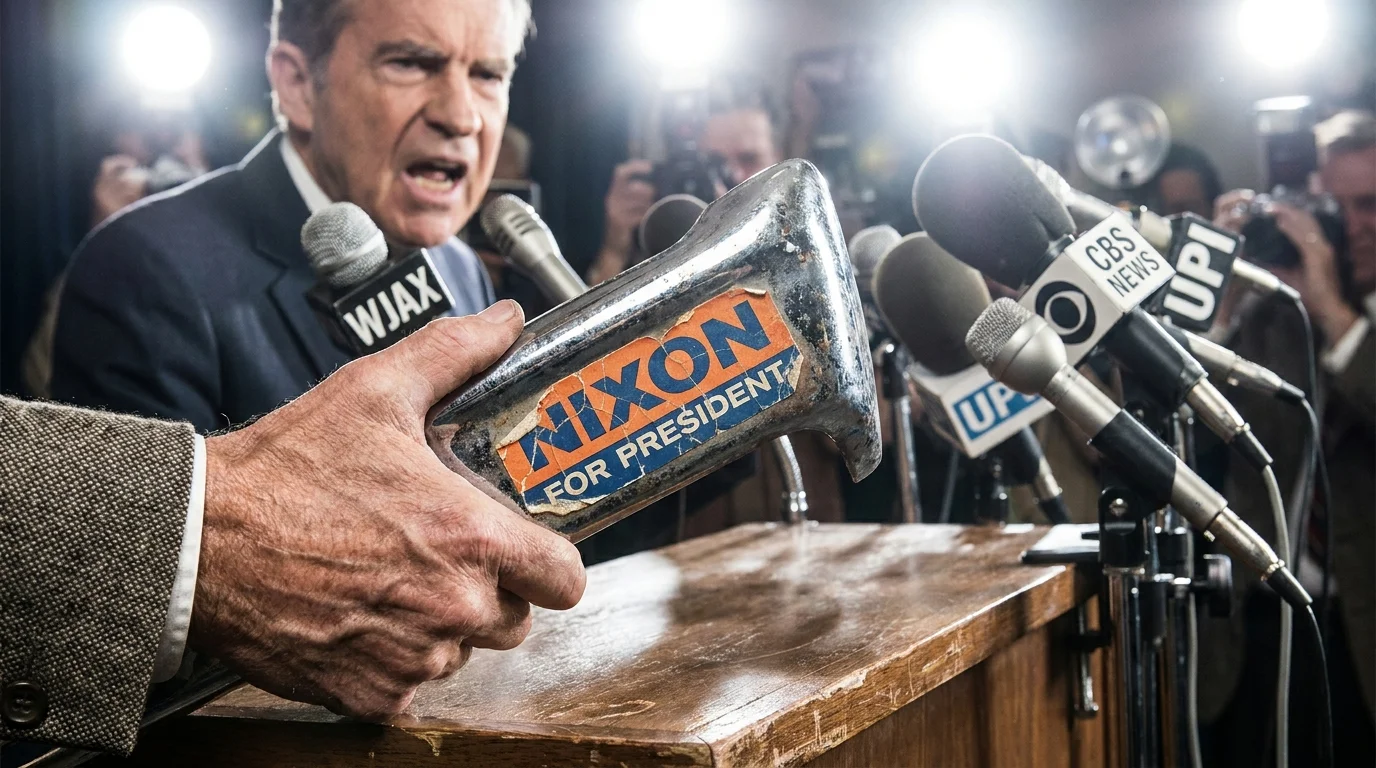
Step into an unheated two-car garage in Macomb County, Michigan, where the late afternoon light cuts through a dusty transom window. The air carries the sharp tang of motor oil, dry lawn clippings, and damp concrete. Underneath a canvas drop cloth rests a 1967 Buick LeSabre, its rear chrome bumper bearing a brittle strip of weathered vinyl. The orange lettering has faded into the shade of dried persimmon, spiderwebbed with tiny fractures, peeling at the edges where moisture gathered over fifty winters.
You run your thumb across that cracked adhesive residue. You are touching the architectural footprint of modern American politics.
Most commentary will tell you that our current political tribalism was born in an algorithm—that social media echo chambers invented the grievance-laden, identity-first campaign. But when you look at that faded strip of orange vinyl, you realize the digital feed is merely a fast-forward version of a strategy perfected on suburban cul-de-sacs more than five decades ago.
The Chrome Bumper as the Original Algorithmic Feed
In the late 1960s, American political strategists faced a puzzle. The suburban migration had pulled millions of working-class families away from traditional urban ward machines, union halls, and church basements where voting loyalties used to be forged over card games and local charity drives. Dispersed along curving asphalt drives with tidy lawns, these voters were geographically isolated yet collectively uneasy.
The standard political pamphlet no longer worked; it felt like junk mail tossed into the recycling bin. Strategists needed a portable badge of identity that turned private unease into public solidarity. The vinyl bumper sticker, mass-produced with inexpensive screen-printing techniques, became the original yard sign and Twitter handle combined. It allowed drivers sitting in commuter traffic on newly paved interstates to look at the car in front of them and realize they were not alone in their quiet frustration.
What felt like a grassroots expression of personal values was actually a meticulously engineered feedback loop. The bumper sticker did not just broadcast a choice; it created a sense of protected kinship in rapidly changing neighborhoods.
- Reverse image metadata tools expose altered political photos with jagged pixel halos
- Section 199A deduction rules strip small business owners with hidden taxable income phaseouts
- Kennedy Center renovation funding forces fierce Capitol Hill showdowns over federal cultural spending
- Oklahoma election results reveal unexpected suburban turnout surges across shifting conservative strongholds
- Jennifer Hegseth Pentagon role sparks explosive debate clashes over federal defense appointments
Consider Arthur Miller, a 42-year-old tool-and-die supervisor living in a freshly built tract home outside Dayton, Ohio, in October 1968. Arthur did not attend raucous political rallies or speak at town halls. His political participation had always been quiet, marked by a straight union ticket. But when canvassers left a heavy-stock mailer on his porch featuring that stark, day-glow orange slogan, Arthur felt a jolt of recognition. He wiped his rear bumper with mineral spirits, peeled the wax backing, and stuck it firmly to the chrome. That small physical act transformed him from a passive spectator into an active node in a national movement.
The Anatomy of Precinct-Level Grievance Architecture
To understand how those early materials bridged the gap between mid-century unease and modern political coalitions, look at how campaign field operations segmented their appeals long before digital microtargeting existed.
Suburban precinct captains in 1968 did not talk about high-altitude economic theory. They focused on hyper-local disruption—changing school zoning maps, rising property assessments, and the perceived breakdown of neighborhood decorum. The messaging operated on three distinct psychological layers, each calibrated to turn quiet anxiety into reliable voter turnout.
1. The Commuter Defense
Targeted directly at middle-income breadwinners who spent ninety minutes a day driving between factory floors and newly paved subdivisions. The literature framed the suburban home not merely as real estate, but as an earned refuge from city turmoil that needed political defense.
2. The Taxpayer Stewardship
Aimed at families managing their first fixed-rate mortgages. Here, the messaging pivoted toward the grievance of inflation and municipal spending, creating a shared identity around the idea of the responsible, uncelebrated citizen carrying the financial weight of national policy.
3. The Cultural Boundary
Designed for multi-generational families navigating generational friction. The printed materials emphasized order, tradition, and institutional respect, offering a symbolic shelter against rapid social upheaval.
Reclaiming the Signal: A Mindful Reader’s Toolkit
When you encounter today’s viral slogans, recognizing their historical machinery prevents you from being manipulated by manufactured outrage. You can strip away the emotional charge by running modern campaign messages through a simple diagnostic filter.
- Locate the invisible ‘us’: Identify whether the message relies on an unstated, virtuous collective that supposedly speaks for the common person without offering verifiable data.
- Trace the physical medium: Notice how modern yard signs, car decals, and profile badges mimic the physical presence of early vinyl stickers to create an illusion of regional consensus.
- Examine the grievance axis: Ask what specific, local disruption the messaging is attempting to link to a broader national crisis.
- Check for economic scapegoating: Watch for language that frames routine institutional friction as an intentional betrayal of hard-working families.
The Clear View Through the Rearview Mirror
When you wipe away the dust of political mythology, you see that our modern debates are not unprecedented ruptures in civic life. They are the continuation of a script written on heavy cardstock and adhesive vinyl during the expansion of the American suburbs. Recognizing this pattern does not make you cynical; it makes you clear-eyed.
When you understand that slogans are tools designed to aggregate private anxieties into voting blocs, the noise loses its power over your daily peace of mind. You stop reacting to the cracked orange letters on the bumper ahead of you and start seeing the road for what it actually is: shared pavement, shared infrastructure, and a quiet opportunity to think for yourself.
The loudest political movements are rarely born in sudden storms; they are carefully cultivated in the quiet routines of ordinary driveways.
| Campaign Era | Primary Distribution Channel | Strategic Identity Benefit |
|---|---|---|
| 1968 Suburban Push | Screen-printed vinyl & doorstep mailers | Validation of private neighborhood anxieties into a collective voting bloc |
| 1990s Talk Radio Era | Drive-time radio call-ins & newsletters | Daily reinforcement of shared grievances during the daily commute |
| Modern Digital Feeds | Algorithmic timelines & short-form video | Instant, round-the-clock tribal sorting and peer-group reinforcement |
Frequently Asked Questions
Why were orange and blue tones so common in late-1960s campaign vinyl?
Screen-printers used high-visibility day-glow pigments because they stood out against overcast highway skies and the shiny chrome bumpers popular on American vehicles of that era.Did the ‘Silent Majority’ slogan originate with political consultants or voters?
While variations of the phrase existed in historical speeches, campaign strategists formalized it into a unified brand identity to capture suburban voters who felt ignored by mainstream media coverage.How did 1968 precinct canvassing differ from modern political outreach?
Early canvassing relied heavily on physical door-to-door literature drops and volunteer ward maps, whereas modern campaigns use predictive voter files and mobile phone location data.Why do physical bumper stickers remain effective in an online campaign environment?
A bumper sticker represents a permanent, physical commitment in a local community, carrying a higher social signal of peer validation than an easily discarded digital post.How can voters separate genuine grassroots messaging from engineered campaign scripts?
Look at the funding sources and distribution apparatus behind the material; engineered messaging relies on uniform national slogans repeated across diverse local precincts without addressing specific municipal needs.