The desk fan hums against the quiet of a midnight room while your screen reflects thousands of rows in cool blue light. A viral post on your feed insists that millions in untraceable cash just flooded your local congressional district through thousands of ghost donors. You expect the paper trail to resemble a labyrinth of offshore accounts and sealed corporate registries, built specifically to keep regular citizens locked out.
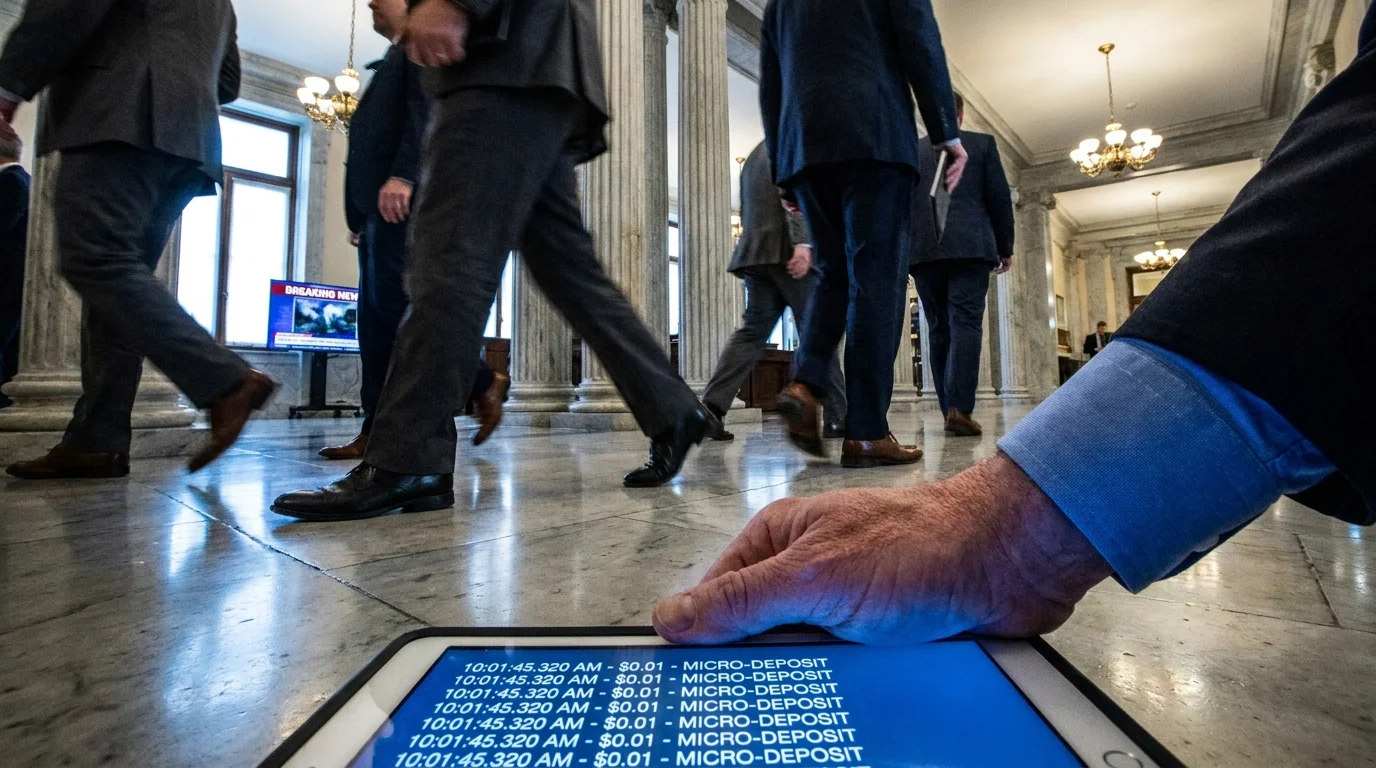
Instead, you open the raw disclosure files from the Federal Election Commission portal and download a simple spreadsheet. Blinking digital spreadsheet cells with identical down-to-the-second micro-deposits stare back at you from the monitor. The story is not hidden behind a wall of legal jargon; it is printed plainly in the time column.
When automated contribution platforms split large sums across hundreds of individual entries, they run into a basic constraint of computer servers. They process batches in microsecond bursts. The sheer speed that allows campaign operations to distribute money in fractions leaves an indelible fingerprint that anyone with a laptop and five spare minutes can read.
The Clockwork Architecture of Digital Straw Donors
Modern campaign finance operates less like a smoky backroom and more like an automated transit turnstile. Automated script distribution networks rely on code routines that take a single pool of funds and break it into hundreds of smaller contributions, often below the threshold that requires detailed employer reporting. Yet, code cannot disguise its own rhythmic pulse.
When an intermediary platform processes an automated batch, the server writes every micro-donation to the ledger with the exact same system clock timestamp. While human donors click buttons at random intervals throughout an evening, a scripted network registers thirty contributions from thirty different zip codes at precisely 02:14:33 AM UTC. The mechanical precision that makes the process cheap is the exact giveaway that exposes it.
- Goldwater 1964 precinct cards sparked grassroots delegate revolts across dusty suburban precincts
- Statehouse constituent phone logs force staffer tallies using handwritten tick marks
- Political billboard contracts switch roadside placements to trap commuters in slow traffic
- Supreme Court mail ballot rulings derail late envelope deadlines across competitive county boards
- Social Security COLA formulas demand Chained CPI cuts stripping monthly grocery checks
Marcus Vance, a 41-year-old high school civics instructor in Columbus, Ohio, spent an evening tracing receipts filed by an independent expenditure committee. By setting a basic filter on the commission’s Schedule A database for donations under fifty dollars sharing identical second-level timestamps, he mapped twenty-two separate contributions routed to a single committee from disparate regions within three clock cycles. He did not need a subpoena or a background in forensic accounting; he simply sorted the data by time.
Reading the Footprints: Three Conduit Patterns to Spot
Identifying automated conduits requires knowing which structural anomalies stand out against normal grassroots giving. You can separate real grassroots surges from automated distributions by looking at three specific filing signatures.
The Burst Relay: This occurs when dozens of micro-donations register with identical timestamps down to the second, often carrying odd-cent values such as $13.37 or $27.42. Organic donors give round numbers at uneven times of day. A cluster of fifty fractional transactions within a five-second window indicates an automated script executing a split balance.
The Earmark Conduit Loop: Certain intermediary platforms process donations on behalf of candidate committees while acting as a pass-through entity. Look at the memo field for code ’15E’, which indicates an earmarked contribution routed through a conduit. If the parent transaction ID matches across multiple disparate donor names simultaneously, the funds moved through a single centralized automated checkout API.
The Phantom Micro-Series: In this pattern, an unwitting recurring donor has their contribution divided across several sister political action committees. Repeated identical fractional amounts hitting five distinct committee IDs at the exact same second signal that a multi-candidate joint fundraising agreement auto-routed the balance upon receipt.
A Five-Minute Method for Slicing Bulk FEC Receipts
You do not need specialized software to verify whether a viral claim about campaign financing holds water. Using standard spreadsheet software, you can isolate automated routing patterns with minimal effort.
First, navigate to the official Federal Election Commission candidate search tool and select the ‘Receipts’ tab. Download the raw CSV file for individual contributions during the reporting period in question.
- Open the file and locate the column labeled TRANSACTION_DT and the associated timestamp or sequence ID.
- Apply a basic filter to isolate transactions under the $200 individual disclosure threshold.
- Sort the list by transaction time down to the second, or secondary transaction sequence numbers if time is masked.
- Search for duplicate clusters where multiple distinct donor records share an identical timestamp and conduit identification code.
Keep your investigation grounded by referencing this tactical verification checklist during your review:
- Primary Data Source: Official FEC Schedule A Bulk Data Export
- Target Conduit Marker: Transaction Type ’15E’ (Earmarked Conduit Transfer)
- Critical Variance Threshold: Zero-second variance across three or more unrelated donor records
- Anomalous Value Indicator: Non-standard fractional cent values repeated across separate names
Reclaiming Clarity in an Era of Algorithmic Noise
When political headlines turn volatile, claims about dark money and hidden donors spread quickly because they play on our feeling of being kept in the dark. Looking directly at public records dissolves that helpless feeling with concrete facts. The infrastructure of campaign finance leaves hard mathematical evidence in public view every single day.
Once you understand that servers operate on strict mechanical rules, you no longer have to rely on third-party assertions or viral screenshots. You can open the raw filing, check the timestamps, and evaluate the truth for yourself.
Read More