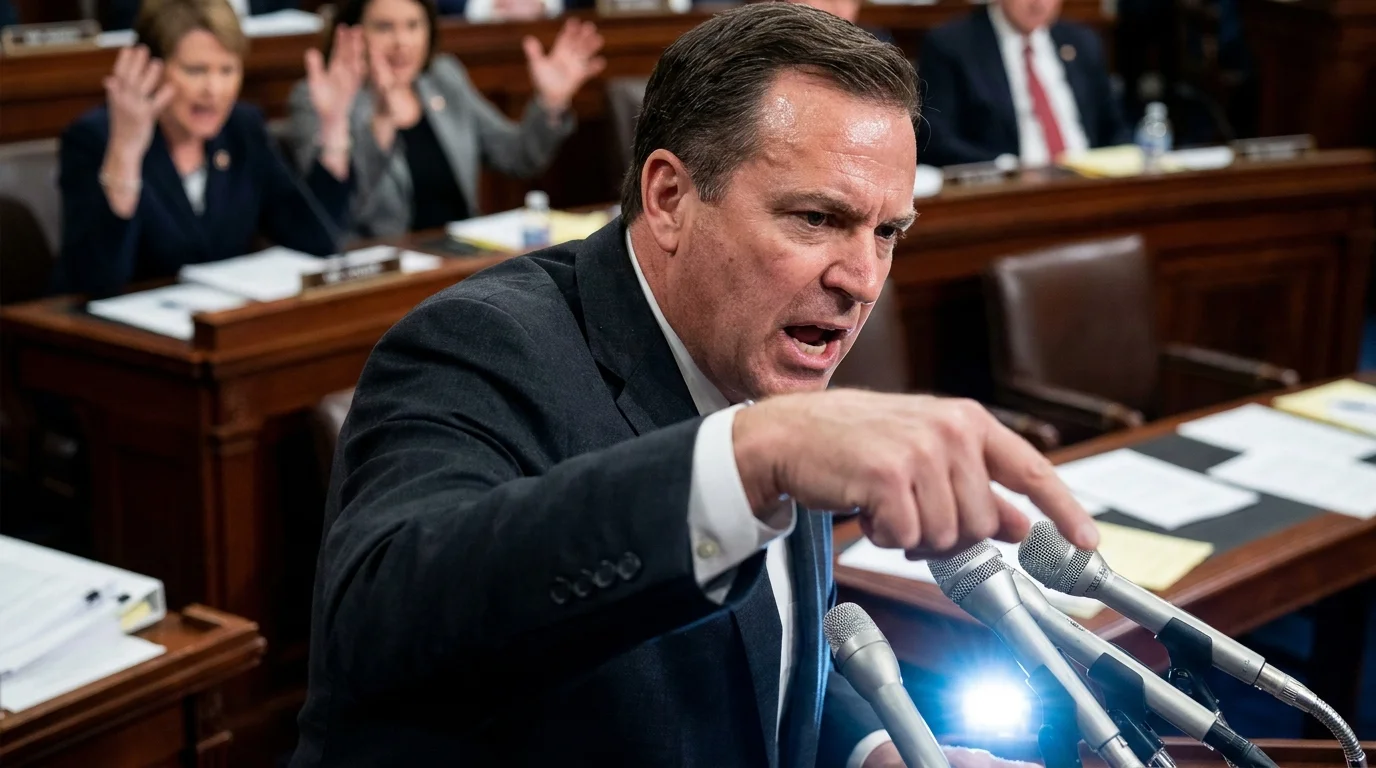
The hallway outside the House chamber smells of wet wool and burnt cafeteria coffee long before the morning gavel drops. When you walk these corridors during a quiet session, you hear only the soft shuffle of leather soles against historic limestone and the steady hum of industrial air handlers pushing warmth into drafty rooms. You might easily mistake the institution for a slow-moving, sleepy beast tangled in procedural ribbons.
By noon, that polite rhythm evaporates. The chamber floor roars to life as members cluster around committee staff, clutching dog-eared printouts of statutory law and highlighting passages with trembling yellow markers. The real war on Capitol Hill is rarely about the raw dollar amounts written into federal bills; it is about who holds the physical power to release or freeze those dollars once the vote is certified.
That dormant battle exploded into the daylight when constitutional scholar Laurence Tribe dropped a series of blistering analyses warning that unilateral White House freezes on congressionally approved funds cross a clear red line. His legal assessment tore through committee backrooms like a sudden draft through a stack of loose paper, turning routine debates over emergency spending into a direct confrontation over the survival of Article I authority.
You are watching lawmakers who usually disagree on basic tax rates find themselves huddled together over legislative texts, while others push the boundary of executive authority to its absolute breaking point. What feels like technical procedural squabbling in the headlines is, in truth, an urgent struggle to determine if a president can unilaterally starve federal programs simply by letting funding sit untouched on an administrative ledger.
The Boiler Room Fallacy: Why Money Bills Aren’t Blank Checks
Most people assume the federal budget functions like a household checking account. You write a check, the recipient deposits it, and if emergencies crop up at home, you simply cancel the payment before the bank clears the balance. This domestic metaphor completely misreads how public power is built into the American framework.
Think of federal budgeting instead as a complex municipal steam plant. Congress designs the plumbing valves, specifying precisely how much steam must flow into which neighborhood radiator to keep the entire city from freezing. When the executive branch decides to weld a shutoff valve closed without telling the boiler operators, the pressure does not vanish into thin air; it builds up behind the wall until something structural gives way.
For five decades, the 1974 Congressional Budget and Impoundment Control Act served as the official pressure valve between the White House and the Capitol. Laurence Tribe’s warnings pulled the veil back on an uncomfortable reality: recent attempts to repurpose emergency declarations to bypass that statute are not minor administrative adjustments, but an intentional rewrite of the separation of powers. If an executive can refuse to execute a spending law passed by both chambers, the legislative vote becomes an advisory suggestion rather than a binding command.
- Battleground Senate debates erupt over disputed entitlement cuts as live polls register panic
- New Hampshire primaries crush frontrunner war chests through direct living room voter scrutiny
- Senate agriculture drafts secretly trade rural nutrition subsidies for Southern crop baselines
- Kroger grocery aisles face sudden consumer boycotts over automated digital price tags
- Mexico border trade shifts force party leaders into sudden protectionist platform pivots
The View from the Procedural Trench
Elena Vance, 44, spent twelve years as a nonpartisan committee parliamentarian before opening a legal policy shop two blocks from the Supreme Court. On Tuesday afternoon, she sat at a battered oak desk covered in yellow legal pads, tracing the line between statutory deferrals and outright constitutional refusal.
“Everyone watches the floor speeches because the cameras are pointed at the microphones,” she says, tapping her pen against an archival copy of the 1974 Act. “But the real friction happens three levels below, where White House budget deputies quietly scrub apportionment schedules. When Laurence Tribe flagged those spending delays as illegal impoundments disguised as administrative pauses, it gave career civil servants the legal armor they needed to say no. That is why lawmakers are suddenly screaming at each other on C-SPAN—their invisible leverage just got dragged into the sunlight.”
The Three Battle Lines Splintering the Chambers
The fallout from these warnings has shattered traditional party lines, carving Capitol Hill into three distinct camps with wildly differing views on how power ought to run.
The Executive Maximalists
This faction argues that the Commander-in-Chief holds inherent Article II authority to manage national crises without waiting for a polarized legislature to debate line items. They treat congressionally allocated funds as spending ceilings rather than mandatory floors, claiming that changing conditions on the ground grant the White House discretion to hold back cash whenever an emergency demands an immediate policy pivot.
For these lawmakers, Tribe’s warnings represent an outdated attempt to handcuff strong governance in an era of rapid global shifts. They view statutory spending commands as suggestions that must yield to executive agility.
The Institutional Custodians
Gathered across both sides of the center aisle, this group views the power of the purse as the only genuine leverage the legislative branch has left. They point directly to the text of the Constitution, which assigns all spending power squarely to Congress, warning that surrendering this control reduces representatives to toothless observers.
To this coalition, the issue is not about whether a specific program deserves funding, but whether any president can nullify a law simply by sitting on the funds. A single unchallenged impoundment sets a precedent that will haunt whichever party controls Congress in the next decade.
The Fiscal Realists
Caught in the crossfire, this smaller bloc focuses entirely on the ripple effect across state economies. They understand that when federal grants freeze at the executive level, local municipal projects stall overnight. These lawmakers are less concerned with grand constitutional philosophy than with the catastrophic cash crunches hitting their home districts when highway subsidies or disaster aid fail to clear federal accounts on schedule.
Decoding the Cloakroom Maneuvers
Understanding these battles requires looking past the cable news soundbites and watching the quiet procedural mechanisms that lawmakers use to force compliance.
When a spending freeze is contested, pay close attention to the following indicators:
- Apportionment Bulletins: Track the Office of Management and Budget’s quarterly notes to verify whether funds are actually being distributed to agencies or held in administrative holding accounts.
- Comptroller General Inquiries: Watch for sudden audit requests from the Government Accountability Office, which serve as the early warning system for illegal deferrals before floor votes take place.
- Committee Subpoena Deadlines: Note when House Appropriations subcommittees issue firm compliance dates for ledger disclosures, signaling that negotiations behind closed doors have broken down.
- Rider Language in Continuing Resolutions: Identify subtle textual amendments that explicitly mandate the release of funds within 30 days under threat of cutting off cabinet-level operational budgets.
By monitoring these administrative pressure points, you spot the structural shift weeks before it breaks into shouting matches during prime-time proceedings.
Why Quiet Constitutional Friction Matters for Your Kitchen Table
It is easy to dismiss clashes over emergency powers as inside-baseball legal gymnastics designed to keep scholars and cable pundits occupied. Yet the outcome of this dispute shapes the everyday texture of your community long before you ever cast another ballot.
If the executive branch wins the right to selectively withhold funding authorized by your elected representatives, the link between your local vote and public spending snaps. Funding for the rural bridge you cross on your morning commute, the wastewater improvements your town board approved, or the emergency heating subsidies your neighbors rely on during January blizzards can simply vanish at the discretion of an unelected agency director.
Constitutional friction is not a sign of institutional failure; it is the system working precisely as designed to keep any single branch from dictating reality. When lawmakers stand at floor lecterns arguing over the mechanics of spending statutes, they are fighting to ensure that the promises made to local communities cannot be rewritten with a quiet stroke of an executive pen.
“The power of the purse was deliberately placed in the hands of the people’s representatives to ensure that no single executive could rule through financial starvation.”
| Key Point | Detail | Added Value for the Reader |
|---|---|---|
| Statutory Mandate | The 1974 Impoundment Control Act forces the executive branch to spend all appropriated funds unless Congress approves an explicit rescission. | Helps you distinguish between routine administrative delays and illegal executive withholding of community funds. |
| Tribe’s Legal Warning | Argues that emergency powers cannot be used as an administrative loophole to override congressional spending directives. | Provides you with the legal baseline needed to decode competing claims during high-stakes floor debates. |
| Local Impact | Executive spending freezes immediately stall municipal infrastructure, school grants, and localized transit projects. | Connects high-level Capitol Hill procedural warfare directly to the public services available in your hometown. |
Frequently Asked Questions
What is an impoundment in presidential spending?
An impoundment occurs when a president refuses to spend federal money that Congress has officially appropriated, effectively vetoing a program by withholding its cash.Why did Laurence Tribe’s warnings cause such an immediate reaction?
His analysis provided lawmakers and legal oversight bodies with a concrete constitutional framework to challenge executive spending delays as direct violations of Article I.How does this dispute differ from a typical government shutdown?
A shutdown happens when Congress fails to pass funding laws; an impoundment clash occurs when Congress *has* passed the law, but the White House refuses to release the approved funds.Can the Supreme Court step in to resolve this floor clash?
Yes, if Congress or impacted states file suit showing that impounded funds caused direct injury, the high court can rule on the constitutional limits of executive budget management.Where can ordinary voters track if local funds are being held up?
You can monitor the Government Accountability Office (GAO) decision database and House Appropriations Committee tracking reports for active spending inquiries.