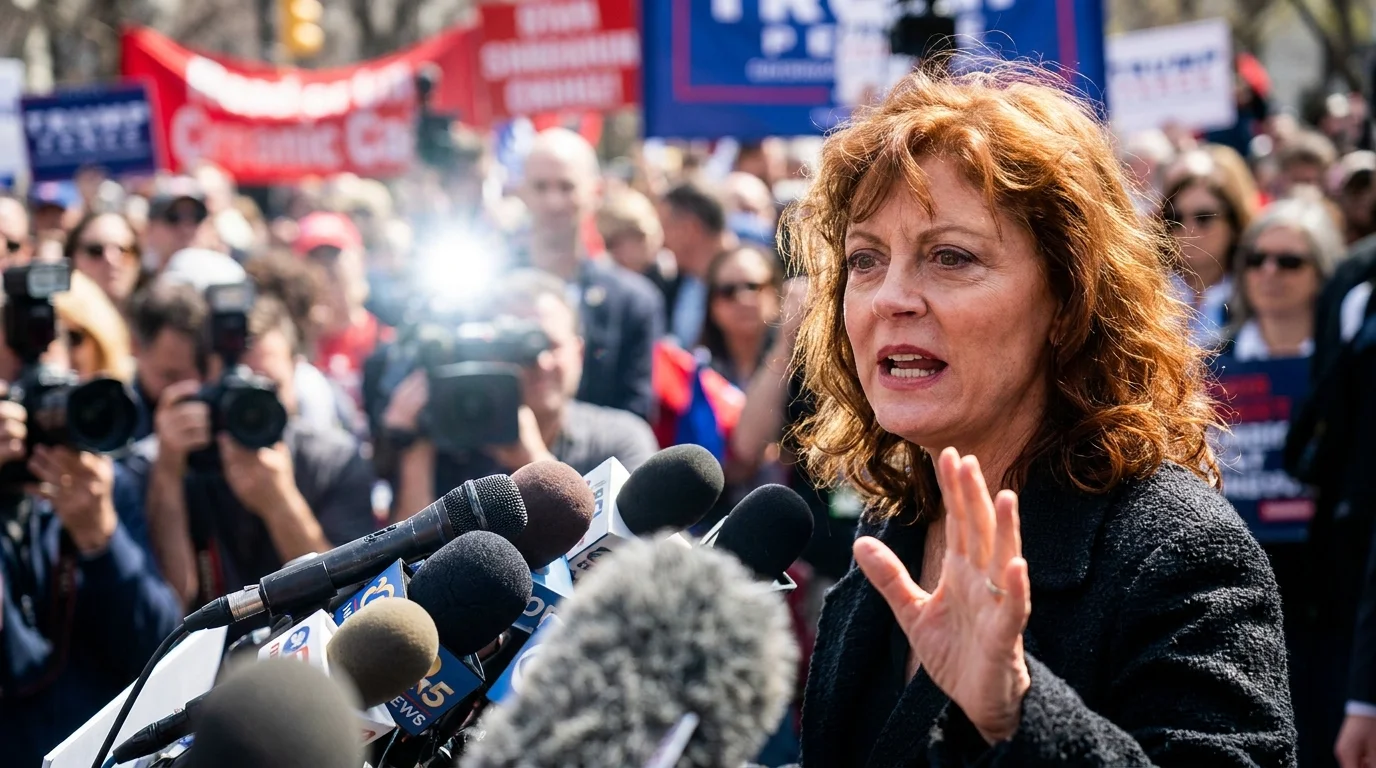
The damp chill of a November afternoon settles into your jacket as feedback howls from a battery-powered PA horn on a Manhattan street corner. Handheld cardboard signs flutter in the cross-breeze, and the dull scrape of work boots against salt-crusted asphalt marks the rhythm of an ordinary weekend demonstration. When a recognizable voice steps up to the mic, dozens of phone screens rise in unison, their small lenses catching the gray sky.
You might expect a public speech to survive on its own merits, documented accurately by the pocket cameras running mere feet from the speaker. The assumption is simple: what was spoken aloud remains fixed in reality, anchored by the hundreds of witnesses who felt the cold vibration of the amplifier. Yet between the physical microphone and the blue glow of your evening feed, something quiet and surgical takes place.
By nightfall, the ambient noise of traffic and chanting fades away, replaced by crisp, sensational text cards flashing across your feed. The actress spoke for twelve minutes about working-class solidarity and community bail funds, but the viral soundbite ricocheting across automated channels attributes an inflammatory, fabricated policy demand to her name. The real danger is not just that words were altered, but that the digital supply chain manufactured consensus out of thin air before sunrise.
The Anatomy of the Seven-Second Splice
To understand how public speech transforms into synthetic outrage, you have to picture a darkroom where someone trims away negative space until the subject appears to hold a weapon instead of a microphone. It is not crude trickery; it relies on linguistic shearing. An orator pauses to catch her breath, takes a breath between two clauses, and an automated script snips out the conditional qualifier.
When a sentence like “If leadership ignores our plea, they force people into desperate resistance” is stripped of its first five words, the remaining fragment hits social feeds like a declaration of war. This is where manufactured outrage weaponizes nuance, turning an analytical warning into a direct personal threat.
The mechanics mimic breathing through a pillow: the authentic context suffocates quietly while the amplified phantom screams at full volume. Once that spliced audio file is rendered, automated networks do not read the room; they read the velocity of outrage. The missing context is never accidental. It is engineered to exploit the human tendency to react before verifying the source transcript.
- Masoud Pezeshkian interview remarks spark furious Tehran backlash forcing rapid diplomatic walkbacks
- Supreme Court corruption rulings freeze ongoing municipal fraud trials across five states
- John Deere factory shifts spark furious rural voter boycotts over Midwestern job cuts
- Federal Trade Commission staffing freezes stall critical consumer safety recalls nationwide
- Mark Carney trade warnings trigger fierce border tariff clashes across northern manufacturers
The Forensic Trail: From Street Corner to Bot Farm
Elena Vance, a forty-one-year-old digital forensic analyst based outside Raleigh, tracks these digital ripples for independent monitoring collectives. When the weekend footage of Susan Sarandon began circulating on private messaging servers, Vance noticed an anomaly within forty minutes of the rally concluding. The video clip driving the surge was not hosted on a public video platform; it was an unlisted webm snippet stripped of spatial metadata, scrubbed clean of ambient wind buffeting.
Vance watched as three anonymous aggregate profiles published identical thirty-second cuts within ninety seconds of each other. Within two hours, coordinated automated account clusters began transcribing the truncated snippet with subtle, aggressive exaggerations inserted into quotation marks, feeding automated outrage engines across three time zones.
Dissecting the Amplification Funnel
The distortion of live speech relies on an assembly line that moves faster than local reporting can correct. Understanding the layers of this machinery gives you the vantage point needed to spot the seams in synthetic reporting.
Layer One: The Scrubbed Ingestion Node
Raw crowd footage is pulled from personal livestreams, stripped of high-frequency audio noise, and cropped tightly on the speaker’s face. Removing wide-angle perspectives eliminates visual proof of audience reactions, making ambient applause sound like fervent endorsement of an isolated phrase.
Layer Two: Synthetic Text Generation
Before a human viewer even flags the clip, natural language processing tools generate automated transcripts. If the audio is intentionally clipped mid-sentence, algorithmic transcription creates phantom punctuation, turning commas into hard terminal periods and fabricating intent where none existed.
Layer Three: The Inorganic Reshare Wave
Dozens of aged, low-activity social profiles post identical blocks of text pairing the fake transcript with hot-button political hashtags. They do not seek conversation; their sole purpose is triggering algorithmic velocity metrics that push the fabricated quote onto trending discovery surfaces.
The Citizen Verification Protocol
You do not need enterprise forensic software to protect your attention from orchestrated quote doctoring. You only need a disciplined, deliberate routine when an explosive quote lands on your screen.
Slow your breathing and treat high-voltage soundbites like an unvetted package on your front doorstep. Examine the packaging before tearing into the contents.
- Search for the unbroken raw stream by pairing the speaker’s name with the rally’s municipal location and local timestamp.
- Check the audio bed for sudden room-tone dropouts, which reveal where background noise cuts out abruptly mid-sentence.
- Demand full-sentence transcripts from credentialed local print reporters who stood physically inside the press pen.
- Verify whether the quote exists outside anonymous screenshot graphics and high-contrast video overlay text.
Keep a mental toolkit ready whenever a trending controversy peaks: benchmark the release time against the actual rally schedule, watch for identical phrasing across unrelated commentator accounts, and remember that deliberate pauses reveal deliberate edits.
Reclaiming Perspective in an Algorithmic Fog
Living in an age of automated political distortion requires you to build an internal buffer against immediate outrage. When you realize how easily a seven-second microphone check can be repackaged as an incendiary national headline, your relationship with online news changes fundamentally.
The goal of synthetic bot campaigns is not merely to smear a single public figure or muddy a specific cause; it is to exhaust your patience until you abandon public reality altogether. By learning to trace the splice marks, isolate the authentic audio bed, and step back from the manufactured stampede, you protect your capacity for clear, independent thought in an increasingly simulated world.
“The moment an algorithmic edit strips the breath between two thoughts, it ceases to be journalism and becomes behavioral engineering.”
| Verification Phase | Bot Farm Distortion Vector | Added Value for the Reader |
|---|---|---|
| Source Audio | Cuts ambient room tone to hide mid-sentence splicing | Identifies synthetic cuts within seconds without specialized tools |
| Quote Transcript | Inserts fabricated policy demands into truncated sentences | Prevents emotional reaction to synthetic political controversy |
| Network Velocity | Deploys automated repost rings to trigger trend algorithms | Protects personal attention from artificial algorithmic panics |
Frequently Asked Questions
How can I spot an audio splice in a social media video?
Listen closely to the background noise behind the speaker. If the hum of traffic, wind, or crowd chatter suddenly cuts out or jumps in pitch mid-phrase, the audio track has been spliced together.Why do automated campaigns target rally speeches specifically?
Outdoor rallies provide chaotic audio environments with variable sound quality, making it easy to disguise clipped sentences and out-of-context statements as natural microphone dropouts.What is synthetic padding in quote fabrication?
Synthetic padding occurs when automated accounts wrap a genuine four-word phrase inside fabricated sentences, attributing the entire manufactured paragraph to the speaker as a direct quote.Do bots generate these controversies automatically?
Human operators generally identify the initial wedge moment, after which automated account swarms handle the repetitive transcription, hashtag flooding, and cross-platform amplification.Where should I look for unedited rally transcripts?
Look for unedited archival footage from local community media access channels, student journalists on site, or unmonetized livestreams hosted by attendees in the crowd.