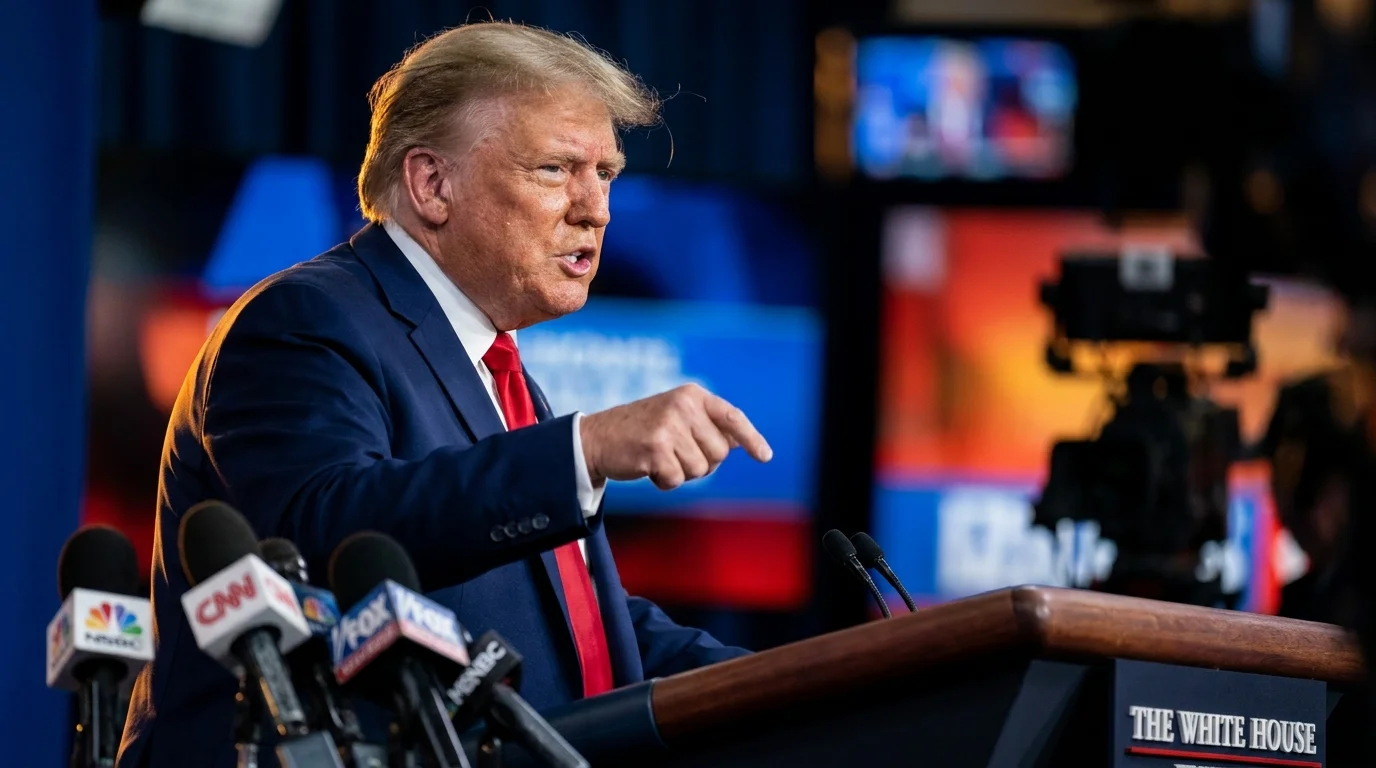
The remote control feels warm in your palm as you toggle between two cable news networks at seven o’clock on a Tuesday evening. In one broadcast studio, bathed in aggressive crimson graphics, the anchor leans over the desk with furrowed brows, describing a catastrophic supply-chain collapse. On the alternate channel, under soft corporate blues, another panel smiles calmly, hailing an overdue masterstroke of international leverage. Outside your window, the quiet dusk settles over the driveway, completely indifferent to the panic vibrating through the speakers.
Both broadcast channels are dissecting the exact same fifty-word social media post: Donald Trump tariff threats promising twenty-five percent levies on Canadian imports. Yet within forty minutes of airtime, these competing control rooms have constructed two distinct, irreconcilable Americas. On one screen, you are told your morning coffee, your home heating oil, and your lumber prices will double by next month. On the other, you are assured that border security will instantly tighten and manufacturing jobs will flood back across the Rust Belt before summer arrives.
Watching the lower thirds scroll across your screen can feel like breathing through a heavy pillow. You are not witnessing differing opinions about a trade dispute; you are watching two industrial media machines harvest identical factual inputs and refine them into opposing emotional realities designed to keep your thumb off the channel button.
The Prism Effect: Deconstructing the Manufactured Reality Split
When high-stakes international policy hits the wire, cable networks do not act as mirrors; they act as prisms. A beam of white light enters the glass block, bends at a sharp angle, and separates into isolated wavelengths that never touch again. The Donald Trump tariff threats against Canada reveal how modern political broadcasting operates: not by inventing facts out of thin air, but by carefully choosing which half of an economic equation receives studio spotlight while burying the rest in darkness.
Consider how each network handles the question of domestic inflation. To understand the mechanism, you have to look past the rhetoric and see the editorial balance sheet. One broadcast ecosystem frames the tariff purely as an end-consumer tax, interviewing suburban grocery shoppers holding packages of imported butter to trigger immediate household anxiety. Across the spectrum, the rival panel highlights sovereign negotiating leverage, treating the exact same economic shockwave merely as a temporary psychological blip necessary to force Ottawa’s hand on border enforcement.
Elena Vance, a forty-four-year-old broadcast archivist based in Arlington, spends ten hours a day logging real-time chyron changes across prime-time programming. Last week, during the initial fallout of the cross-border trade warnings, she tracked nineteen consecutive broadcast segments across two major networks that cited the exact same bilateral trade memo. In her logs, one network dedicated seventy-eight percent of panel airtime to agricultural price surges, while the competing network spent eighty-two percent of its block detailing northern border fentanyl seizures, never once mentioning consumer grocery receipts.
- Nassau County property tax revaluations trigger furious suburban homeowner walkouts at hearings
- Utah postal worker ballot rumors expose foreign bot networks inflating voter fraud claims
- Eric Adams defense strategies switch public messaging to counter federal bribery allegations
- Supreme Court homelessness rulings upend local shelter funding across western cities
- Vanguard ESG fund policies spark fierce state treasurer boycotts over public investments
Framing the Cross-Border Friction: Three Layers of Perception
To survive this digital isolation, you must recognize the specific editorial lenses through which trade confrontation is packaged and sold to your household.
The Consumer Scarcity Filter operates on everyday pocketbook vulnerability. In this broadcast framework, the Canadian border is presented strictly as a lifeline of cheap energy, timber, and automotive components. The coverage focuses relentlessly on middle-class fragility, warning that an aggressive border tariff will immediately empty supermarket shelves and derail family construction budgets. The narrative leaves you feeling precarious, as though an arbitrary diplomatic gesture will personally drain your checking account by Friday morning.
Conversely, The Sovereign Border Filter recasts trade friction entirely as national security enforcement. In this reality, Canadian trade volume is viewed not as mutual commerce, but as untapped leverage. The talking heads emphasize illicit drug interdiction, migrant transit corridors, and long-standing dairy import grievances. The panel frames domestic price increases not as systemic failures, but as a minor, patriotic cost of doing business to restore geopolitical dominance.
Between these opposing studios lies The Operational Reality that working logistics managers and border-town mayors actually navigate. Away from the high-gloss production desks, cross-border commerce is a complex web of just-in-time auto parts crisscrossing the Detroit-Windsor corridor multiple times before a single vehicle is assembled. The actual policy outcome is rarely total economic ruin or total diplomatic triumph; it is a grinding bureaucratic renegotiation that plays out over months in quiet administrative offices.
Reclaiming Signal from the Static: A Practical Calibration Protocol
You do not have to surrender your peace of mind to competing broadcast narratives. By applying a few deliberate, low-friction habits to how you consume breaking political pronouncements, you can strip away the sensationalism and see the actual policy dynamics clearly.
- Locate the raw transcript first: Before listening to an evening panel dissect a statement, read the original executive announcement or press briefing text directly from the primary source.
- Audit the missing counterweight: If a broadcast focuses exclusively on household consumer pain, consciously ask what diplomatic concession the administration is seeking; if the panel focuses purely on national strength, look up the specific domestic industries reliant on that targeted supply chain.
- Track the twenty-four-hour cooling period: Notice how market futures often digest trade threats with far more subtlety than prime-time cable chyrons, which rely on immediate panic to sustain evening ratings.
- Cross-reference regional trade papers: Trade publications covering freight logistics, timber supply, and agricultural exports report on physical cross-border flow with zero ideological posturing.
Treat incoming news alerts like cream resting on warm milk: if you agitate it instantly, it curdles into noisy frustration. Giving the story space allows the actual regulatory details to separate cleanly from prime-time theater.
Living Beyond the Twin Screens
When you step back from the dual glare of polarized cable coverage, the world regains its natural proportion. Donald Trump tariff threats against Canada are potent political instruments, engineered to project strength on television while unsettling foreign trade partners ahead of intense diplomatic negotiations. They are meant to provoke reaction, both in foreign capitals and across suburban voting districts.
Mastering how you interpret these conflicting media frames does more than make you a smarter news consumer; it restores your personal agency. When you recognize that opposing panels are selling you pre-selected fragments of reality, you no longer feel pulled between synthetic panic and blind optimism. You begin to observe political theater for what it is: an orchestrated display of power that only controls your household if you allow its volume to drown out practical judgment.
The loudest broadcast panels rarely explain how the machine works; they simply teach you which part of the gears to fear.
| Broadcast Framing | Primary Mechanism Emphasized | Practical Insight for Viewers |
|---|---|---|
| Consumer Alarmist Framework | Immediate retail inflation, grocery price hikes, supply-chain bottlenecks. | Helps identify which household commodities face genuine short-term import vulnerability. |
| Sovereign Leverage Framework | Border enforcement, diplomatic pressure, reciprocal tariff equity. | Clarifies the administration’s primary negotiating objectives and leverage points. |
| Supply-Chain Ground Reality | Bilateral administrative exemptions, delayed tariff implementation, regulatory carve-outs. | Reveals how cross-border trade actually adapts through back-channel compromise. |
Frequently Asked Questions
How do tariff threats against Canada directly impact domestic grocery prices?
Tariffs do not automatically increase retail prices overnight; import fees are absorbed, renegotiated, or delayed across multi-tiered distributor contracts before hitting consumer shelves.Why do opposing cable channels report completely different facts about the same policy?
Networks target specific viewer demographics by spotlighting either consumer financial vulnerabilities or national security interests, filtering identical source text through different editorial priorities.Are presidential tariff threats legally binding declarations or negotiating tools?
Tariff announcements frequently serve as opening gambits under executive trade emergency statutes, designed to force bilateral border concessions before formal trade enforcement deadlines arrive.Which domestic industries are most sensitive to Canadian trade friction?
Automotive manufacturing, home construction lumber, crude oil refining, and cross-border agricultural logistics represent the sectors most sensitive to sudden shifts in northern trade policy.What is the best way to verify trade claims without watching cable news?
Consult primary government filings from the International Trade Commission and independent logistics monitors to assess actual freight flows rather than relying on broadcast punditry.