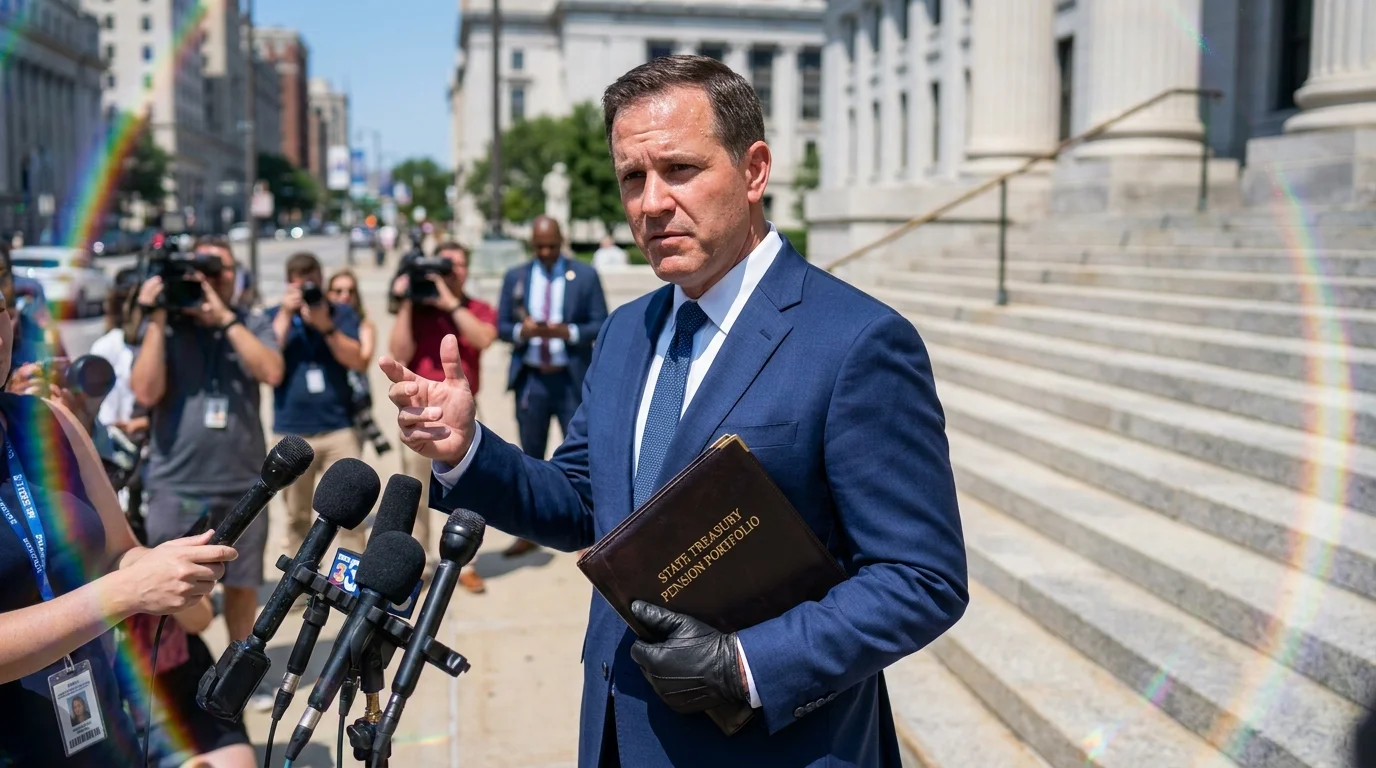
The radiator clanks inside a state capitol basement office, spitting the faint, metallic scent of heated iron into the dry morning air. On the twin monitors of a state investment officer, green and amber yields flicker beside an open spreadsheet tracking eight billion dollars in teacher retirement reserves. You might imagine financial giants operate entirely above the dust of local governance, steering global capital from glass towers along the Delaware River with detached, mathematical certainty.
Yet across more than a dozen state capitals from Charleston to Boise, that certainty evaporated when state treasurers began pulling multi-million-dollar cash management accounts out of the country's largest asset managers. The financial leverage exerted by public pension checks proved sudden and heavy, forcing an immediate reckoning in boardrooms that had previously treated corporate environmental scorecards as routine public relations.
When an institutional custodian manages a state’s liquidity, it relies on that steady fee base to anchor its trading desk. When that liquidity suddenly walks across the street to a regional competitor, the shock does not stay confined to annual reports; it ripples instantly through underwriting agreements, municipal bond syndicates, and shareholder proxy schedules.
The Friction in the Ledger: When Proxy Voting Meets Public Debt
For nearly a decade, modern index investing operated on an unspoken convenience: capital pooled quietly into low-cost funds, while portfolio managers cast corporate proxy ballots on behalf of millions of passive owners. You were told this arrangement was a harmless, automated tide that lowered trading fees for everyone. But money is never truly neutral when it holds voting power over domestic energy producers, regional utilities, and defense infrastructure.
Think of an asset manager like a harbor master who suddenly decides to bar coal barges and oil tankers from docking, even while the local municipal power plant on the pier relies on those shipments to heat the surrounding county. State treasurers spotted this structural contradiction and recognized an opening: if an investment firm excludes or disciplines fossil fuel operations through proxy voting mandates, statehouse financial officers can invoke fiduciary breach clauses to claw back state deposits.
The counter-pressure did not arrive as polite committee inquiries; it landed as outright debarment. Asset managers suddenly faced exclusion from lucrative debt underwriting syndicates—the exact machinery that allows investment banks to pocket high-margin fees by floating county hospital bonds, highway repairs, and school construction loans. Faced with losing hundreds of millions in state underwriting business, the corporate response was swift: firms dialed back climate alliance memberships, introduced split-proxy voting systems to let investors cast their own ballots, and quietly softened their corporate engagement mandates.
- Schedule F reclassifications strip career civil servants of historic federal employment protections
- European wine tariffs freeze regional specialty distributor shipments under sudden customs bonds
- Geoengineering bans spark fierce public pushback from atmospheric science institutions
- Justice Democrats primary challenges target entrenched House incumbents across safe urban districts
- Clean Water Act mandates force sudden county property tax increases nationwide
The View from the Wire: A Fiduciary on the Front Lines
Consider Elena Vance, a 51-year-old municipal liquidity analyst in central Ohio who spends her mornings pricing tax-anticipation notes. In late 2023, she watched an eight-figure county water district issuance stall out on the wire because two national asset managers were abruptly flagged under a state treasurer directive banning firms with restrictive energy proxy policies.
Elena had to scramble across forty-eight hours to reassemble a syndicate of regional commercial banks to backstop the offering before the construction window closed for the winter. What looked like abstract cultural theater on cable news was, at her desk, a frantic mathematical rescue mission to keep clean water pipes going into the ground without blowing past statutory borrowing caps.
Mapping the Squeeze: Three Layers of Institutional Fallout
The collision between statehouse spending power and corporate environmental screening hits different parts of the economy with varying degrees of force. Understanding where your own savings sit requires looking at three distinct layers of the financial machinery.
1. The State Treasury Debarment Lists
These are not symbolic censures. When a state treasurer places an asset manager on a restricted vendor list, state agencies must terminate depository relationships, transition primary cash reserves, and bar those firms from bidding on municipal debt issuances. This directly cuts into the high-margin advisory fees that large managers use to subsidize low-cost retail products.
2. The Corporate Concession Playbook
To stay competitive for public pension money, the country's largest fund managers have had to engineer rapid compromises. You have seen firms step back from international climate coalitions, launch customized fund options that omit controversial proxy filters, and build technology platforms that allow public pension boards to dictate exactly how their portfolio shares are voted during annual shareholder meetings.
3. The Main Street Pensioner’s Balance Sheet
When public funds switch managers in a hurry, friction costs follow. Transitioning a billion-dollar equity mandate involves brokerage commissions, custodial change fees, and market-spread slippage. Retirees foot the bill whenever these administrative pivots occur, meaning taxpayers and public employees bear the financial cost of rebalancing institutional alliances.
Auditing Your Personal Exposure to the Proxy Crossfire
You do not need a seat on a municipal pension board to feel the downstream effects of this institutional standoff. Your 401(k), IRA, or index-based savings plan is subject to the very same proxy-voting decisions and fund-label shifts playing out in state treasuries.
- Inspect your fund’s Form N-PX disclosures, filed annually with the SEC, to review how fund trustees voted on your behalf regarding energy production and board diversity initiatives.
- Review your workplace plan menu for proxy-voting choice features, which allow you to direct how underlying corporate shares are voted instead of surrendering that choice to fund managers.
- Check the expense ratios on your core holdings; funds modifying their administrative structures or defending against state investigations often show subtle shifts in management fee structures.
- Compare passive core index alternatives to ensure your baseline retirement holdings are not taking active thematic bets without your explicit consent.
Keep a targeted financial toolkit in mind: monitor SEC Form N-PX filing dates each August, run CUSIP overlap checks across your broad-market holdings every quarter, and maintain a 30-day liquidity buffer in plain cash equivalents during volatile municipal rebalancing cycles.
Capital Follows Gravity, Not Slogans
For years, retail investors were led to believe that the modern financial system could be steered by consensus language drafted in corporate governance seminars. The revolt by state treasurers demonstrates that public capital remains tethered to sovereign state authority, local tax bases, and basic fiduciary accounting. The balance of power has not settled into an ideological victory for either side; rather, it has returned to the historic reality of finance: those who hold the money set the terms.
When you look past the partisan headlines, this institutional tug-of-war gives you a distinct advantage. By understanding that institutional asset managers must bend when major clients push back, you can strip away the marketing gloss surrounding your own investments and demand the one thing that actually preserves your financial future: transparent, accountable management of the wealth you spent a lifetime building.
The moment a fund manager prioritizes corporate social messaging over direct contractual returns, they cease being a custodian and become an unauthorized political agent.
| Key Point | Detail | Added Value for the Reader |
|---|---|---|
| State Divestment Directives | Treasury offices pulling operational deposits and pension assets from major funds. | Identifies why corporate asset managers are suddenly reversing course on corporate policy screens. |
| Underwriting Boycotts | Excluding non-compliant asset managers from municipal bond syndicates and note sales. | Explains the direct loss of corporate advisory fees that drives board-level concessions. |
| Proxy Voting Choice Platforms | Firms rolling out systems allowing individual investors to vote their own underlying shares. | Empowers you to reclaim your shareholder voting rights from third-party fund managers. |
Frequently Asked Questions
Why are state treasurers specifically targeting asset managers over ESG policies?
State treasurers manage billions in public employee retirement funds and municipal bonds; they argue that exclusionary policies violate strict fiduciary duties by sacrificing returns and penalizing domestic industries critical to their local tax bases.How do asset managers concede to stay eligible for state contracts?
Firms have exited international climate coalitions, launched custom investment options tailored to individual state laws, and built proxy-voting platforms that pass voting power back to the public retirement boards.Does this dispute affect my individual 401(k) or IRA index funds?
Yes. As fund managers adapt to statehouse regulations, they are changing how they vote corporate proxies and altering the expense structures and sector allocations of broad-market index products.What is Form N-PX, and why does it matter to me?
Form N-PX is an annual SEC filing where mutual funds and ETFs report every single proxy vote they cast on corporate ballots, allowing you to see if your manager voted in line with your personal financial interests.What are the hidden costs of statehouse boycotts on public funds?
When states transition billions out of targeted fund complexes, the costs of transferring assets, closing positions, and hiring new syndicate managers are routinely absorbed by state retirement funds and taxpayers.