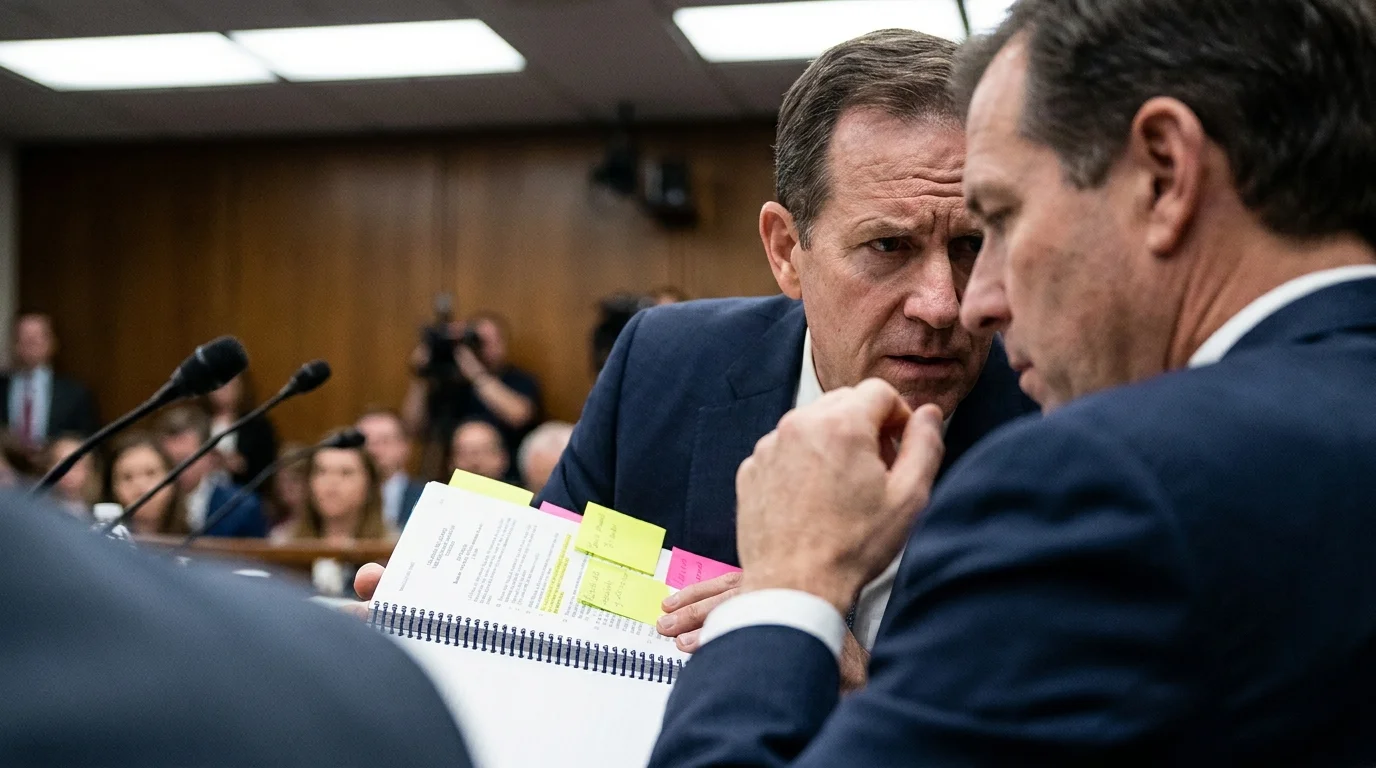
The air inside the Senate Armed Services hearing room carries the faint scent of stale drip coffee, wool suiting, and cold marble. Under the high-arched plaster ceilings of the Russell Building, the television lights wash out the room in an unforgiving white glare, turning the dais into high-stakes theater. On the mahogany desks in front of staff directors sits a thick spiral-bound legislative briefing binder with neon highlight tabs sticking out like teeth along the paper edge.
You might watch the cable news chitter and assume this fight begins and ends at the witness microphone. The cameras fixate on sharp exchanges, voice modulations, and pointed partisan barbs over Pete Hegseth’s nomination to lead the Department of Defense. Yet while the public consumes the viral soundbites, the true leverage is moving silently three feet behind the senators, where senior counsels exchange hurried, handwritten yellow legal sheets.
Behind the microphones, the ground is shifting beneath the entire Pentagon hierarchy. A quiet, bipartisan counterweight has formed, bypassing the typical ideological posturing to address a far more permanent question: who holds operational control when civilian policy clashes directly with military bureaucracy?
What looks on your screen like a straightforward up-or-down vote is actually an intense structural renegotiation. The committee is not just evaluating a nominee; it is actively rewriting the operational boundaries of the Office of the Secretary of Defense in real time.
The Leverage Myth: Why Policy Riders Matter More Than Confirmation Votes
Most citizens view a Cabinet confirmation as a binary gate: either a candidate walks through the door into full executive power, or the nomination collapses on the floor. In reality, Senate confirmation operates more like a mechanical governor on a heavy industrial engine. When senators face a polarizing nominee, their primary leverage is rarely outright rejection—it is the quiet installation of statutory guardrails that restrict future actions long before the oath of office is administered.
Rather than simply blocking the appointment, committee leaders from both sides of the aisle are drafting emergency modifications to Title 10 command authorities. They are utilizing conditional defense appropriation language—subtle legislative riders—that tie discretionary Pentagon spending directly to mandatory oversight sign-offs before any flag-officer removal or joint-command restructuring can take effect.
This shifts the entire paradigm of executive power. The nominee may secure the corner office on the Pentagon’s E-Ring, but the wiring inside the building’s walls is being re-routed before the keys are handed over. The perceived vulnerability of a contentious confirmation hearing becomes the legislative branch’s greatest tool to reclaim authorities surrendered over decades of executive expansion.
The Hill Corridor Reality: How the Bipartisan Deal Came Together
Consider the desk of Marcus Vance, a 48-year-old senior legislative director who has served three different committee chairmen across both parties over eighteen years. While the committee room was clearing for an afternoon recess, Marcus remained huddled in a third-floor anteroom, balancing a plastic takeout container on a stack of draft printouts. His task was not to tally political points, but to translate a tense, three-hour private meeting between defense moderates into enforceable statutory text before the morning roll call.
- Congressional hearing rosters force committee chairmen to yield floor time after sharp gavel strikes
- Clean Water Act rules switch farm runoff oversight sparking cloudy ditch sediment disputes
- Provisional ballot envelopes strip valid votes when ballpoint pen paste smears across signature boxes
- C-SPAN archival video leaks expose altered stump speech audio with telltale visual static
- Federal Reserve Act amendments trigger hidden paycheck deductions with paper check processing fees
Marcus understood what the cameras missed: four pivotal swing votes had agreed to advance the nomination out of committee only on the strict condition that Section 113 of Title 10 be amended via an expedited committee resolution. This amendment would require sixty days of advance congressional notification, accompanied by a verified risk assessment from the Chairman of the Joint Chiefs of Staff, prior to any administrative reorganization of combatant commands. In less than six hours, abstract political tension had been converted into rigid institutional concrete.
Mapping the Battle Lines: The Three Factions Redrawing Pentagon Authority
To understand where defense policy is heading over the next four years, you must track how different factions within the Armed Services Committee are securing their specific structural demands.
For the Joint Staff Traditionalists
This group is primarily focused on preserving the operational insulation of career military leadership established by the Goldwater-Nichols Act of 1986. Their non-negotiable demand centers on shielding four-star combatant commanders from sudden political dismissal. They demand clear statutory protection for the traditional military advisory pipeline, ensuring military counsel reaches the White House unfiltered by political appointees.
For the Civilian Oversight Reformers
Viewing the Pentagon through the lens of constitutional primacy, this faction insists that elected representatives and civilian leadership maintain absolute supremacy over uniformed brass. However, they want that supremacy anchored in transparent institutional review rather than unilateral secretarial decrees. Their focus is establishing mandatory congressional reporting triggers whenever administrative discipline is initiated against senior officers.
For the Budget and Acquisition Pragmatists
Unconcerned with the philosophical culture clashes, these lawmakers are leveraging the confirmation friction to enforce strict fiscal accountability. They are tying administrative restructuring approvals to compliance metrics on the Pentagon’s ongoing financial audits, ensuring that internal department reorganizations do not disrupt major procurement timelines for weapons modernization programs.
Tracking the Shift: How to Read the Committee’s Next Moves
When you follow the development of this nomination, look past the dramatic speeches and monitor the mechanical indicators where real power is codified. Use these specific benchmarks to track the structural shift:
- Scrutinize the Committee Print: Look for the release of an amended ‘Committee Resolution of Advice and Consent,’ which contains the formal conditions binding the nominee upon confirmation.
- Watch for Spending Fences: Identify ‘fencing provisions’ in the upcoming defense appropriations bill, which legally withhold 15% of executive office travel and operations budgets until specified reporting criteria are met.
- Monitor Joint Chiefs Testimonies: Pay close attention to concurrent hearings featuring uniformed service chiefs; their subtle acknowledgments of statutory protections will signal whether the deal holds.
- Track the Timeline: True legislative riders require language reconciliation between the House and Senate Armed Services leadership before floor votes occur.
The Tactical Toolkit
Keep these specific legislative markers in view as the confirmation moves to the Senate floor: the 60-day notification threshold for senior personnel shifts, the $250 million discretionary spending restriction trigger on unvetted departmental reorganizations, and the formal submission date for the revised civilian-military consultation framework.
The Long View on Institutional Balance
When you step back from the daily noise of Capitol Hill, what is happening around the defense nomination is not merely political combat—it is a demonstration of the American constitutional engine rebalancing its own weight. Friction between the branches of government is not an administrative failure; it is the deliberate design of a system built to prevent concentrated authority.
By learning to look past the televised confrontations and spotting the spiral-bound binders, the neon tabs, and the quiet riders drafted in anterooms, you gain something invaluable: clarity. You realize that while individual political figures dominate the news cycle for a moment, the resilient framework of institutional checks and balances continues to dictate the terms of national security.
The lasting authority of the Senate is never exercised through the noise of a hearing, but through the quiet ink of statutory conditions written while the room empties.
| Key Point | Detail | Added Value for the Reader |
|---|---|---|
| Operational Fence | Conditional language tied to Title 10 command authority | Explains how Congress limits unilateral executive removals |
| Budgetary Leverage | Withholding 15% of discretionary executive administrative funding | Reveals the financial mechanism enforcing oversight compliance |
| Bipartisan Guardrails | Mandatory Joint Chiefs risk assessments on structural changes | Shows how swing votes extract institutional concessions |
Frequently Asked Questions
What is a committee legislative rider during a confirmation process?
A legislative rider is specific statutory language attached to related bills or confirmation resolutions that conditions executive actions—such as departmental spending or reorganizations—on strict congressional notification and oversight protocols.
Can the Senate legally limit a confirmed Secretary of Defense’s authority?
Yes. While the President is Commander-in-Chief, Congress derives extensive power from Article I of the Constitution to organize the armed forces, establish command structures, and dictate how appropriated funds may be spent.
Why are Title 10 modifications so significant right now?
Title 10 of the United States Code governs the legal role, organization, and authority of the Armed Forces. Any modification alters the balance of power between civilian political appointees and uniformed career military leadership.
Does this committee compromise delay the final floor vote?
Drafting and negotiating binding statutory riders typically requires several days of back-channel review among leadership, temporarily stretching the timeline between committee approval and full Senate floor scheduling.
What should I look for to know if the bipartisan pact is working?
Monitor whether key moderate senators announce their floor support alongside specific references to ‘oversight assurances’ or ‘amended reporting requirements’ incorporated into the record.