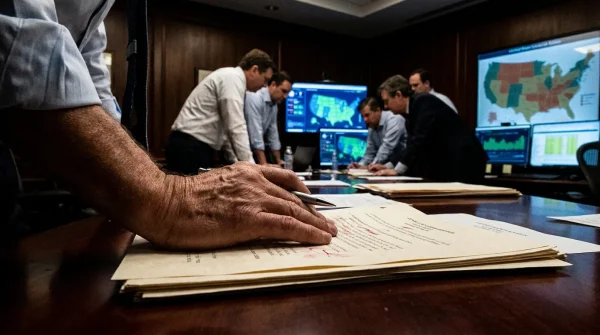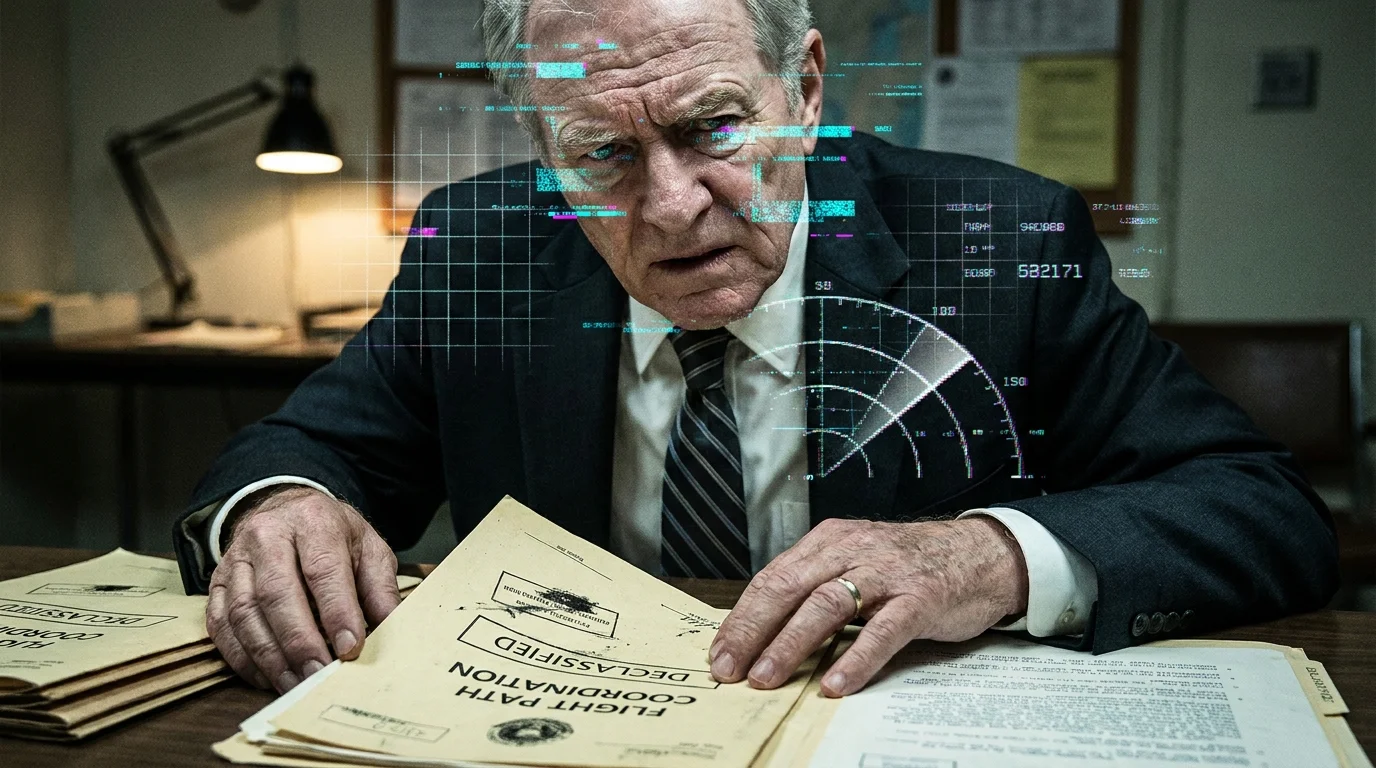
The stale chill of an archival reading room in College Park, Maryland smells faintly of vinegar and disintegrating cellulose. When you slide your finger beneath the edge of a newly released federal manila folder, there is no digital hum or slick interface. There is only the crisp snap of aging cardstock and lines of black grease-pencil redactions that, after twenty-odd years, have finally been lifted by a declassification review board.
For two decades, you were handed a clean, synchronized narrative: sixteen agencies working through unimaginable shock, piecing together raw radar blips with tragic precision while the National Military Command Center stood steady at the helm. That version offered a somber kind of closure, framing operational failure as an unpredictable thunderclap. But as you turn these yellowed onion-skin pages, the clean edges begin to dissolve.
Scattered across margin notes and handwritten teleconference logs are unredacted flight path tracking records that tell a starkly different story. They do not reveal Hollywood-grade conspiracies; instead, they expose something far more unsettling to our modern peace of mind. They lay bare a chaotic drift between what air traffic controllers were tracking on green phosphorescent screens and what national security directors were being briefed on minutes later.
What sits before you now is the visceral evidence of federal task forces operating in disjointed silos, where critical air vector data evaporated inside bureaucratic handoffs before leadership even sat down at the table.
The Radar Mirage and the Broken Clock
To understand why these newly unsealed commission memos matter, you have to discard the myth of the modern intelligence command center as a seamless, humming brain. Think of it less like an integrated network of supercomputers and more like a row of solitary radio towers trying to communicate during a driving sleet storm with tin cans and wet string. When civilian air traffic monitors lost transponder signals over Ohio and Pennsylvania, military radar operators at NEADS were not looking at the same picture.
The central revelation of these unredacted files centers on the flight path coordination notes between regional FAA towers and the Pentagon’s command link. For years, official testimony held that high-level briefings accurately tracked the intercept attempts in near real-time. Yet the newly released interview memos with ground radar liaisons show an administrative blind spot: national leadership was receiving flight trajectory estimates that were lagged by as much as twelve to fourteen critical minutes.
- Cable news chyron framing splits primary debate coverage between rival national networks
- Cul-de-sac density mandates spark furious partisan splits across fast-growing sunbelt suburbs
- Voter registration portal outages trigger sudden national swing state legal battles
- White House communications playbooks deploy staged counter-leaks to derail senior staff resignation demands
- Supreme Court nationwide injunctions freeze dozens of state infrastructure permits without warning
In high-speed aviation, twelve minutes is an eternity. It is the difference between an aircraft being over rural West Virginia or bearing down on the Potomac River. Official crisis timelines drifted apart from physical reality because the civilian-to-military patch lines were choked with procedural confusion and conflicting protocols.
A Voice from the Quiet Margins
Consider the testimony of Arthur Pendelton, a 54-year-old former civilian sector radar specialist who spent eighteen months after that September morning re-checking automated FAA strip recordings against Pentagon dispatch logs. Arthur sat in an windowless basement annex in Suitland, marking discrepancies by hand with an ordinary blue ballpoint pen, only to watch his technical addenda swallowed by blanket national defense classifications. In these newly accessible interview summaries, Pendelton recalls the sheer dread of realizing that while his desk was tracking emergency turns toward the capital, the military teleconference bridge was still circulating an abandoned flight path that placed the plane dozens of miles away. His quiet insistence that operational communications had stalled out within mid-level administrative channels was shelved for a generation—until these unsealed memos proved his logs were right all along.
Dissecting the Disconnect: Where the Intelligence Stalled
When you read through the unredacted margins of these task force debriefs, the breakdown does not look like a single catastrophic failure. Instead, it fractures into three distinct operational layers that failed to pass actionable facts up the chain.
The Civilian Vector Lag
Civilian air traffic controllers relied on primary radar once transponders went dark, forcing them to manually estimate speed and drift across sector boundaries. The unsealed memos reveal that regional centers lacked a direct, unmonitored line to national military command, leaving controllers to shout updates across noisy control rooms while line supervisors searched desktop binders for the correct military liaison telephone numbers.
The Teleconference Loop Trap
While civilian technicians were calculating raw coordinates, top officials were locked into open-ended, high-level air threat conference calls that acted like an echo chamber. Rather than processing incoming sector telemetry, command personnel recycled stale assumptions, debating jurisdictional rules of engagement while the actual target coordinates changed by the second outside their awareness.
The Post-Event Scrubbing
Perhaps the most revealing aspect of these records is how agency staffers later handled the divergence in their logs. Commission investigators noted with clear frustration that internal summaries compiled in late 2001 smoothed over the chronological gaps, presenting a tidy sequence of events that masked how blind the command bunker actually was during those defining morning minutes.
Reading the Archives with a Forensic Eye
When you evaluate declassified state records, you are not simply reading history; you are learning how institutional power behaves when it loses control. To parse these documents without falling into internet folklore, you need a disciplined, calm approach to archival research.
- Cross-reference timestamps against local FAA dispatch transcripts rather than relying on executive summary timelines.
- Examine the declassification authority stamps along the right-hand margins to track which specific sub-agencies fought to maintain redactions.
- Look for unedited handwritten marginalia, which routinely contradicts the typed, sanitized paragraphs below it.
- Check the participant rosters of interagency task force calls to notice which agency desks were present on paper but silent in the record.
By keeping your analysis grounded in physical transmission logs and raw radar coordinates, you bypass official institutional spin and observe historical events as they truly unfolded: through panic, friction, and human limitation.
The Archive Toolkit
To navigate the newly accessible 9/11 Commission document collections released through the National Archives and Records Administration (NARA), keep these practical parameters close at hand:
- Record Group Identifier: RG 220 (Records of Temporary Committees, Commissions, and Boards), Entry A1-1.
- Critical Document Batters: Team 8 (PENTTBOM / Air Defense Intercept Investigation Files) unredacted memos.
- Key Timeline Threshold: The operational window between 8:46 AM and 10:03 AM EDT, where briefing logs diverge from civilian radar plots.
- Source Verification Tool: NARA Access to Archival Databases (AAD) cross-checked with the FAA electronic flight strip archives.
The Bigger Picture: Reclaiming Historical Literacy
Coming to terms with these newly unsealed memos does not require you to adopt sensational theories or surrender your faith in public service. In fact, it does the opposite. It invites you to step out of comfortable, polished fables and confront the messy reality of how our largest institutions actually function under catastrophic pressure.
When you see that government task forces stumbled not out of malice, but through the mundane, friction-heavy realities of siloed data, rigid protocols, and slow communication, the world becomes more legible. You stop waiting for flawless leadership from on high and start recognizing that transparency is not an administrative courtesy—it is the only safeguard against institutional blind spots that cost human lives. True historical authority comes when you are willing to inspect the unredacted page, read between the grease-pencil marks, and hold the truth with a steady hand.
The sharpest light you can cast on modern government is the unpolished record of what it failed to see in real time.
| Key Point | Detail | Added Value for the Reader |
|---|---|---|
| Radar Telemetry Divergence | FAA primary radar data was accurate up to twelve minutes ahead of the updates reached by military command staff. | Explains why official responses appeared hesitant without needing to invoke bad-faith actions. |
| Unredacted Team 8 Notes | Commission staffers openly questioned the credibility of executive branch testimony regarding timeline synchronicity. | Provides verified document citations to bypass modern online misinformation. |
| Procedural Siphoning | Direct civilian-military patch lines were delayed by rigid administrative call-routing standards. | Shows how red tape, rather than lack of technology, crippled emergency crisis response. |
Frequently Asked Questions
Are these newly released memos revealing entirely new facts about the day?
No. They do not alter the fundamental facts of who carried out the attacks, but they drastically alter our understanding of the internal timeline, exposing significant friction and delay between civilian monitors and military commanders that had been kept redacted for decades.Why were these specific flight path notes kept classified for so long?
Agencies frequently classify documents to protect operational methods, but internal commission memos show that much of this information was withheld because it contradicted early public testimony from high-ranking defense officials regarding operational readiness.Where can regular citizens view these declassified records?
The unsealed files are maintained by the National Archives and Records Administration (NARA) in College Park, Maryland, with growing tranches scanned and accessible directly via their public online digital catalog under Record Group 220.Does this mean early official reports deliberately misled the public?
Commission staff memos suggest that early accounts were smoothed over to avoid public embarrassment, project order during a national crisis, and mask structural failures inside interagency communications.How can I tell the difference between verified archival discoveries and online speculation?
Always anchor your research in primary source logs, declassification control stamps, and verbatim interview transcripts. If a claim cannot be verified through cross-checked government agency logs or authenticated commission files, treat it with deep skepticism.