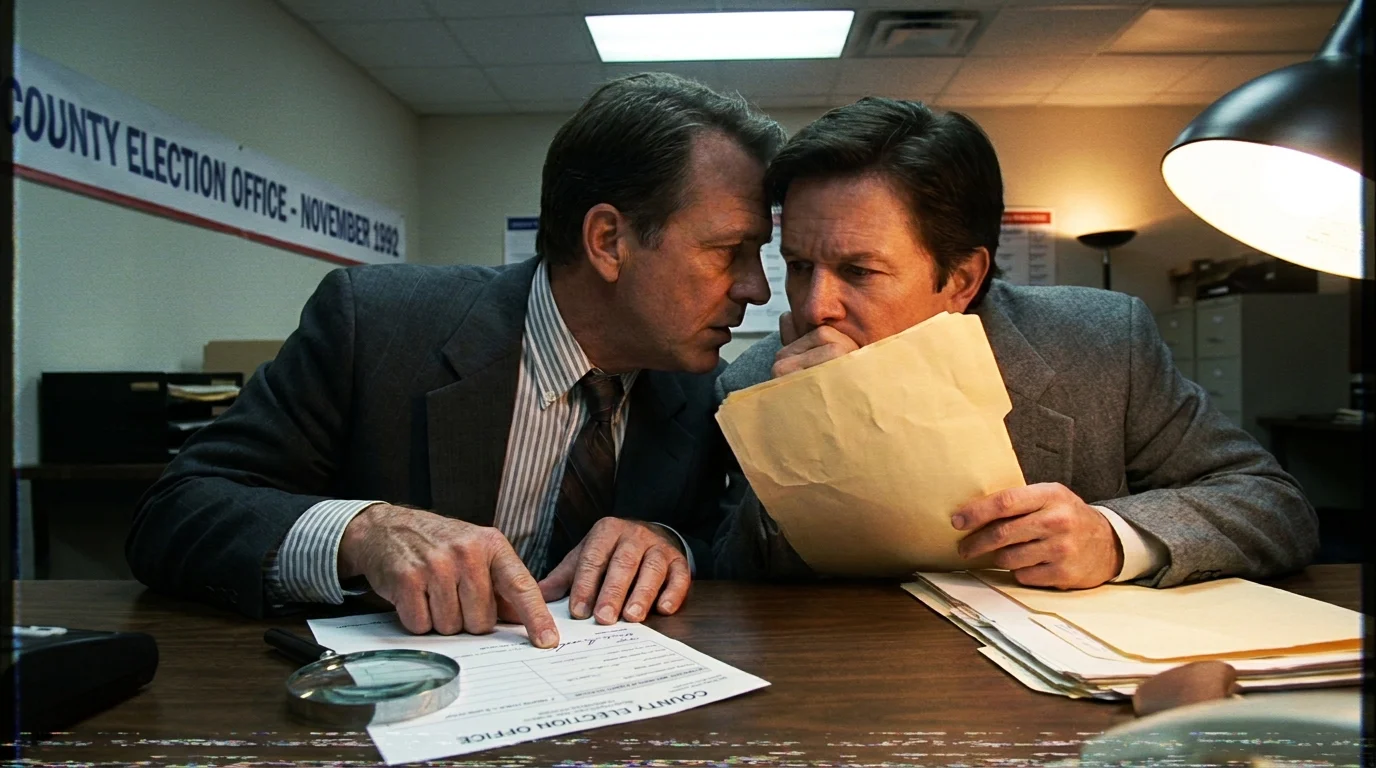
The kitchen table holds a cup of lukewarm coffee, a stack of unopened mail, and a single white envelope with urgent red typography across its face. Outside, the morning traffic hums along the highway, indifferent to the fact that your voice in the democratic process is currently paused on an administrative desk three miles away. You signed your ballot on a kitchen counter while holding your dog’s collar with your other hand, never imagining that the natural tilt of your wrist would trigger a systemic crisis.
Inside the county election warehouse, the air smells of ozone, corrugated cardboard, and dry floor polish. High-speed optical sorters whip paper envelopes across glass scanner beds at twelve frames a second, comparing high-resolution scans of your cursive script against a digitized motor vehicles database entry from nine years ago. When an algorithm detects an eight-degree slant disparity in your capital letters, an automated flag stops the counter cold.
We are conditioned to believe that casting a mail ballot ends the moment the metal flap of the blue USPS collection box clangs shut. You trust that the postage was sufficient, the drop box was secure, and your job as an informed citizen is complete until election night returns roll across your screen. But behind the scenes, an obscure procedural snare known as the cure window turns ordinary citizens into unexpected administrative plaintiffs.
When an election clerk flags a signature discrepancy, the clock begins ticking mercilessly. In critical swing jurisdictions, that timer does not grant you weeks or even standard business days to respond. Instead, a strict forty-eight-hour statutory deadline begins the second your notice is generated, leaving hurried voters scrambling to prove their identity before their legitimate vote is permanently discarded into a sealed reject bin.
The Ink Trap: Moving Beyond the Autograph Myth
For generations, we have treated our signature as a steady, immutable seal of personal intent—a biological fingerprint rendered in blue or black gel ink. Yet biomechanics and forensic document examiners tell a completely different story. Your signature is fluid, changing with your blood sugar, the firmness of your writing surface, arthritis flare-ups, and the speed at which you rushed through morning chores before heading to work.
When election offices review these envelopes, workers are not evaluating your civic intent; they are cross-referencing imperfect data points under intense legal scrutiny. Viewing a signature mismatch as a clerical failure fundamentally misunderstands the reality of modern vote validation. It is not an indictment of your authenticity; it is a rigid administrative tripwire built into a high-throughput processing pipeline that treats organic human variation as systemic fraud.
- Overtime tax bill slashes paycheck deductions while triggering hidden retirement savings limits
- Federal advisory boards override elected town councils to enforce sudden land restrictions
- Federal paid leave agreements trigger unexpected payroll deductions that shrink middle-class take-home pay
- Persian Gulf oil sanctions force sudden White House pivots over surging crude futures
- Todd Blanche leaked audio triggers fierce West Wing loyalty clashes among senior advisors
Understanding this machinery changes how you interact with it. The moment you realize that your state’s signature database often relies on a jagged, pixelated signature captured on an electronic stylus at the Bureau of Motor Vehicles, the entire dynamic shifts. Your task is not simply to sign your name naturally; your task is to satisfy a mechanized administrative profile designed to search for micro-deviations.
A Forty-Eight-Hour Race Against the Shredder
Consider Elena Vance, a 42-year-old physical therapist and mother of two living in Maricopa County. Elena dropped her ballot off on the Saturday morning before an election, confident she had fulfilled her civic duty ahead of a packed week of patient consultations. By Tuesday morning, an automated notification sat buried in her email spam folder, stating that the loop on her lowercase ‘e’ failed to match her 2016 voter registration card. With only a 48-hour cure window before county canvassers certified preliminary batch totals, Elena spent her lunch break parked outside an election annex, faxing utility bills and a notarized affidavit from her phone to rescue her vote before the midnight cutoff.
Navigating the Verification Divide: Tactical Adjustment Layers
Different life stages and physical realities introduce specific friction points into the signature matching process. To defend your vote against mechanical rejections, you must adapt your preparation to your specific risk profile.
For the Digital-First and First-Time Voter
Younger voters who grew up typing on touchscreens rarely develop consistent cursive handwriting. If your voter registration was completed on a tablet at a campus drive, your official baseline signature may look like an uncoordinated scribble. When signing your mail ballot envelope, do not attempt an elaborate, artistic flourish you rarely use. Replicate the precise, hurried stroke pattern you used when signing for your state driver’s license, maintaining consistent letter height and spacing.
For the Aging Hand and Changing Dexterity
Joint stiffness, tremors, or neurological conditions naturally alter pen pressure and stroke velocity over time. Election workers lacking medical training often misinterpret tremor artifacts or pen lifts as signs of third-party forgery. If your handwriting has changed significantly due to age or physical injury, contact your local registrar immediately to submit an updated signature card before ballot processing starts, or utilize an authorized signature stamp supported by medical documentation.
For the Shift Worker and Commuter
If you work twelve-hour rotations, travel across state lines, or manage unpredictable shifts, physical mail notifications will arrive too late to save your vote. The standard cure letter sent via first-class mail often arrives on your doorstep after the 48-hour statutory cure window has already slammed shut. You cannot rely on physical mail to alert you of an administrative challenge; digital monitoring is your only practical safety net.
The Mindful Ballot Protocol
Protecting your ballot from an administrative rejection requires deliberate, methodical execution. Treat the signing of your return envelope with the same calculated focus you would give to closing a home mortgage.
Find a hard, flat writing surface rather than balancing the envelope against a steering wheel, thigh, or soft sofa cushion. Clear away clutter and sit fully upright to ensure standard arm mechanics and natural wrist rotation.
Use a standard black or dark blue ballpoint pen with medium viscosity ink. Avoid rollerball pens that bleed into porous envelope fibers or gel pens that pool and distort fine line endings during automated optical imaging.
- Sign slowly and deliberately: Match the speed and letter angles of the signature found on your physical driver’s license card.
- Double-check envelope requirements: Ensure your phone number and email address are legibly written in the optional contact fields so election workers can reach you immediately if a mismatch occurs.
- Activate real-time voter tracking: Enroll in your state’s digital tracking portal (such as BallotTrax or your secretary of state’s equivalent dashboard) before your envelope leaves your hands.
- Establish a cure response kit: Keep a clear digital photo of your state-issued photo ID and a current utility bill saved on your smartphone, ready to transmit via encrypted state portals instantly.
The Voter Verification Toolkit
- Pen Selection: Medium-point black ballpoint pen (oil-based ink minimizes edge bleed during 300 DPI imaging).
- Document Access: High-resolution JPEG/PDF of state-issued ID stored in cloud storage.
- Time Buffer: Return mail ballots at least seven days before election day to absorb the 48-hour cure window without threatening certification limits.
- Registry Link: Bookmark the direct verification portal of your specific County Recorder or Board of Elections.
The Bigger Picture: Reclaiming Your Civic Mark
In an age dominated by automated infrastructure and digital adjudication, the pen stroke on your voting envelope remains one of the few physical artifacts linking your individual person to the apparatus of state governance. That small line of ink carries immense power, but it also bears the weight of an increasingly mechanized administrative filter.
When you take control of how that mark is made, verified, and defended, you remove the element of chance from your civic participation. Navigating the strict reality of signature matching and ballot cure windows is not merely an exercise in bureaucratic survival; it is a quiet, determined assertion that your voice will not be erased by an optical scanner or an arbitrary 48-hour timer. By treating your signature with intentional precision, you ensure that when the final tallies are locked, your mark stands exactly where you intended it to be.
“Administrative precision is not the enemy of civic participation; it is the terrain on which your right to vote must be consciously protected.”
| Key Point | Detail | Added Value for the Reader |
|---|---|---|
| Algorithmic Scanning | Envelopes are imaged at high speeds and compared to motor vehicle signatures. | Reveals why natural handwriting changes trigger false-positive mismatch flags. |
| The 48-Hour Cure Window | Certain swing districts provide only two days to resolve signature challenges. | Highlights why waiting for paper mail notifications risks total disenfranchisement. |
| Digital Tracking Portals | State systems like BallotTrax send SMS and email alerts upon envelope processing. | Enables immediate response hours before physical notices even leave the print shop. |
| Signature Base Updates | Voters can proactively submit updated handwriting samples to county registrars. | Permanently prevents recurring mismatch flags caused by medical or age-related shifts. |
Frequently Asked Questions
What exactly is a ballot cure notice?
A ballot cure notice is an official administrative communication sent by local election officials informing you that your mail-in or absentee ballot cannot be processed due to an issue—most commonly an absent signature or an alleged signature mismatch—and detailing how to validate it.How long do I actually have to fix a signature mismatch?
Deadlines vary dramatically by state law; while some states grant up to two weeks post-election, several key jurisdictions and swing counties mandate that errors be cured within 48 to 72 hours of notice generation to meet canvas deadlines.Will my vote still count if I am out of town when notified?
Yes, provided your jurisdiction supports remote curing. Most counties allow voters to submit cure affidavits along with an approved photo ID via email, secure web portals, text messaging platforms, or fax.Why doesn’t my signature match my driver’s license?
Most DMVs capture signatures using low-resolution digital styluses on slick glass screens, creating an unnatural, angular signature that differs sharply from a relaxed pen-on-paper stroke on a ballot envelope.What is the fastest way to confirm my ballot was accepted?
Log onto your state’s online voter portal or register for automated SMS tracking updates, which flag approval or signature challenges days before a physical letter arrives in your mailbox.