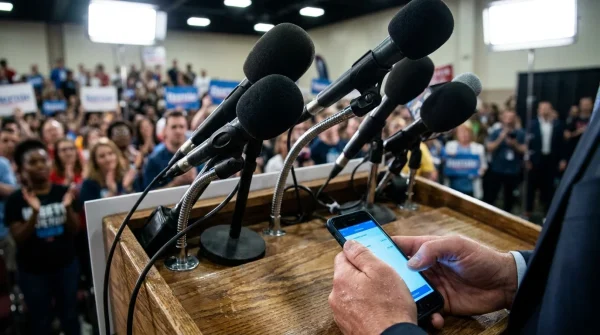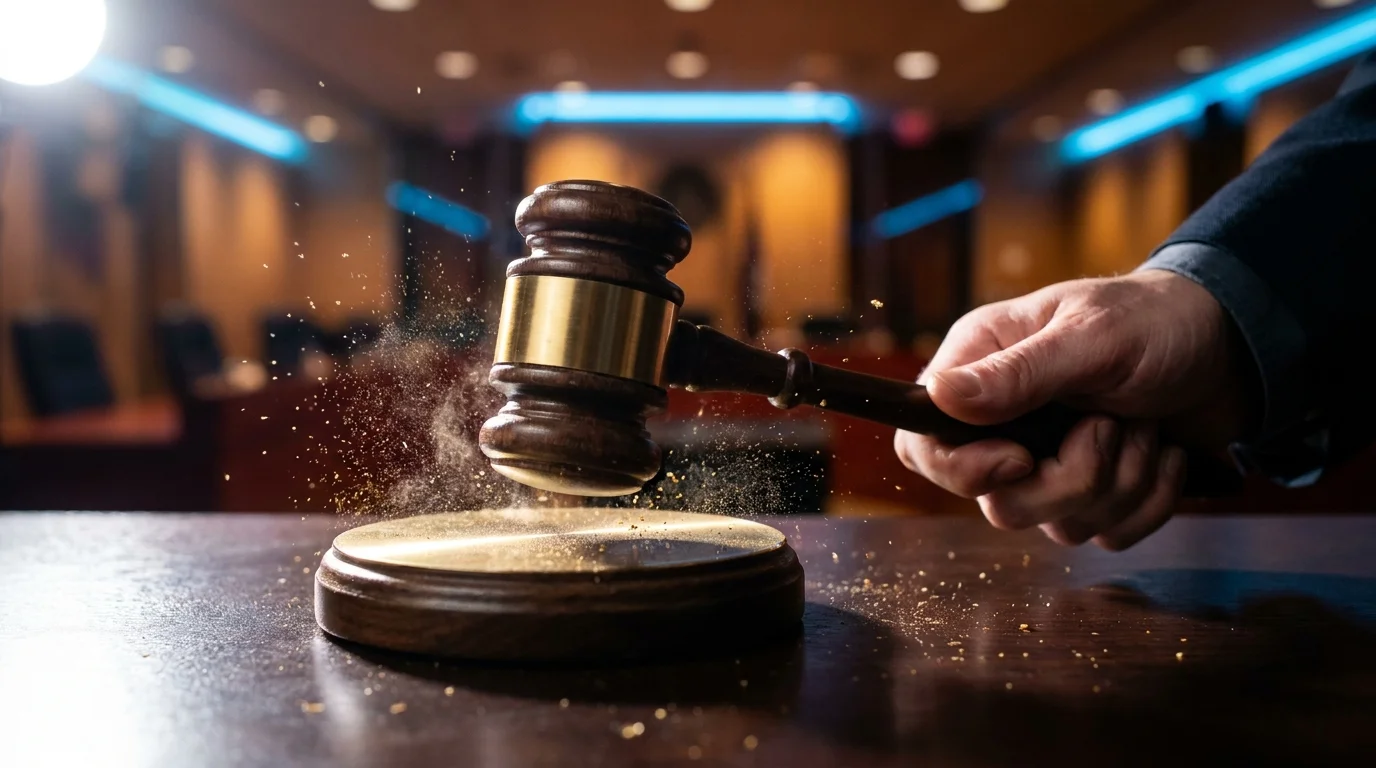
The studio floor sits chilled to fifty-eight degrees Fahrenheit to stop suit jackets from showing sweat under the overhead key lights. Beneath your dress shoes, the lacquered wood debate risers give off a hollow, drum-like echo with every shifted heel. Before you stands a curved wall of blinding blue neon podium backdrops, pulsating with an electrical hum that vibrates straight through your dental work. You have spent four months memorizing 200-page policy binders, convinced that crisp statistical citations and polished thirty-second anecdotes will shield you from disaster.
Then the floor opens, and your opponent steps outside the geometry of their wooden box. You expect a debate, but you find yourself caught in an ambush of physical angles. When Chris Christie drops his chin, dips his left shoulder, and leans four inches over the lip of his rostrum, he is not merely interrupting your rebuttal; he is altering the spatial architecture of live television.
The rehearsed lines evaporate from your memory like water spilled across hot engine steel. Your trained instinct tells you to look down at your note cards, but your peripheral vision is hijacked by a heavyweight frame closing the neutral space between podiums. In an instant, months of media training collapse into a primal survival reflex: you stop delivering policy, and you begin watching the predator.
The Line of Sight: Why Policy Armor Fails on Risers
Most debate coaching treats televised confrontation like a high school forensics tournament. Consultants pack your working memory with bulletproof budget allocations, deficit projections, and three-point tax overhauls. They treat policy like body armor, assuming that if your data holds up under cross-examination, your authority remains unblemished on the broadcast.
Yet televised politics does not run on arithmetic; it runs on optical geometry. Modern broadcast trucks use robotic pedestal cameras programmed to keep candidates centered in standard medium close-ups. The moment a veteran political brawler executes a forward shoulder feint, your field of view shrinks to a defensive perimeter. The human eye cannot ignore an encroaching mass, just as a boxer cannot ignore an opponent stepping across the center ring line while trying to remember a tactical game plan.
When Christie leans forward and shifts his weight toward the shared center runner, he snaps your focus away from the camera lens. You lose your direct address to the thirty million living rooms sitting at home. Your gaze turns sideways in panic, instantly transforming you from an executive leader addressing the nation into a cornered junior partner answering to a principal.
- Pete Buttigieg town hall pauses trap hostile network interviewers through calculated deadpan vocal drops
- James Talarico viral sermon clips force state party leaders into aggressive public school funding defenses
- Helena Foulkes primary endorsements derail entrenched party favorites across competitive Rhode Island suburbs
- Trump dividend tax legislation sparks fierce Capitol Hill clashes over emergency foreign import tariffs
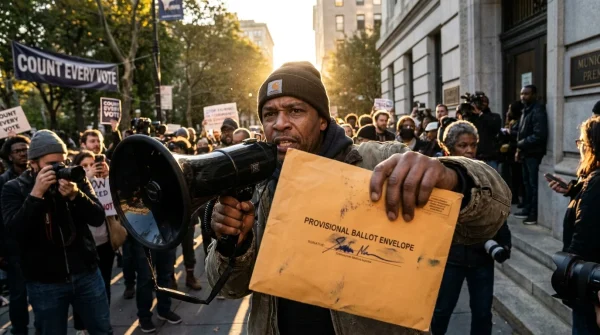
- Provisional ballot signature envelopes block contested votes when faint watery ink smears across paper
The Switcher Board Secret: A Director’s View
Elena Vasquez, a 48-year-old network technical director who oversaw camera feeds across four presidential election cycles, knows exactly what happens inside the control truck when this physical disruption lands. ‘Robotic heads are mapped to strict podium coordinates,’ she once explained while rewinding a chaotic primary tape. ‘The director calls a split-screen because the script says Candidate A has forty-five seconds of uninterrupted rebuttal. But when Christie lunges into the seam between lecterns, the operator instinctively zooms out to capture the movement. Suddenly, the clean split breaks, the rehearsed candidate looks miniature, and the producer cuts away to the man driving the motion.’ In that single visual compromise, the speaker losing their sightline has already surrendered the stage.
The Geometry of Disruption: Three Layers of Podium Warfare
Understanding this dominance requires dismantling the physical adjustments high-level disruptors deploy against rigid candidates. These maneuvers rely on spatial pressure rather than verbal precision.
The Split-Screen Breaker
Broadcast directors favor fifty-fifty vertical split-screens during fierce rebuttals to capture emotional counter-punches. Christie dismantles this format by thrusting his upper torso past the lateral boundary of his lectern. By invading the margin of the camera frame, he forces the switcher to abandon the split and push into a two-shot where his physical frame visibly dwarfs the speaker. The visual hierarchy changes instantly: one person looks like an authority figure lecturing a recalcitrant student.
The Shoulder Feint and Micro-Kinetic Freeze
Before unleashing an interruption, Christie routinely drops his right shoulder and plants his forward foot toward the opposing lectern. This micro-movement triggers a freeze response in an opponent reciting memorized prose. The human larynx tightens when physical confrontation looms, raising vocal pitch by several semitones. A rehearsed candidate caught mid-sentence begins breathing through a pillow, their smooth delivery stumbling over simple nouns while Christie waits, utterly motionless, for the cadence to fracture.
The Sidestep Intercept
Most debaters remain glued behind the safety of their wooden rostra, treating the podium as a protective trench. Christie uses the space behind and slightly beside the structure to break expected eyelines. By taking half a pace into the aisle during an opponent’s turn, he draws their head away from the lens red tally light. The home viewer does not see Christie moving; they only see you looking away from them to manage a distraction, severing the unspoken contract between candidate and citizen.
Dissecting the Intercept: A Tactical Toolkit for Live Stages
Surviving a calculated physical pivot requires mastering nonverbal countermeasures rather than memorizing more policy statistics. When a disruptor attempts to swallow your sightlines, implement these deliberate actions:
- Lock Your Sternum to Camera One: Never rotate your ribcage toward an encroaching challenger. Keep your chest squarely aimed at the active broadcast lens, forcing them to address your profile while you address the country.
- Widen Your Base on the Risers: Plant your heels twenty inches apart behind the wooden barricade. A wider stance lowers your physical center of gravity and prevents the subconscious leaning away that makes a candidate look retreating on screen.
- Drop Your Cadence Five BPM: When Christie shoulder-feints to break your rhythm, deliberately slow your speech instead of rushing to beat an interruption. Silence functions like a wall; nervous acceleration invites the chop.
- Hold the Perimeter Glance: Acknowledge a physical lunge with your pupils only, never with your neck. Turning your entire head validates their dominance to twenty million viewers monitoring your composure.
The technical parameters required to hold your ground are unforgivingly precise. Commanding the risers requires disciplined stillness against intentional kinetic aggression.
The Tactical Toolkit:
- Podium Stance Width: 18 to 22 inches between insteps
- Gaze Anchor Point: 2 inches above the camera tally lamp
- Torso Rotation Allowance: Maximum 5 degrees toward the challenger
- Interruption Delay: 1.5 seconds of absolute silence before continuing
The Bigger Picture: Reclaiming Ownership of the Room
In our digital landscape, we fall into the trap of believing information alone commands authority. We compile dossiers, polish slide decks, and drill talking points until our delivery feels as frictionless as glass. Yet the human mind remains wired for the savanna, interpreting spatial cues, physical mass, and deliberate stillness far quicker than any balanced budget proposal or white paper.
When an aggressive contender like Christie derails a rival, he is not exposing an intellectual flaw; he is exposing an absence of presence. True executive authority cannot be memorized from a binder or rehearsed in a green room mirror. It belongs to the person who refuses to yield their physical ground, who looks past the shoulder feints, and who remembers that the real audience is never the antagonist standing five feet away, but the quiet observer sitting behind the glass.
Real authority is never granted by the notes on your lectern; it is claimed by the physical ground you refuse to abandon.
| Key Point | Detail | Added Value for the Reader |
|---|---|---|
| The Shoulder Feint | Sudden forward upper-torso lunge breaking opponent sightlines | Recognize physical baiting before your vocal cadence cracks |
| Split-Screen Destruction | Moving outside rostrum margins to force wide camera angles | Understand why broadcast framing alters audience power perception |
| The Eyeline Sever | Drawing an opponent’s gaze away from the active red tally light | Maintain direct connection with your audience despite peripheral noise |
| Kinetic Stillness | Lowering center of gravity to counter spatial aggression | Transform defensive hesitation into an immovable executive posture |
Frequently Asked Questions
How does physical movement impact television camera framing?
Broadcast directors use pre-programmed robotic lenses mapped to static lecterns. Sudden physical shifts force operators into wide shots, shrinking the rehearsed candidate and handing visual dominance to the mover.Why do rehearsed debaters stammer when an opponent steps forward?
An advancing physical mass triggers a primal neurological threat response, causing the throat muscles to tighten and disrupting access to short-term memorized scripts.What is the best defense against a debate stage shoulder feint?
Keep your chest squarely aligned with the primary camera lens, drop your vocal tempo, and track the encroaching opponent using eye movement only, keeping your neck anchored forward.Can detailed policy knowledge overcome aggressive stage presence?
Rarely on television. Viewers register nonverbal dominance and eye contact long before processing complex statistical arguments, making spatial confidence decisive.Why do candidates stand on raised wooden risers during broadcasts?
Risers elevate candidates to standard camera height and hide heavy production cabling, but their hollow construction amplifies footwork and telegraphs physical aggression.