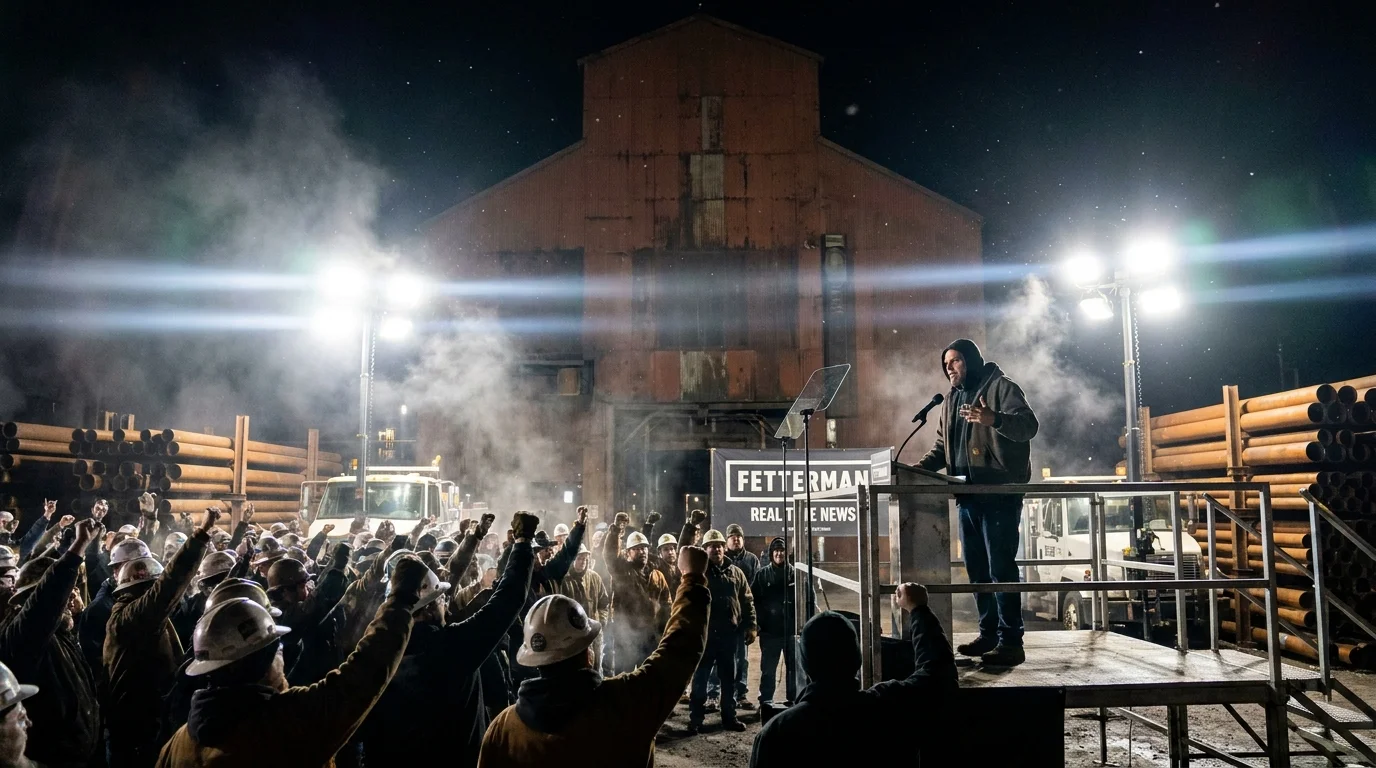
Stand near the riverbanks of the Monongahela on a raw November morning, and the air carries a mineral tang like wet pennies. Outside a cavernous, rust-colored mill warehouse, slag-dusted raw steel piping sits stacked in thirty-foot pyramids, waiting under gray cloud cover. The surface of each pipe feels rough as pumice, dusted with the chalky grit that settles over every surface within two miles of an open hearth.
For years, conventional policy observers expected you to accept a clean narrative: modern politics runs on party discipline, and traditional heavy manufacturing belongs to textbook history rather than active floor debate. Yet the real-time search spike surrounding Senator John Fetterman reveals an abrupt shift in what working communities demand from their representatives.
When search trends flare overnight across Pennsylvania, Ohio, and Indiana manufacturing hubs, they are not tracking ideological sound bites. They register the anxious hum of union halls watching low-cost foreign metal flood coastal ports while regional orders dry up on the docket.
The sudden break with traditional party orthodoxy is not random defiance. It represents a direct response to a surging voter priority that prioritizes the physical security of American foundries over the polished consensus of international commerce pacts.
The Rust-Belt Anvil: Why Party Discipline Fractures Under Heat
Consider political orthodoxy as a brittle pane of glass, whereas manufacturing survival resembles cast iron. Under ordinary conditions, party caucuses expect unified votes on trade amendments and international supply chain frameworks. But when raw material orders slip overseas, that polished alignment shatters against the shop floor.
The current Senate friction centers on an aggressive push to insert strict domestic-origin mandates into ongoing infrastructure appropriations. While leadership urged caution to avoid rattling bilateral trade pacts, the mandate demands that federally funded industrial pipelines use metal smelted, poured, and rolled within domestic borders. For communities whose school districts and municipal water funds depend on operational furnace shifts, this issue leaves zero room for diplomatic delay.
- Bernie Sanders AI legislation demands strict workplace automation bans sparking intense tech lobbying
- Voter signature verification machines reject mail-in ballot envelopes over degraded ballpoint pen strokes
- Voter turnout micro-targeting models force precinct door knockers onto very specific gravel driveways
- Suffragette picketing parade banners sparked modern street demonstrations using high contrast purple silk
- Highway trust fund gas taxes trigger hidden state fuel surcharges on weekly paychecks
When you look past partisan talking points, you discover an unexpected tactical advantage. Breaking ranks on trade does not isolate an industrial senator; it builds an unyielding regional firewall that bridges union leadership and local supply chain executives who rarely agree on tax policy.
A Floor Fight Born in Braddock: Marcus Alvarez and the Mill Gate
Marcus Alvarez, a 48-year-old rolling mill operator outside Pittsburgh, tracks federal procurement notices the way institutional traders watch ticker tapes. In his break room last Tuesday, between forty-five-minute cooling cycles, the talk did not touch on beltway committee hearings or national cable talking heads. Marcus pulled up shipping logs on his phone, showing three barges of imported structural pipe docked downstream, undercutting local yard contracts by twenty-two percent. That quiet ledger bleed prompted direct outreach to regional congressional liaisons, accelerating the Senate floor amendment that caught leadership off guard.
Mapping the Industrial Fault Lines: Who Wins and Who Adjusts
The confrontation over domestic steel pipeline mandates fractures traditional voting coalitions into distinct camps. Understanding these layers helps you anticipate where capital and political capital flow next.
For the Regional Mill Operator
Local fabricators and secondary suppliers gain immediate predictability. When statutory language binds federal loan guarantees to domestic origin rules, capital expenditures for furnace relining can proceed without the terror of sudden overseas price dumps wiping out balance sheets mid-project.
For Coastal Importers and Logistics Hubs
Port distributors face tighter compliance margins and heightened verification audits. Rather than relying on simple country-of-origin stamps, procurement brokers now face detailed chemical tracing requirements to prove scrap sourcing occurred within domestic supply loops.
For General Infrastructure Contractors
Project managers handling water and energy distribution systems must navigate short-term price adjustments. While unit costs per linear foot may increase slightly, procurement timelines gain insulation from overseas shipping backlogs and geopolitical canal disruptions.
The Tactical Toolkit: Navigating Domestic Procurement Realities
Tracking the real-world fallout of this legislative showdown requires watching specific operational indicators rather than party press releases. You can monitor how these supply chain shifts impact local commerce through clear checkpoints.
- Scrap Surcharge Indexes: Watch the monthly Midwest scrap metal benchmark to gauge regional inventory tightening before contract renewals hit municipal desks.
- Federal Docket Amendments: Monitor specific domestic-content waivers submitted to the Department of Transportation; a drop in approved waivers signals aggressive regulatory enforcement.
- Mill Capacity Utilization: Track the American Iron and Steel Institute weekly output figures; numbers crossing eighty percent indicate that federal purchasing mandates are actively pulling idle capacity back online.
- County Tax Assessment Calendars: Follow industrial property valuations across manufacturing counties to see if renewed domestic orders stabilize local public service funding.
The Human Anchor of Industrial Policy
Political commentary often treats manufacturing tariffs as abstract bargaining chips played on international game boards. But policy begins and ends with the physical reality of a community holding its breath while a night shift clocks in. When you realize that political capital can still be spent to protect the physical craft of your neighbors, the noisy theater of Washington recedes.
The value of this legislative push lies in clarity. When a lawmaker defies party expectations to defend the blast furnaces of home towns, it proves that local voter pressure still possesses the weight to reshape national economic policy.
Real economic security is not negotiated at international summits; it is poured in 2,800-degree ladles by workers who need their government to hold the door shut against predatory dumping.
| Key Point | Detail | Added Value for the Reader |
|---|---|---|
| Domestic Origin Trigger | Mandates 100% US-melted steel for infrastructure projects | Protects local job stability and municipal tax baselines |
| Party Realignment | Direct split from conventional party trade policy | Demonstrates local voter leverage over national party agendas |
| Supply Chain Integrity | Implements forensic origin tracing for raw pipe inventory | Minimizes delivery delays caused by overseas logistical shocks |
Frequently Asked Questions
Why did this issue cause an immediate spike in search interest?
The sudden divergence between a prominent party figure and institutional leadership over blue-collar trade protections caught national attention, highlighting an unexpected clash between progressive trade stances and local industrial labor.How does this Senate move affect pipeline and water infrastructure costs?
While domestic steel carries a modest initial material premium, it eliminates severe overseas transit volatility and foreign currency risks, providing municipal budgets with stable long-term forecasting.What is the specific amendment driving the confrontation?
The clash focuses on an enforcement rider that restricts federal grant disbursements solely to projects utilizing domestic blast-furnace and electric-arc products, closing prior administrative waiver loopholes.How are rival political factions responding to the maneuver?
Traditional free-trade advocates argue the move risks retaliatory foreign tariffs, while blue-collar manufacturing caucuses from both sides of the aisle are quietly aligning behind the measure.What should local business owners watch for next?
Keep an eye on the final committee reconciliation text to see whether the strict domestic sourcing mandates survive administrative waiver negotiations before the bill reaches the executive desk.