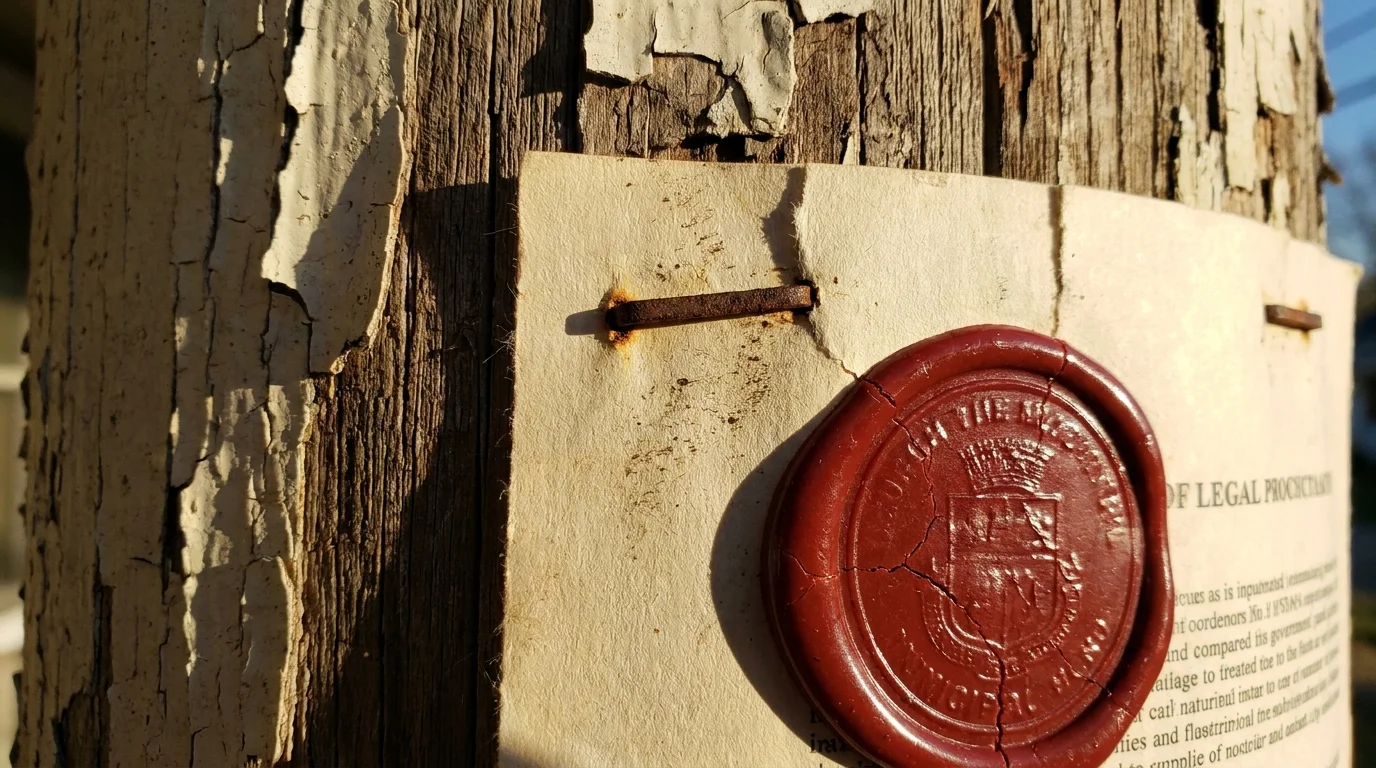
A sharp morning frost clings to the edges of your front steps, catching the pale morning light against brittle coats of paint. You walk down to retrieve the paper, only to stop inches from the porch frame where flaking exterior lead paint sits directly beside a stamped, red-inked stop-work notice taped flush to the storm door. The adhesive pulls away another sliver of historic timber, leaving raw grain exposed to the damp November air. Just twenty-four hours earlier, a local carpenter had measured your window bays for insulated sashes designed to stop the winter drafts bleeding your household budget dry.
You bought your home under the comforting premise that neighborhood preservation codes exist to guard community charm from predatory developers. You pictured thoughtful stewards protecting century-old street canopies and brick sidewalks. But the legal citation pinned to your home tells a completely detached story, citing an obscure municipal ordinance subclause you never voted for, drafted by an administrative panel you never elected.
The standard civic assumption is simple: if a city government restricts what you can install on your private property, your elected council representatives must bear the electoral consequences of that vote. The hidden reality operating inside hundreds of American historic districts operates in reverse. Through subtle structural maneuvers, local councils routinely outsource statutory authority to unelected advisory committees, granting them unchecked discretion to veto essential structural repairs under the protective guise of aesthetic harmony.
Behind closed boardroom doors, **an unappointed administrative shadow** now dictates whether your family is legally allowed to install double-pane glass or modern insulation.
The Consensus Inversion: When Advisory Panels Overrule Your Ballot
To understand why your repair permit vanished, you have to look at the procedural machine known as the Consensus Inversion Play. On paper, historic preservation commissions are purely advisory bodies. State enabling statutes generally require that municipal authority remain anchored to elected officials—mayors, aldermen, and town council members. To bypass this constitutional friction, municipalities write administrative bypasses into their local land-use code.
The city council adopts the preservation commission’s aesthetic guidelines as a presumptive standard of care. When you apply for a Certificate of Appropriateness to swap rotting, single-pane wooden sashes for high-efficiency wood-clad alternatives, your application does not land before the council. It diverts to a sub-panel of preservation purists, architects, and unelected appointees. This panel issues a formal denial within a closed-door work session, packaging their aesthetic preference as an administrative finding of fact.
- State paid family leave deductions strip weekly take home wages from crinkled paper paystubs
- Colonial Pipeline diesel allocation limits enforce sudden freight surcharges across greasy asphalt truck stops
- Declassified Able Archer 83 telexes reveal frantic Soviet mobilization inside concrete missile bunkers
- Master-planned community tax assessments force angry suburban homeowners onto packed municipal lawn chairs
- Federal disaster slush fund claims spark viral panic across offshore bot farm networks
Here is where the inversion takes hold: municipal bylaws frequently dictate that the elected city council cannot overturn an advisory denial without a supermajority vote, or they bar the council from hearing appeals altogether, routing your only legal recourse through an exhausting county circuit court. By creating an automatic consent agenda, **unelected boards quietly manufacture unanimity** that insulates elected politicians from voter backlash while giving appointed preservationists absolute veto power over your front porch.
The Cost of Purity: Elena Vance and the $34,000 Window Trap
Elena Vance, a 48-year-old high school biology teacher in Doylestown, Pennsylvania, learned how this machinery operates when the north-facing windows of her 1912 foursquare began rotting at the sill. Water was seeping behind the plaster, breeding black mold in her ground-floor study. Elena submitted plans for custom, historically matched composite sashes that matched the original six-over-one muntin profile down to a sixteenth of an inch. Her local commission denied the application behind closed doors, ruling that only true divided-light, single-pane wood windows with exterior storm panels met the aesthetic rubric. The restoration estimate using reclaimed antique heart pine came back at $34,000—triple her annual home maintenance savings. When she petitioned her elected town council member, she was handed an administrative pamphlet explaining that council members were legally barred from intervening in commission determinations.
Navigating the Three Tiers of Architectural Enforcement
Preservation mandates do not land equally across all residential structures. The severity of municipal interference depends heavily on how your property is classified under the commission’s inventory survey. Recognizing which box your home occupies determines your legal room to maneuver.
The Landmark Anchor (Pre-1900 Construction)
These properties bear the heaviest regulatory cross. Commission guidelines often mandate authentic restoration over replacement, meaning modern composite materials, regardless of performance, face an outright ban. For owners here, routine maintenance feels like breathing through a pillow; stripping paint requires specialized heat guns and certified abatement contractors, and replacing historic glass means tracking down salvage dealers while your heating fuel bills double.
The Mid-Century Infill (1945–1970 Construction)
Often swept into expansive historic overlay districts to create continuous geographic borders, these houses were originally built with post-war experimental materials. When an advisory board applies strict pre-war restoration rubrics to mid-century ranch homes or split-levels, **preservation dogma directly undermines durability**, leaving owners legally forbidden from applying modern flashing, durable metal roofing, or exterior continuous insulation to drafty, uninsulated frames.
The Borderline Steward (Fringe-Zone Working Homes)
Homes sitting on the outer edge of historic districts often shoulder compliance costs simply to preserve the view shed of wealthier properties downtown. Owners in this tier frequently discover their renovation rights have been traded away so adjacent neighborhoods can maintain higher municipal grant funding metrics, turning low-profile properties into involuntary architectural buffers.
Disarming the Consent Decree: A Tactical Administrative Roadmap
Reclaiming your right to maintain your home requires stepping outside the aesthetic debate and forcing the commission onto constitutional and procedural ground. Passionate arguments about comfort or climate awareness will not sway an advisory panel; procedural leverage will.
- Audit the Quorum and Advisory Minutes: Request the official audio recordings and minutes of the specific work-session where your application was evaluated. Look for violations of state open-meeting acts; advisory panels frequently discuss property determinations during informal site visits or unrecorded sidebar conversations before the public hearing convenes.
- Invoke State Building Energy Codes: Most states have adopted updated international energy conservation standards that mandate specific envelope thermal performance. When an advisory board orders you to retain drafty single-pane glazing, secure a written letter from your municipal building code officer confirming that the commission’s order contradicts statutory state energy baselines. Building safety and energy conservation statutes routinely preempt local aesthetic guidelines.
- Exploit the Economic Hardship Clause: Do not just claim work is expensive; supply three certified contractor bids showing the cost disparity between modern performance-grade repairs and commission-mandated historical restoration. If the restoration cost exceeds twenty percent of the structure’s assessed value without adding appraisal equity, you trigger statutory hardship shields that force advisory panels to grant administrative variances.
Assemble a clean tactical folder before speaking at your public appeal. Include a calibrated digital thermal imaging scan of your existing facade, your state’s enacted energy baseline requirements, and a formal request for an on-the-record finding of economic viability. **Strategic documentation forces municipal hesitation**, transforming you from an aggrieved homeowner into a serious legal liability for an unbonded board.
Reclaiming Stewardship from Procedural Silos
Historic preservation at its best is an act of deep affection for craftsmanship and shared memory. It celebrates the hands that leveled the foundation stones and fitted the mortise-and-tenon joints that keep a home standing a century after its builder walked out the door. But authentic stewardship cannot survive under administrative isolation. When neighborhood care becomes an exercise in backroom consensus decrees, the soul of preservation rots from the inside out.
A house is not a museum exhibit frozen under glass; it is living shelter designed to keep a family warm, safe, and solvent. Real conservation honors both the historical record and the human life unfolding within its walls. By recognizing the procedural gears that turn behind closed advisory panels, you pull preservation out of the shadows and return it to where it always belonged: a transparent, accountable contract between neighbors.
Preservation fails the moment an advisory committee prioritizes the purity of an antique window frame over the structural solvency of the human family living behind it.
| Key Point | Detail | Added Value for the Reader |
|---|---|---|
| Consensus Inversion Mechanism | Advisory panels use unrecorded work sessions to create binding aesthetic rejections. | Identifies how advisory boards exercise municipal power without electoral liability. |
| State Code Preemption | State energy and safety building codes overrule local aesthetic guidelines. | Gives you an undeniable legal counterweight to overturn non-appealable architectural vetoes. |
| Hardship Trigger Ratios | Restoration quotes exceeding 20% of assessed improvement value spark legal variances. | Provides an exact financial threshold to legally invalidate arbitrary historic material mandates. |
Frequently Asked Questions
Can an unelected advisory board legally stop construction on my private property?
An advisory board cannot directly issue a stop-work order under its own authority, but it exercises indirect control. Municipalities routinely write administrative cross-delegation rules that trigger automatic building-permit revocations whenever an advisory panel withholds a Certificate of Appropriateness.What is the quickest way to challenge a preservation panel’s material veto?
File an immediate procedural grievance under your state’s Open Public Meetings Act. If the commission discussed your application in private pre-hearings or conducted non-public site evaluations without notifying you, their final determination is legally vulnerable to administrative nullification.Are replacement windows completely barred in all designated historic districts?
No. Most districts allow replacements if the exterior profile matches historic sightlines. Focus your application on wood-clad composite units that match original muntin widths, and cite National Park Service Preservation Brief 14 regarding energy retrofits to validate your application.How do I prove economic hardship to a historic commission?
Submit three itemized contractor bids for historical restoration versus modern code-compliant replacement. If the delta between the two threatens reasonable economic use of the property, most municipal bylaws require panels to grant a variance or face court-ordered takings litigation.Does an elected city council have the power to overturn an advisory board denial?
Yes, provided your local charter allows appeal hearings. Even when local code attempts to make the advisory decision final, elected councils retain sovereign legislative oversight; organizing three to four neighbors to attend a formal council meeting can force an administrative review.