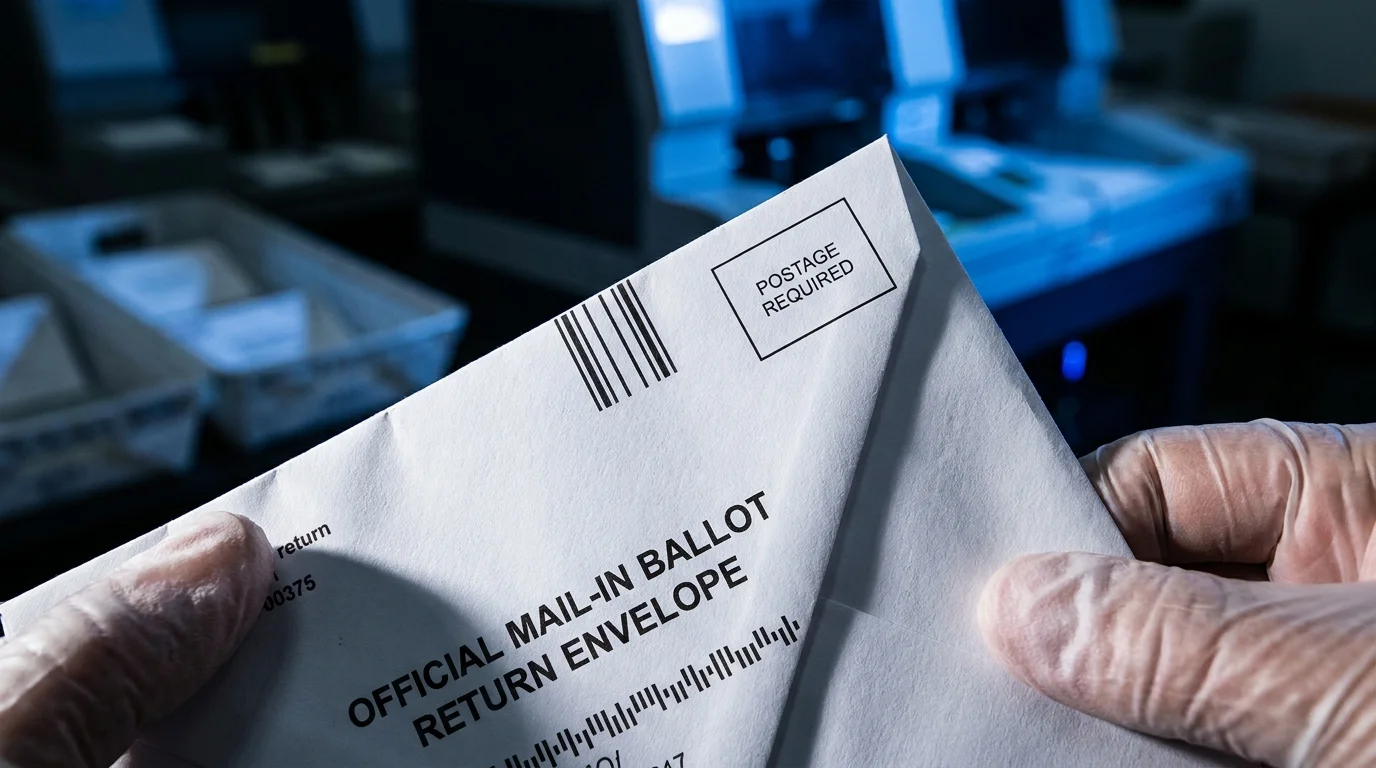
The dull thud of the steel pull-down drawer on the blue curbside mailbox echoes down the empty sidewalk. You drop your return envelope into that dark, cool belly, listening to paper brush against paper before hitting the canvas floor below. It feels like an errand crossed off your mental checklist, sealed with moist adhesive and sent under the sacred trust of a government agency. You walk away assuming the clock has formally paused for your civic duty.
Yet inside the regional logistics distribution plant twenty miles away, the air smells of machine oil and pulverized paper dust. Long conveyor ribbons hum under fluorescent tubes, screaming at speeds designed to process thirty-six thousand envelopes every single hour. In that blur of rubberized pinch rollers and suction cups, your paper vote glides invisibly past the optical sensors, bypassing the heavy black strike of manual ink you took for granted.
What leaves that distribution bay is clean, unscratched, and legally defenseless. State election codes across thirty-two jurisdictions mandate that a ballot received after the close of polls carries a legible, dated cancellation mark applied by postal hands. When automated optical scanning heads read intelligent barcodes without physically branding the paper fibers, your envelope enters county canvassing rooms as an unverified artifact.
You did not fail the deadline. The machinery simply refused to touch your envelope with wet ink, quietly disqualifying your voice before the first tally screen ever illuminates.
The Phantom Transit: When Optical Efficiency Destroys Legal Proof
For more than a century, an American postmark was a violent, physical act. Metal type, pressed against felt saturated with lampblack oil, bruised the postage stamp to ensure it could never be reattached to another envelope. That bruise was a municipal clock, sealing time and location into paper fibers with legal finality that satisfied sworn state canvass boards.
Today, the United States Postal Service operates as a modern data logistics powerhouse, not a hand-stamping depot. When your return envelope enters the automated stream, high-speed sorting machines rely on phosphorescent ink detection and Advanced Facer Canceler Systems. If an envelope bears a pre-printed business reply permit or a barcode with automated tracking, the machine frequently determines that cancellation is technically redundant for transit efficiency, sparing the envelope the mechanical strike of an ink roller.
The sorting computer does not care about county canvass thresholds. It only cares about conveyance velocity through distribution corridors. Election administrative boards are bound by explicit state statutes that demand an unmistakable, physical calendar stamp on the face of the paper envelope.
- Port trucking waivers expire at midnight halting regional freight corridors before state updates
- Municipal sewer bonds inflate unexpected four-figure escrow fee spikes inside homeowner checking accounts
- Driver license renewals strip registered voters from active rolls before municipal election day
- Privatized toll concessions fuel soaring commuter rate spikes across suburban highway corridors
- Overtime rule injunctions force employers into emergency dawn payroll resets after midnight rulings
When an un-inked envelope arrives at your local election warehouse forty-eight hours after the polls shutter, county attorneys stare at bare cardboard. Without that smudge of black carbon, the ballot is treated by law as an illegal late submission, regardless of when you slipped it through the blue postal flap.
A Canary in the County Canvass Vault
Marcus Campbell, a 54-year-old canvass board technician in Northampton County, Pennsylvania, spends the three days following every November election hunched over a laminating table with a lighted jeweler’s loupe. In November 2022, Marcus watched his team stack four hundred and eighteen pristine, un-blemished mail ballots into cardboard preservation boxes labeled ‘Disallowed: No Postmark.’
“The envelopes were bone white on the upper right corner,” Marcus remembers, tracing the edge of his magnifying glass. “You could see through the voter look-up logs that these folks filled out their ballots ten days early. But because they dropped them in a rural collection box that bypassed the local hub’s manual canceling desk, the regional sorter treated them as commercial metered transit. I had to personally sign off on throwing out valid signatures because the automated system never kissed the envelope with an ink wheel.”
The Anatomy of Envelope Processing: Where the Stamp Vanishes
Understanding how your return envelope travels through the distribution network reveals why ordinary drop-off habits turn into technical landmines during election week.
The Curbside Blue Box Trap
Curbside collection boxes are cleared into oversized canvas hampers. These mixed collections bypass local desk clerks entirely, trucking straight to major regional processing facilities. When collection volumes peak on Sunday nights and Monday mornings, postal handlers push these loads into high-capacity automated feeds where ink rollers are selectively disengaged to avoid ink transfer jams on slick window envelopes.
Pre-Paid Permit Envelopes
If your county supervisor provides an envelope that reads ‘No Postage Necessary If Mailed In The United States,’ postal accounting treats the transit payment as bulk automated debt. Because there is no adhesive stamp to deface, regional machinery treats physical ink cancellation as an unnecessary wear item, frequently skipping the cancel head entirely unless local plant leadership issues an emergency election mail override memo.
The Post-Election Receipt Window
Nineteen states allow ballots to be tallied days after election night, provided they were physically mailed by eight o’clock on voting day. If your envelope lacks that circular black crown of dated ink, election statutes do not allow workers to guess or rely on digital transit timestamps from corporate tracking dashboards. In the eyes of statutory canvass judges, the physical absence of ink equals an untimely vote.
The Voter’s Counter-Defense: A Tactical Logistics Checklist
Safeguarding your vote requires treating the postal system like an automated assembly line that must be forced to leave a physical audit trail. Take these specific precautions before letting go of the paper envelope:
- Request a Hand Cancellation at the Window: Walk past the blue box in the parking lot and place the envelope directly onto the postal counter. Tell the clerk: ‘Please hand-cancel this election ballot with today’s round date stamp while I watch.’
- Verify the Round-Dater Seal: Ensure the red or black circular ink strike visibly covers both the edge of the postage square and the envelope paper itself.
- Observe the 144-Hour Buffer Rule: Drop all mail-in votes at least six business days prior to your state’s local deadline if you cannot visit a counter in person. This ensures arrival before election night, rendering the postmark requirement legally moot in most counties.
- Utilize Official County Drop Boxes: Bypass the federal mail stream entirely by depositing your envelope into a municipal drop box monitored by county election workers, which uses timestamped mechanical intake logs instead of postal ink.
Never rely on a rural mailbox pickup flag on election week. If a substitute carrier runs the route late, your envelope might sit in a postal truck overnight, missing the terminal cancellation window before the plant lights kick on.
The Value of Physical Proof in a Cloud-Based World
In our headlong race toward invisible digital transactions, we frequently forget that our democratic process rests on old-fashioned, tangible evidence. An election is not a software handshake; it is an audit trail built on physical custody, wet signatures, and mechanical verification marks.
When you take three deliberate minutes to stand at a brick-and-mortar postal counter, asking a human clerk to press a rubber stamp into an ink pad, you are actively defending yourself against algorithmic omissions. It is not stubborn paranoia; it is an understanding of how automated networks function when no human eyes are watching the belt.
Take control of that final exchange. The peace of mind that comes with a dark, legible ink mark stamped across your return envelope guarantees that your civic choice will be preserved, verified, and counted.
The sharpest machine scanner in the world cannot repair the damage of missing ink when a statutory canvass board opens the storage vault.
| Filing Method | Postmark Probability | Canvass Vulnerability Level |
|---|---|---|
| Curbside Blue Drop Box | Moderate to Low (Machine Dependent) | High for late-window arrivals lacking ink |
| Direct Post Office Counter Request | Guaranteed 100% (Visual Verification) | Zero risk regarding postmark disputes |
| Designated Municipal Drop Box | Exempt from Postal Cancellation | Zero postal risk; verified directly by county |
Common Postmark Controversies Explained
Does a printed barcode track my ballot in place of a postmark?
No. While Postal Intelligent Mail barcodes track envelope transit across the country, most state election codes strictly require a legible, physical ink date stamp directly applied to the envelope surface.Why don’t postal machines stamp every election envelope automatically?
High-speed sortation equipment focuses on transit speed, often disabling physical ink canceling wheels on pre-paid envelopes to clear processing jams during high-volume sorting shifts.What happens if the clerk’s hand cancellation stamp is blurry or smeared?
As long as the numerical date, month, and station designation remain distinguishable under standard optical magnification, election canvassers will certify the mark as valid proof of timely mailing.Does dropping my ballot in a mailbox on election morning guarantee an on-time postmark?
No. Envelopes collected after the box’s posted final pickup hour will not arrive at the regional hub for processing until the following business morning, making them legally late.Can I track whether my county received and accepted my mail ballot?
Yes. Most states host an online voter registration portal that updates the specific status of your ballot package from ‘Mailed’ to ‘Received’ and ‘Processed’ by county staff.