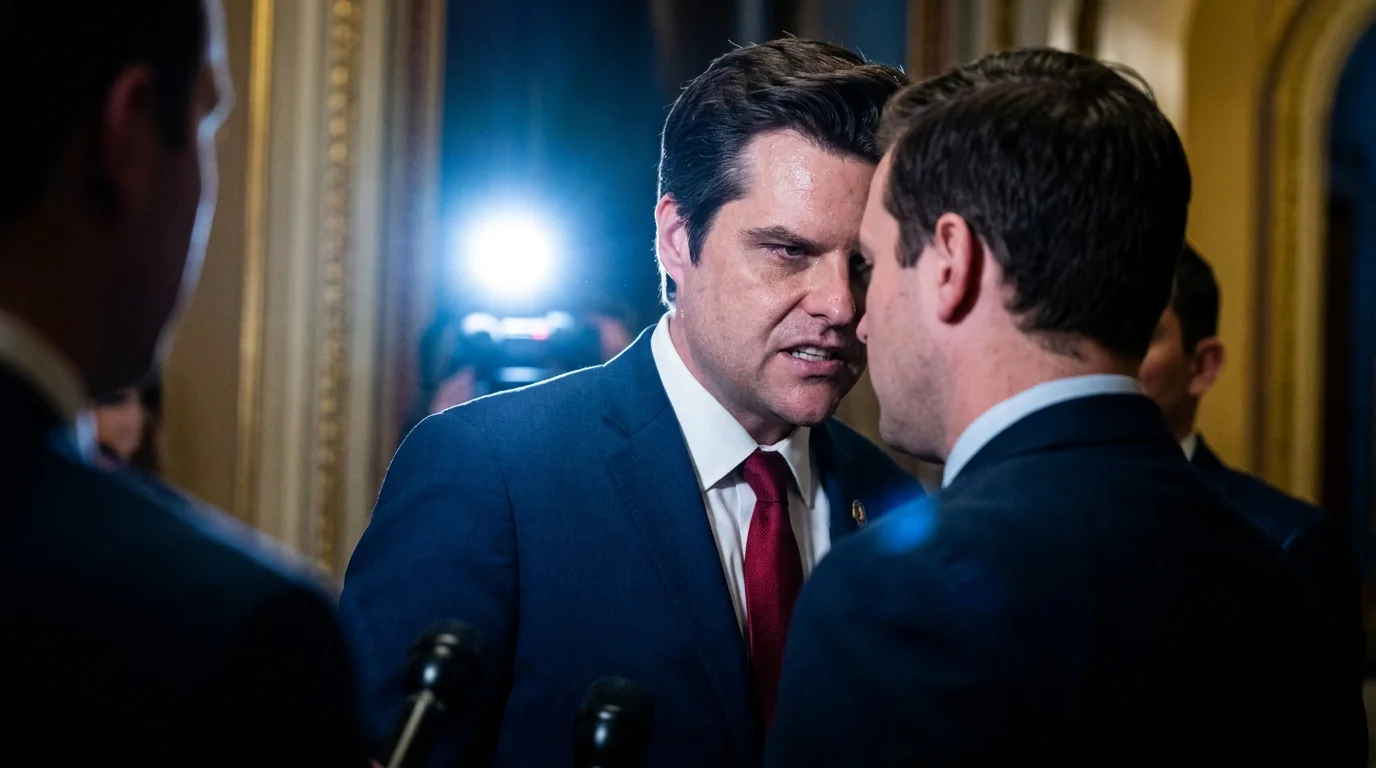
The corridor outside the House chamber smells of polished marble and damp wool overcoats shaking off the sharp Washington rain. Phones vibrate against ribs in a jagged, unsynchronized rhythm, lighting up darkened pocket corners with frantic off-the-record pings. You watch lawmakers cluster near the brass-studded doors, murmuring behind raised palms while floor staff adjust voting cards that will never be cast today. What looks from a television screen like sudden procedural paralysis is, in reality, a meticulously timed chemical burn designed to melt down the clock.
You might expect a political standoff to arrive like an explosion, shattering windows with obvious fury. Instead, the real machinery of Capitol survival sounds like the quiet thud of heavy oak doors sealing shut while floor managers manufacture an intentional procedural logjam to swallow the morning news cycle whole.
Behind the visible freeze on floor business lies an explosive document: the House Ethics Committee’s findings into former Representative Matt Gaetz. By resigning his seat moments after receiving an executive nod, the target did not simply exit the building; he pulled an administrative rip-cord that technically evaporated the committee’s formal jurisdiction over him as a sitting member. Yet the physical file remains in carbon and ink, held in procedural purgatory while competing factions fight over whether daylight or a paper shredder meets it first.
The Firebreak Strategy: When Stalling Becomes Architecture
To understand why regular votes grind to a halt over an unreleased folder, you have to discard the idea that scandals resolve through truth or falsity. In modern legislative crisis control, survival is purely thermodynamic: you must control heat distribution until the oxygen in the room thins out completely.
Think of the House Ethics report not as a static legal brief, but as dry timber stacked inside a ventilation shaft. Counter-leaking weaponizes selective friction to ensure that every time an adversary tries to strike a match, a fresh procedural firebreak starves the flame before it reaches the floor.
When a target under scrutiny anticipates an adverse findings package, waiting for the document drop is institutional suicide. The counter-strategy relies on drowning the specific allegations beneath a high-volume debate over institutional norms, committee jurisdiction, and precedent. By demanding that members vote on procedural mechanics rather than the underlying conduct, lawmakers are forced to choose between party solidarity and committee decorum, effectively weaponizing their own peer pressure against them.
- Bruen handgun rulings freeze local municipal permit boards amid surging legal challenges
- Harley-Davidson corporate policies fuel nationwide dealership boycotts following sudden executive changes
- FBI field offices resist executive reassignments that strip career agent protections
- Canadian timber tariffs halt homebuilding projects as border state contractors revolt
- Raw milk deregulation bills spark furious statehouse clashes between inspectors and lawmakers
David Vance, a 48-year-old veteran communications strategist who spent fourteen years managing congressional committee defenses, describes this triage as surgical misdirection. Vance keeps an unwritten rule scrawled in an old spiral notebook: never deny an allegation when you can drown the delivery system in technical doubt. During closed-door prep sessions, he taught embattled lawmakers to treat formal disclosures like controlled detonations, steering the press pack toward arguing about committee bylaws while the underlying facts turn stale in transit.
Layers of the Spin Machine: How Different Factions Manage the Fallout
Crisis communication inside the Capitol does not operate from a single teleprompter. It breaks into distinct frequency bands, each calibrated to keep specific voting blocs from abandoning their defensive perimeter.
For the Partisan Loyalist: The Retaliation Narrative
This messaging layer reframes any unreleased material as an illegitimate hit job executed by an entrenched establishment. You will notice statements saturated with phrases like ‘deep-state vendetta’ and ‘procedural ambush.’ The practical outcome? Supporters disregard the content before ever reading a single redacted line, viewing curiosity itself as an act of political betrayal.
For the Institutionalist: The Jurisdictional Shield
A far quieter, cooler rhetoric protects members representing swing districts who cannot afford to defend raw misconduct. Jurisdictional limits offer safe legal harbor by allowing members to state that once an official resigns, releasing a private dossier sets a dangerous institutional precedent for private citizens. This converts a debate about personal ethics into a high-minded seminar on legislative authority.
For the Floor Whippers: The Collateral Hostage
When leadership needs to suppress a document release, they threaten the entire legislative calendar. By signaling that forcing an ethics disclosure will derail critical appropriation bills or regional farm subsidies, floor managers force rank-and-file lawmakers to choose between satisfying transparency advocates or securing federal project funding for their home counties.
Decoding the Smokescreen: A Citizen’s Tactical Toolkit
You do not need an insider pass or a press badge to separate procedural theater from genuine institutional accountability. When the next headline alerts flash across your screen, use these four diagnostic filters to track where the lever is actually being pulled:
- Watch the Clock Transitions: Major procedural motions and strategic resignation announcements invariably occur during Friday afternoon dead zones or directly alongside major holiday recesses to starve media momentum.
- Audit the Vocabulary: If a politician stops discussing the substance of an allegation and begins speaking exclusively about ‘the sanctity of committee precedent,’ the underlying report is devastating.
- Track the Proxy Leaks: Look for sudden, unverified counter-leaks involving opposing committee members surfacing on secondary blogs; these are deployed to create false balance and dilute public outrage.
- Monitor the Floor Quorum Calls: Unexplained floor delays and extended procedural recesses are the telltale sign of backroom hostage negotiations trading policy votes for investigative silence.
The entire operation operates on sheer exhaustion. If crisis managers can keep the document contested for fourteen consecutive calendar days, national attention naturally drifts toward the next geopolitical flare or market shudder, allowing the disputed report to sink beneath the surface without a formal release.
The Bigger Picture: Reclaiming Your Signal in the Noise
Watching the floor of the United States House of Representatives grind to a dead halt over an unprinted dossier can leave you feeling cynical, as if public governance were nothing more than a private shield for the powerful. But recognizing the mechanics of the game restores your agency. When you see how a counter-leak is drafted, how a recess is weaponized, and how jurisdiction is warped into a deflector dish, the spectacle loses its power to manipulate your attention.
Understanding the anatomy of political survival transforms you from a spectator swallowed by the fury into a clear-eyed auditor of the republic. You no longer react to the noise; you measure the silence, watching exactly where the hands disappear beneath the desk to keep the record dark.
In the calculus of institutional survival, an unresolved procedural controversy is infinitely safer than an undisputed factual record.
| Key Point | Detail | Added Value for the Reader |
|---|---|---|
| Jurisdictional Evaporation | Resigning before a committee vote technically ends congressional authority over the individual. | Helps you understand why resigning immediately can actually be an offensive legal shield rather than a surrender. |
| Procedural Interruption | Using motion delays and floor filibusters to stall basic legislative business. | Explains why seemingly unrelated bills fail to move when backroom ethics battles peak. |
| Selective Siphon Leaks | Releasing partial excerpts or counter-accusations to sympathetic reporters. | Allows you to recognize when a breaking ‘scoop’ is being used as bait to redirect your attention. |
Frequently Asked Questions
Can the House Ethics Committee release a report on a member who has resigned?
Historically, the committee loses official jurisdiction once a member leaves Congress, typically halting proceedings. However, the committee retains absolute discretion to vote internally on publishing its collected findings for public historical record if a majority of its bipartisan members agree.Why do ethics debates shut down regular voting on the House floor?
Lawmakers use privileged procedural motions to force floor consideration of ethics disclosures, which instantly take precedence over standard legislative bills and force party leaders to freeze the voting calendar to avoid unexpected public roll calls.What is a counter-leak in crisis communications?
A counter-leak is an intentional, off-the-record disclosure of rival information or partial internal memos designed to distract reporters, muddy the factual waters, and blunt the momentum of an impending adverse revelation.Can the Department of Justice obtain materials from the House Ethics Committee?
Yes, federal investigators can request or subpoena evidentiary files gathered by congressional committees, though congressional bodies frequently assert Speech or Debate Clause protections to control how internal materials are turned over.How can ordinary citizens verify if an ethics leak is authentic?
Cross-reference leaked claims against formal committee voting records, check whether bipartisan leadership signatures accompany the release, and observe whether named officials issue explicit sworn denials or merely hide behind procedural objections.