The hall smells of industrial air conditioning and damp wool coats shaken dry after a sudden autumn drizzle outside Philadelphia. You hear the rhythmic shutter clicks of long camera lenses stacked on the press riser, a low electrical hum vibrating from the lighting trusses overhead, and the muted shuffle of two thousand pairs of dress shoes settling onto taped gym floorboards. It looks like an ordinary high-school auditorium dressed up for a campaign swing, but every square inch of ambient silence has been bought, measured, and calibrated.
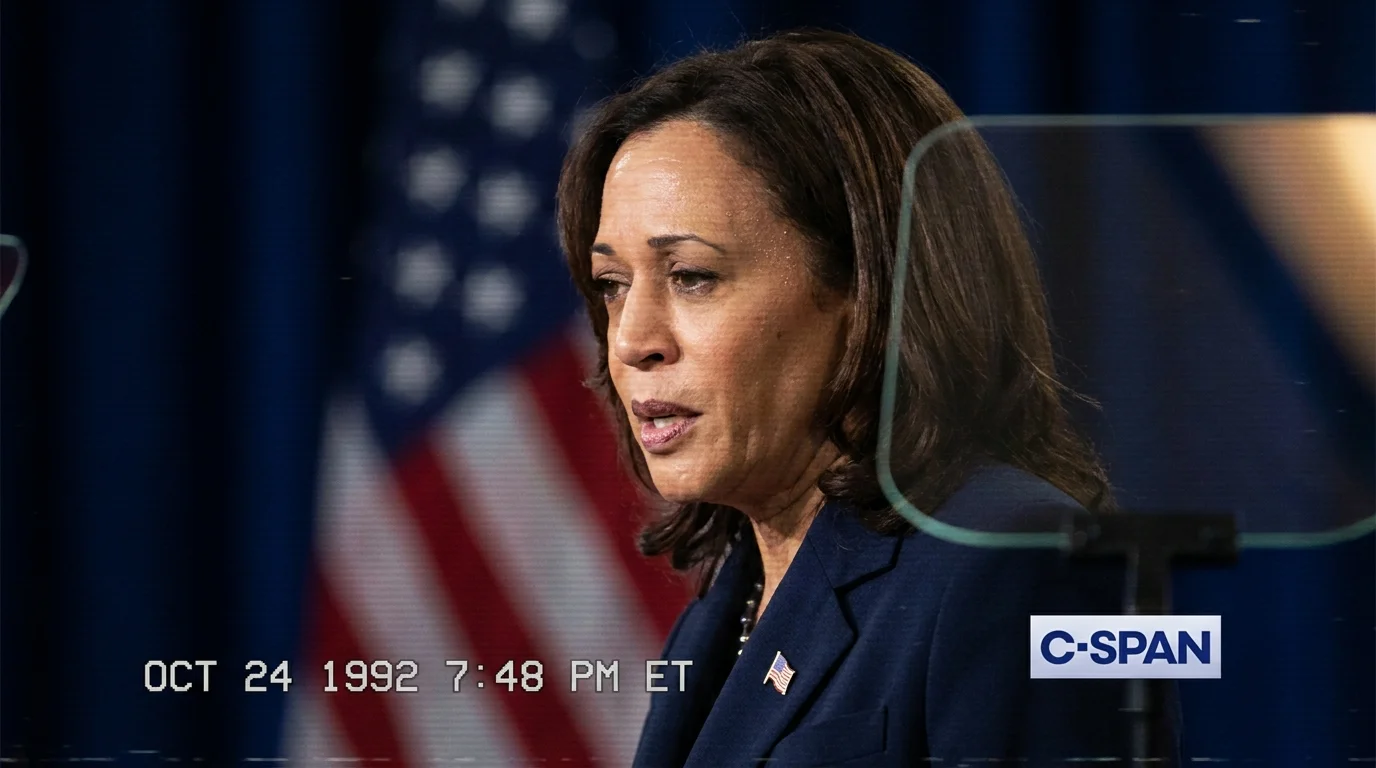
When Kamala Harris steps behind the lectern, the initial cheer crests and then dies away into an attentive, cautious quiet. You expect the relentless, percussive thunder of a traditional stump rally—the booming cadence where applause lines drop like clockwork every twenty seconds. Instead, she begins a sentence, drops her chin slightly, breaks eye contact with the center glass, and stops. For four long, unhurried seconds, nobody makes a sound.
In that quiet pocket, you feel the room reset. The stillness mimics a living room conversation where someone loses their train of thought, weighs an uncomfortable memory, or searches for the exact right word. It feels spontaneous, vulnerable, and deeply human. Yet if you were standing six feet to her left, looking at the glowing diagonal glass flats flanking the rostrum, you would see that this hesitation was planned days ago in an office suite off K Street.
What appears to be a sudden moment of conscience is actually an engineered acoustic strategy designed specifically for you—or at least, for the swing-district voter sitting three chairs down who still feels exhausted by political combat.
The Invisible Architecture of the Scripted Hesitation
Most people assume a teleprompter is simply a scrolling digital manuscript. You think of it as a rolling ribbon of words that forces a speaker to march in lockstep, moving forward until the final period. But modern political rhetoric does not treat speech as print; it treats it like musical notation. The goal for undecided suburban moderates is never to sound polished. Polish signals partisan training, and partisan training triggers defensive skepticism.
To bypass that reflex, speechwriters create an acoustic illusion: the simulated search for words. When a speaker appears to struggle slightly with their phrasing, your brain drops its analytical guard. You lean in. You stop evaluating an argument as an ideological sales pitch and begin processing it as a collaborative act of reflection. The speaker is not lecturing you; they are supposedly thinking aloud beside you.
- Trump Iran standoff shifts abruptly as senior national security advisers urge direct confrontation
- Ken Paxton triggers fierce Republican panic after internal survey reveals sudden voter defections
- Hakeem Jeffries confronts sudden House revolt as rank-and-file Democrats break party lines
- Provisional ballot envelopes strip thousands of valid votes over minor flap sealing errors
- State turnpike concessions trap daily highway commuters under inflated private food pricing
This relies on the principle of conversational disfluency. In everyday human speech, we stumble, stretch out vowels, and leave dead air while our prefrontal cortex juggles nuance. When a leader reads clean, unblemished prose, it sounds like an agency press release. By deliberately injecting structural pauses, breath marks, and calculated restarts into the text, the prompter transforms a battleground speech into what feels like a porch talk.
The Prompt Monitor: A Shared Secret from the Briefing Room
Consider Elena Vance, a veteran communications strategist who spent twelve years scoring transcript monitors for statewide gubernatorial races before consulting on national campaign rollouts. In prep sessions, Elena does not look at word choice; she looks at pulse rates and glance angles.
“The most dangerous enemy of an undecided swing voter is certainty,” Elena likes to remind her clients while tapping a blue editing pencil against a lectern. “If you sound certain about a complex cultural or economic reality, a suburban independent thinks you do not understand their household ledger. Certainty feels cheap. But if you take a breath where an amateur would rush through, you make the voter feel that their private anxiety has reached the stage.”
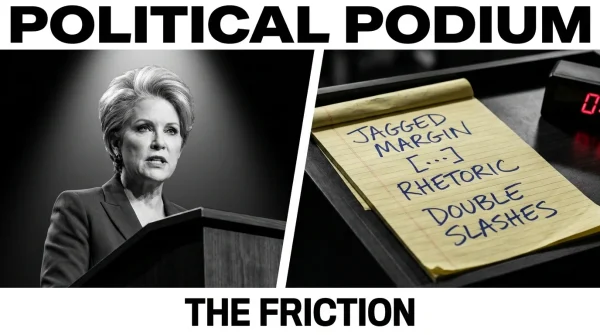
Elena uses bespoke notation systems that direct candidate body language directly from the scrolling glass. A double bracket does not mean an aside; it signals an intentional drop in projection volume. A set of three forward slashes tells the candidate to deliberately drop their gaze to the physical binder on the shelf below, creating the optical effect of someone momentarily overwhelmed by the gravity of an issue before looking back up with quiet resolve.
Anatomy of the Prompter Screen: Three Adjustment Layers
The text rolling past Harris’s line of sight does not resemble the transcript released to national reporters. It is broken into rhythmic segments, flanked by visual cues that dictate pace, physical posture, and breath control.
1. The Micro-Stumble and Self-Correction
Watch closely when the Vice President begins a sentence on reproductive rights or small-business tax incentives, catches herself, and resets with a phrase like, “And let us be clear about this—no, really look at what this means.”
On the glass screen, this is not an improvisation. It is typed as a staggered block:
[STOP PULL-BACK]
And let us be clear—
[DROP CHIN / 2-SEC HOLD]
No. Look at what this means.
This syntactic fracture forces the listener’s ear to catch up. In linguistics, this is known as a pragmatic marker of sincerity. It signals to the listener that the speaker just had a thought too urgent to be contained by their prepared remarks.
2. The Lateral Scan Pause
Suburban swing voters are notoriously allergic to grandstanding. When addressing topics like healthcare deductibles or local utility bills, the teleprompter inserts spatial prompts rather than rhetorical flourishes.
The script will read:
[OFF-AXIS HOLD // IGNORE GLASS]
You know what it feels like at the kitchen table.
[4-BEAT COUNT]
When the envelope sits there unopened.
By forcing the candidate to deliberately look between the two glass panels into the dead space of the front row, the performance breaks the theatrical plane. The camera captures her looking away from the apparatus of authority and directly into the mid-distance, mimicking the body language of someone trying to recall a private kitchen-table memory.
3. The Whispered Decrescendo
The traditional stump speech ends on a crescendo—shouted cadences that build toward a standing ovation. Modern suburban targeting flips this balance. The prompter scripts a downward decrescendo where the voice drops almost to a whisper, forcing the auditorium audio engineer to ride the fader upward.
This forces the entire venue to strain slightly to catch the phrasing. It transforms an auditorium holding thousands of partisan attendees into an intimate, high-stakes consultation. For the moderate suburban parent watching a twelve-second clip on an algorithmic feed later that night, it reads not as political theater, but as an urgent, confessional truth.
Mindful Listening: The Tactical Toolkit for Deciphering Cadence
You can train your ear to catch these mechanical seams in real-time broadcasts. The next time you watch a major address, ignore the headline topic and track the physical mechanics of the delivery.
- Track the Three-Second Horizon: Watch the speaker’s eyes when they deliver an emotional pivot. If their pupils drift away from the teleprompter glass to an unlit corner of the stage right before an emotional shift, you are watching a scripted glance marker designed to project vulnerability.
- Listen for the Glottal Catch: Notice when a sentence is broken midway through a monosyllabic word. Natural hesitation happens at phrase boundaries; scripted hesitation often cuts clean words in half to manufacture an appearance of raw emotion.
- Watch the Hand Resting Reflex: Unrehearsed speakers gesture wildly when they lose their rhythm. A speaker working through a scripted pause will usually drop both hands flat onto the sides of the lectern, squaring their shoulders to ground their physical authority while the verbal silence hangs.
- Time the Silence: An organic pause rarely exceeds 1.5 seconds on live television because dead air creates severe cognitive panic for politicians. A pause that extends past three seconds is almost always programmed, counted silently in the speaker’s head to let sound system reverberation die out completely.
The Bigger Picture: Reclaiming Your Mental Workspace
Understanding the architecture of the calculated pause does not require you to become cynical. Rhetoric has been an art form since antiquity, and leaders have always relied on cadence, meter, and deliberate silence to build trust. What matters is recognizing that silence on a modern political stage is never empty space; it is deliberate real estate.
When you learn to see the scaffolding behind the performance, you gain a subtle, grounding power. You stop reacting to the emotional texture of an address and start evaluating the structural substance of the policy beneath it. The pauses stop pulling at your instincts, and the silence returns to what it actually is: a canvas where an argument must stand or fall on its own merits.
In an era dominated by hyper-accelerated digital noise, the most effective persuasion tactic is not shouting louder than your opponent. It is possessing the discipline to stop speaking entirely, knowing that the human mind will naturally rush in to fill the quiet.
Read More