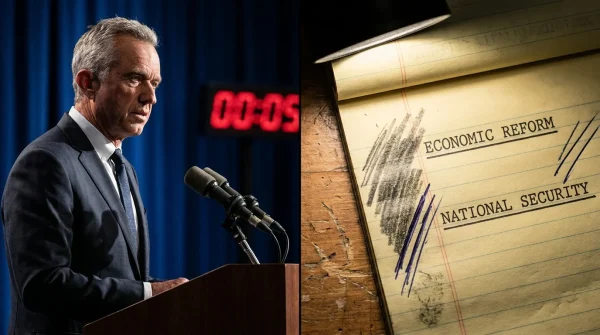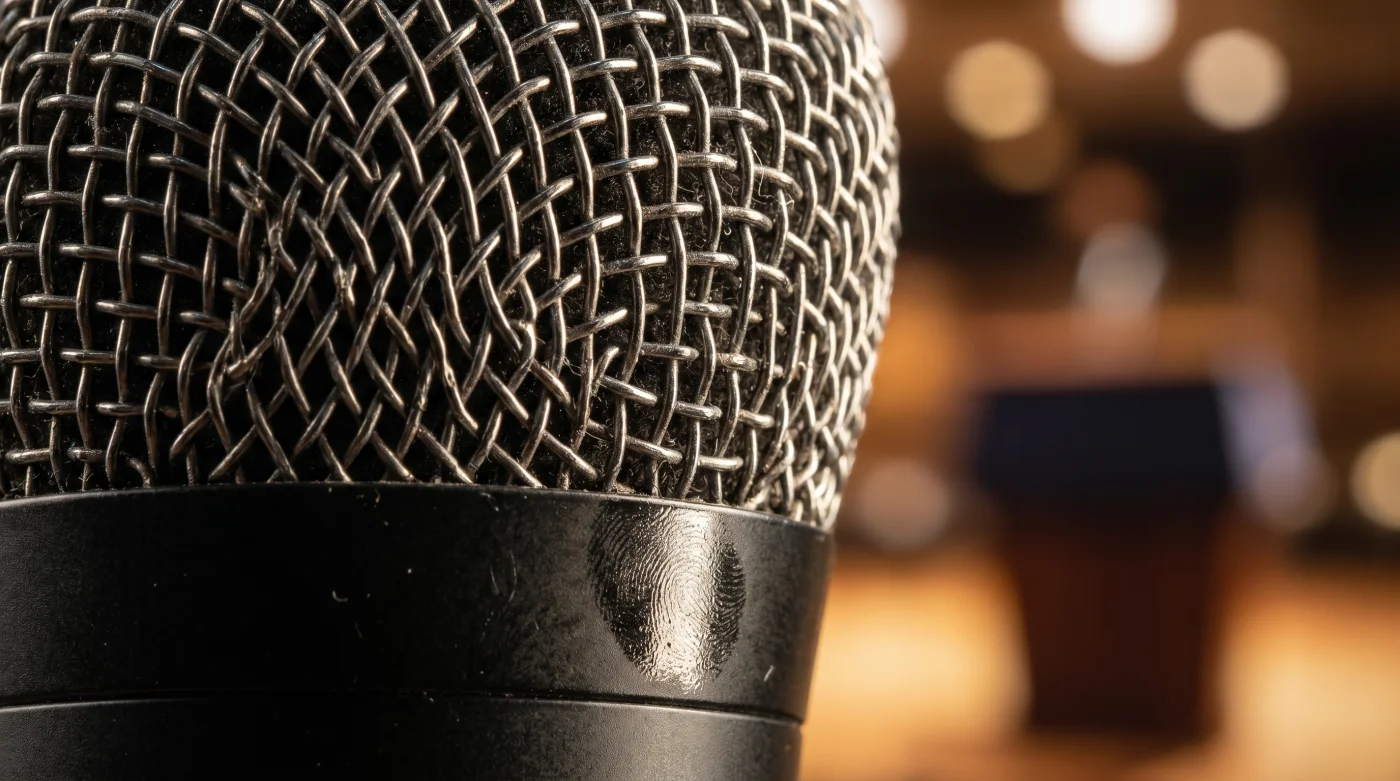
You settle into your living room as the evening broadcast begins, the television screen casting a cool glow across your walls. The debate stage appears, bathed in hot tungsten light, with two podiums standing like silent islands. Before a single word is spoken, if you listen closely, you can almost hear the sterile room tone of the studio—a quiet, heavy pressure waiting to be broken by human voices.
Underneath the polished wood and careful lighting, a mechanical reality dictates the winner. It is not the moderator, nor the specific phrasing of a policy proposal, that controls the flow of power in the room; it is **the invisible acoustic ceiling** built by the network’s audio engineers.
You are conditioned to believe that a political debate is a clash of ideas, a space where the most logical argument naturally rises to the surface. You watch with the expectation that the candidate who slowly and carefully lays out a steady, measured plan for your community will win the minds of the electorate.
The unspoken reality of the campaign trail is entirely different. The physical hardware of live television relies on broadcast limiters, automatic algorithms designed to violently suppress loud noises so they do not blow out home speakers, **crushing steady logical arguments** into a muffled background hum.
The Acoustic Funnel: How Hardware Shapes Reality
To understand modern political strategy, you must first picture the broadcast audio compressor as a physical funnel. When a candidate speaks at a normal, measured pace, their voice pours through the funnel like a smooth stream of water. The hardware allows this steady flow to reach your living room untouched. But the moment a sudden, loud burst of sound hits that same funnel, a heavy mechanical valve slams shut to prevent an overflow.
This means the system inherently treats an articulate, complex explanation as a baseline to be managed, while it treats a sharp, staccato interruption as **an immediate physical threat** that triggers the audio clamp.
Political campaigns realized long ago that this technological quirk—a mundane detail meant to protect television speakers—is actually a massive tactical advantage. If your opponent is carefully explaining the nuances of a tax bill, you do not need a better counter-argument to defeat them. You simply need to produce a sharp, clipping vocal frequency.
By interjecting with a loud, nasal consonant, the aggressive candidate forces the broadcast limiter to panic. The algorithm instantly drops the volume of the entire room, **acting like a heavy pillow** pressed over the steady speaker’s microphone. The hardware silences the logic, rewarding the disruption.
The Soundboard Secret: Marcus Vance
Marcus Vance, a 52-year-old front-of-house sound engineer who transitioned into political media consulting, built an entire career on this specific acoustic loophole. During a pivotal primary season, Marcus watched his client—a brilliant but soft-spoken former professor—lose ground in every public appearance. The client’s deep, resonant baritone voice required a wide frequency band to sound authoritative, but it was easily swallowed by the mix.
Marcus stopped prepping his client on policy and started coaching him on broadcast limits. He taught the candidate to abandon the soothing, steady rhythm of a lecture and instead deliver key phrases using **clipped, aggressive upper-midrange frequencies**. By deliberately altering his vocal pitch to mimic the sharp crack of a snare drum, the candidate stopped being drowned out by his louder opponents and began slicing straight through the network’s compression ceiling.
Tuning the Political Frequency: Tactical Adjustments
Campaign logic dictates that every candidate must adopt a specific vocal persona not to appeal to your emotions, but to manipulate the studio microphone. Understanding these distinct approaches changes the way you process a broadcast.
For the Staccato Disruptor
These candidates do not want a long turn to speak. They rely on sharp, rapid interjections—often using hard ‘T’ and ‘K’ sounds—to constantly trigger the limiter’s ‘ducking’ effect. This strategy is designed to intentionally muddy the broadcast, creating a chaotic audio environment where the opponent’s steady rhythm is constantly broken into jagged, incoherent fragments.
For the Proximity Whisperer
Some candidates understand that lowering their volume can force the hardware to work in their favor. By leaning intimately close to the microphone, they utilize the proximity effect, artificially boosting their bass frequencies. When the broadcast compressor attempts to level out the audio, it pushes **their quiet, intimate tone** to the very front of the mix, making them sound grounded and dominant while their shouting opponent sounds distant and shrill.
Decoding the Broadcast Stage
You can begin to watch these political performances with the critical eye of an audio engineer. By looking past the gestures and focusing on the acoustic environment, the hidden game reveals itself.
Next time you watch a live broadcast, practice a few mindful observations to separate the policy from the acoustic manipulation. Focus on the actual mechanics of the sound.
- Watch the candidate’s physical distance from the microphone head; notice who anchors themselves to the podium and who paces away from the optimal pickup zone.
- Listen for the ‘pumping’ effect—the unnatural, sudden dip in background room noise immediately after someone shouts.
- Identify the hard consonant strikes; track how often a candidate uses sharp, single-syllable words to cut across a flowing sentence.
- Pay attention to the moderator’s volume; notice if their voice suddenly sounds muffled when a candidate refuses to stop talking.
Your Tactical Toolkit: Pay attention to the first five minutes of the broadcast. The audio engineers are still fine-tuning the compression ratios during the opening statements. The candidate who establishes **acoustic dominance in those minutes** usually dictates the physical rhythm of the entire night.
Hearing Past the Limiter
When you finally recognize how heavily the physical hardware shapes the conversation, the frustration of watching a chaotic debate begins to fade. You stop feeling angry at the perceived rudeness of the participants, and instead, you see the cold, calculated manipulation of the studio equipment.
Understanding this unspoken rule of campaign logic gives you back your critical distance. You are no longer swept up in the engineered chaos. You can sit in your living room, listen to the clipped frequencies bouncing against the broadcast limiters, and **calmly evaluate the actual substance** hiding beneath the noise.
The microphone does not care about the truth of your statement; it only respects the physical force of your sound wave.
| Key Point | Detail | Added Value for the Reader |
|---|---|---|
| Broadcast Limiters | Hardware designed to prevent loud audio peaks from damaging television speakers. | Explains why sudden shouts mute other speakers automatically. |
| Frequency Clipping | Candidates intentionally using sharp, nasal tones to pierce through background noise. | Helps you recognize deliberate acoustic strategies over natural speaking. |
| Proximity Effect | Leaning close to the mic to artificially boost bass and sound more authoritative. | Reveals why some candidates appear artificially dominant on screen. |
Frequently Asked Questions
Why do candidates talk over each other if it just sounds like noise?
They are not trying to be heard clearly; they are intentionally triggering the audio compressor to physically drop the volume of their opponent’s microphone.Does the moderator have a volume control button?
While directors can cut mics entirely, the automated limiters handle the live mix, meaning sudden loud sounds automatically suppress steady voices before a human can react.Why do some voices sound painfully sharp during an argument?
Campaigns train candidates to push their voices into upper-midrange frequencies, which slice through broadcast compression better than lower, natural tones.Can I change my TV settings to fix this?
No, the audio compression is baked into the network’s master output before it ever reaches your cable box or streaming device.How should I judge a debate knowing this?
Focus on the quiet moments of steady explanation rather than the high-volume clashes, as the hardware is actively working against nuanced delivery.