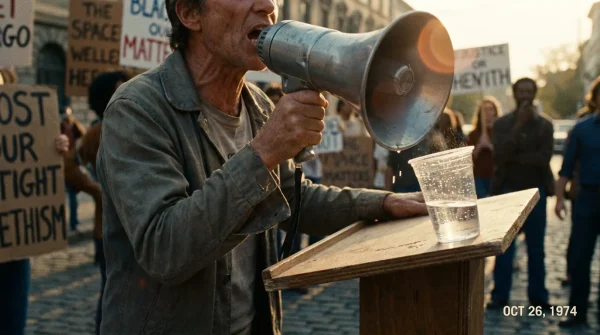
You run a fingertip across the yellowed parchment charter, feeling the brittle bite of aged rag paper and the rough ridges of an embossed red wax seal crumbling into brick-colored dust. The room smells of dry sage, old holster leather, and the faint metallic tang of mimeograph toner preserved from another decade. Outside the basement archive window, the high-desert sun bakes the sandstone steps of a rural county courthouse where federal rangers and local deputies park on opposite sides of the gravel lot.
You have likely been told that the sudden refusal of local lawmen to enforce federal mandates is a product of modern algorithm-driven anger. Pundits insist these standoffs were born in the fever swamps of recent social media forums, engineered overnight by cable commentary and digital outrage. Yet when you examine the physical paper trail, that convenient explanation disintegrates instantly.
The script resting beneath the archival glass does not belong to the internet age. Its language mirrors nineteenth-century vigilante compacts drafted under kerosene lamps, revived meticulously during the tax revolts of the early 1970s. What looks like spontaneous modern defiance is actually an unbroken mechanical inheritance, built to challenge federal supremacy long before the first fiber-optic cable was buried in the desert floor.
The Mirage of Digital Rebellion
To understand the friction currently paralyzing Western rangelands, you must abandon the idea that this movement is reactive. It operates less like a sudden flash fire and more like an underground coal seam, burning quietly beneath the topsoil until it hits an open pocket of institutional oxygen. The central doctrine claims that the county sheriff outranks the president within their territorial borders, serving as an absolute constitutional shield between citizens and federal agents.
This philosophy treats the American county line not as an administrative border, but as an ancient fortress wall. Modern commentators often mistake the movement’s frontier aesthetic for simple political theater, failing to recognize that its legal architecture was drafted with razor-sharp intent. By transforming the sheriff from a statutory process server into an untouchable constitutional arbiter, the doctrine converts routine bureaucratic disputes over water rights and grazing permits into high-stakes jurisdictional showdowns.
The root mechanism traces directly back to the self-styled legal scholars of the 1970s who founded the early Posse Comitatus networks. Men like William Potter Gale did not simply protest federal regulations; they manufactured parallel legal systems. They copied the exact phrasing of Gold Rush miners’ leagues and territorial vigilance committees, teaching rural sheriffs that their power derived from ancient Anglo-Saxon common law rather than state legislative charters.
- Credit Card Competition Act swipe fees trigger sudden checkout surcharges across rattling touchscreens
- Fujairah crude pipeline terminal routes demand immediate channel dredging to bypass regional shipping blockades
- Operation Northwoods planning memos expose handwritten Pentagon signatures demanding simulated maritime strikes
- Usha Vance broadcast profile edits derail voter trust through selective visual color grading
- Nassau County duplex zoning bans block suburban builders from copper water line hookups
The Archivist in the Sagebrush
Harlan Boyd, a 58-year-old municipal archivist and former deputy clerk in Elko County, Nevada, knows this paper trail intimately. In 1994, while clearing out metal filing cabinets left behind in a decommissioned road-department shed, Boyd uncovered a series of hand-typed manifestos bound in faded blue cardstock, each bearing the same cracked wax stamp seen on frontier land contracts from 1888. “People think these deputies are quoting recent campaign speeches,” Boyd explains quietly, smoothing a preservation sleeve over a 1974 posse charter. “They aren’t. They are reciting whole paragraphs written fifty years ago by men who believed the federal government died the moment it left the District of Columbia.”
The Three Fault Lines of County Nullification
The doctrine does not apply its pressure evenly across the American landscape. Depending on where you live and how your local economy breathes, the friction reveals itself through three distinct administrative fractures:
The Public Range Allotment: In the arid Intermountain West, the battle centers entirely on the Bureau of Land Management and the U.S. Forest Service. Here, sheriffs invoke frontier compacts to protect ranchers who refuse to pay federal grazing fees or accept livestock reductions. The sheriff threatens to arrest federal rangers for trespassing, treating federal land managers as armed foreign intruders on sovereign county soil.
The Second Amendment Firewall: In suburban and transitional rural counties, the doctrine shifts from public dirt to personal hardware. Sheriffs issue formal proclamations declaring their refusal to execute federal gun control legislation, red flag confiscation orders, or mandatory registration directives. State preemption statutes crumble when a local lawman claims direct constitutional accountability solely to the voters who cast ballots for his badge.
The Emergency Mandate Boycott: When public health orders or environmental compliance rules descend from state or federal agencies, constitutional sheriffs position themselves as discretionary filters. They decline to deploy deputies for business closures, environmental water curtailments, or agricultural runoff inspections, turning the county border into an unregulated sanctuary that starves state agencies of physical enforcement personnel.
Auditing Local Authority: A Citizen’s Navigational Protocol
Navigating this jurisdictional divide requires clear eyes rather than partisan panic. When your local sheriff enters a public dispute with a federal agency, you need to separate political posturing from actionable legal jeopardy.
- Inspect the formal minutes of your Board of County Commissioners to see if public defense funds have been earmarked for sheriff jurisdictional litigation.
- Track whether your sheriff has signed cooperative law enforcement agreements (CLEAs) with the U.S. Forest Service or BLM, which legally govern mutual aid on federal acreage.
- Examine state attorney general advisory opinions regarding the limits of county sheriff statutory power to identify where state courts draw the boundary line.
- Differentiate between symbolic resolutions passed for public acclaim and binding policy directives delivered to patrol deputies regarding federal interdiction.
Your tactical toolkit for local governance:
- 18 U.S.C. § 242: The federal statute governing deprivation of civil rights under color of law, frequently tested during inter-agency blockades.
- Federal Land Policy and Management Act (FLPMA) of 1976: The specific congressional act that permanently retained public lands in federal ownership, serving as the spark for modern range disputes.
- County Resolution Archives: The municipal public record database where jurisdictional resistance language is officially codified before enforcement actions occur.
The Quiet Architecture of Frontier Sovereignty
When you peel back the rhetoric surrounding the constitutional sheriff movement, you are left with an enduring American contradiction. The country was built by central planners who drew tidy geometric grids on maps, but it was settled by people who carried their own law in their saddlebags and sealed their agreements in beeswax. That historical tension did not vanish when the frontier closed; it merely found a home in county code books and rural patrol vehicles.
Understanding this lineage gives you a steady hand when the headlines turn frantic. When a local lawman stands on a dusty access road to turn back a federal land manager, he is not inventing a brand-new rebellion for a television camera. He is reading from an old script that has waited half a century in a courthouse drawer, waiting for the wax to crack once more.
“The county line remains the only boundary in American life where nineteenth-century common-law myth and twentieth-century administrative power collide at gunpoint.”
| Key Point | Historical Detail | Added Value for the Reader |
|---|---|---|
| Frontier Compact Legacy | Nineteenth-century miner leagues used vigilance charters stamped in red wax to bypass territorial marshals. | Reveals that modern sheriff nullification mirrors early Western settler defense compacts rather than recent political movements. |
| 1970s Posse Resurgence | William Potter Gale systematized common-law legal packets to resist federal tax and land mandates. | Supplies the precise historical link explaining why modern sheriff statements share identical legal phrasing across different states. |
| Inter-Agency Friction | Sheriffs systematically cancel cooperative agreements with the BLM and Forest Service over grazing rights. | Enables you to anticipate real-world impacts on public trail access, grazing fees, and wildfire management coordination. |
Frequently Asked Questions
Does a county sheriff legally possess higher authority than federal law enforcement?
No. Under the Supremacy Clause of Article VI of the U.S. Constitution and decades of binding Supreme Court precedent, federal statutes and constitutional federal agency regulations override conflicting local or county authorities.Where did the idea of the absolute constitutional sheriff originate?
While invoking the ancient English common-law concept of the posse comitatus, the modern legal framework was synthesized in the early 1970s by far-right organizers who argued the county was the highest legitimate seat of government in the United States.Can a sheriff stop federal land agents from enforcing regulations on public lands?
Federal agencies retain explicit statutory authority over federal lands, such as national parks, national forests, and BLM districts. While a sheriff may refuse to assist federal agents, physically impeding them exposes local officials to federal criminal charges.How do these jurisdictional disputes impact local county budgets?
When counties enter jurisdictional showdowns, they often face expensive civil rights litigation, loss of federal law enforcement grants, and sudden cancellations of federal resource-revenue-sharing payments that support local public schools.What is the difference between a Second Amendment Sanctuary resolution and sheriff nullification?
A sanctuary resolution is typically a legislative policy passed by county commissioners directing staff not to expend local taxpayer funds on enforcing certain gun measures, whereas sheriff nullification relies on the individual lawman asserting personal constitutional power to actively block enforcement.