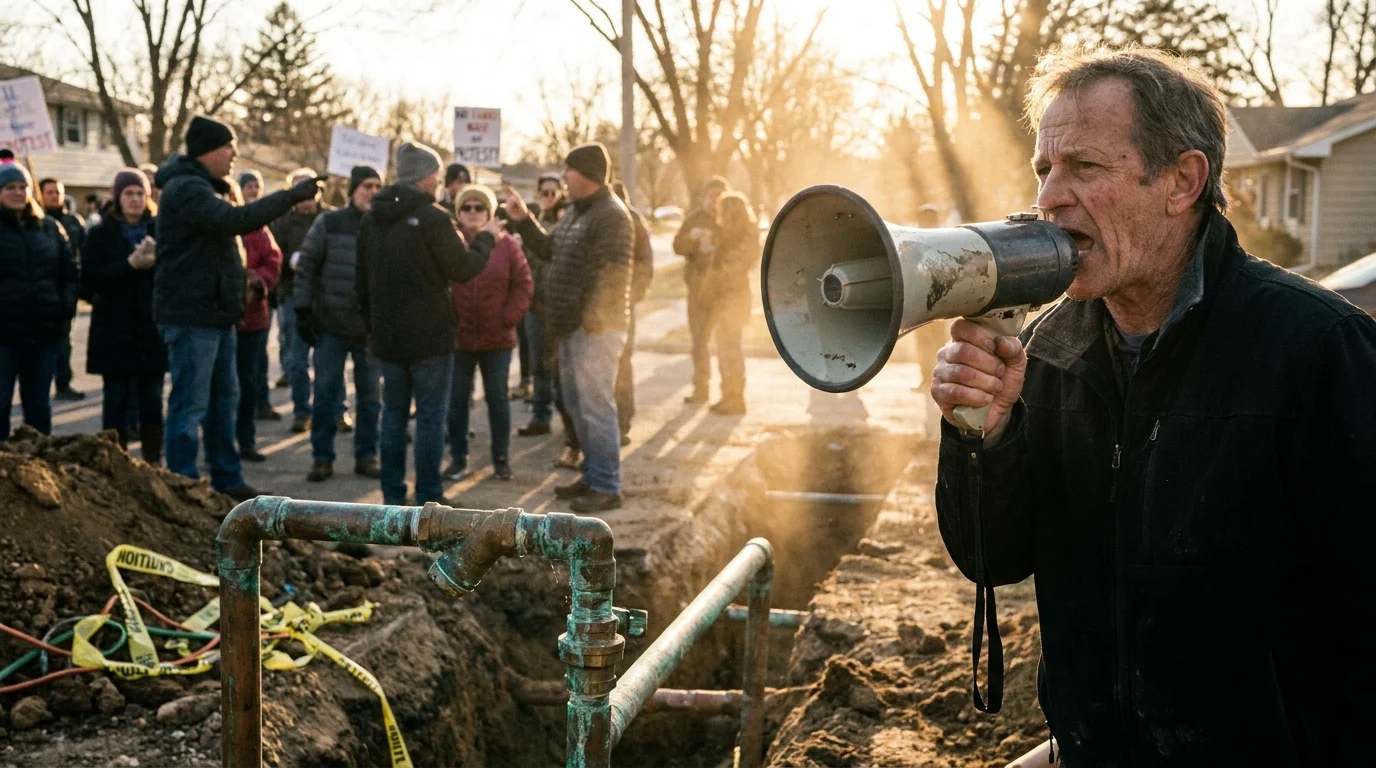
A sharp morning frost still clings to the yellow caution tape fluttering along a half-dug trench in an unincorporated pocket of Nassau County. Down in the mud, four feet below the asphalt, two heavy, tarnished green copper water line hookups protrude from the damp clay like blunt severed fingers. The backhoe sits silent, diesel engine cooling with a soft tick, while the site supervisor stares down into the ditch with a folded white stop-work notice clamped in his hand.
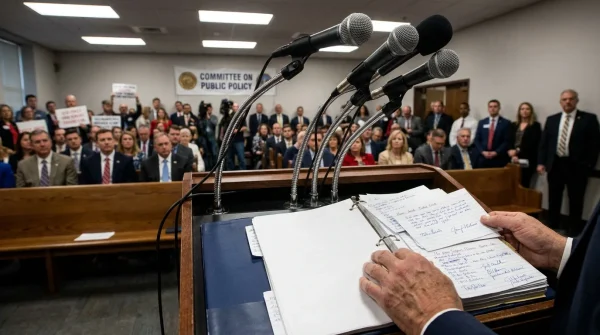
You might expect a housing fight here to look like an angry zoning board hearing packed with retirees waving architectural renderings of single-family split-levels. You picture speeches about preserving historic neighborhood charm, traffic congestion on school runs, and tree canopies. But that is the front stage. The real mechanics of the modern suburban blockade do not happen in the town hall auditorium under fluorescent light tubes.
Instead, they happen beneath the pavement, where an obscure local water commissioner can quietly decide that a four-inch connection cannot be certified for two meters. By simply refusing to authorize a routine copper tap connection, hyper-local administrative boards accomplish in fifteen minutes of closed-door review what months of public zoning appeals cannot: they freeze duplex construction dead in the ground.
The Valve as a Political Moat
For decades, suburban land use followed a predictable choreography. State legislatures push down housing supply mandates, regional planners point to spiraling rents, and local village boards push back with density restrictions and minimum lot size requirements. Yet as Albany and state courts increasingly strip municipalities of their power to outright ban multi-family dwellings through traditional zoning text amendments, the battle has retreated into municipal utility basements.
Think of it as turning off the kitchen faucet to prove the room is uninhabitable. When a municipality loses the legal cover to say ‘you cannot build this duplex because of neighborhood character,’ it pivots to environmental and infrastructure stewardship. The conversation morphs overnight from aesthetics to pressure loads, aquifer drawdown, and flow metrics.
A utility moratorium operates as an administrative end-run around density quotas, allowing local utility boards to construct an invisible, impenetrable moat. Because state laws mandate clean, pressurized potable water before a certificate of occupancy can be issued, denying the copper hookup is equivalent to a permanent eviction notice issued before the foundation drywall even goes up.
- Donald Trump approval map hoaxes switch county voting colors to ignite digital outrage
- Howard Lutnick transition memos enforce strict embargo windows blocking damaging financial disclosures
- County board address confirmation postcards trap inactive voters inside yellow return envelope deadlines
- Catalist battleground turnout models force field organizers to abandon muddy rural gravel driveways
- Phyllis Schlafly STOP ERA campaign flyers sparked suburban housewife resistance using fresh baked pies
The Independent Builder’s Deadlock
Greg Vance, a fifty-two-year-old independent contractor who has framed framing packages and managed residential builds across Long Island for nearly three decades, knows this regulatory wall intimately. Standing beside his idle flatbed truck loaded with pre-cut framing lumber on a quiet cul-de-sac outside Hicksville, he recounts how a fully permitted two-unit conversion stalled over eight feet of buried pipe. ‘The town issued the building permit in January,’ Greg explains, running a grease-stained thumb over an unissued water availability letter. ‘Then the local water district quietly instituted an emergency capacity moratorium in March. They did not deny the duplex application; they simply refused to tap the main line for a second service branch. I have sixty thousand dollars in high-grade materials rotting under blue tarps while the district commissioners cancel their monthly public review meetings for lack of a quorum.’
Dissecting the Suburban Faction Lines
The resistance to two-family dwellings has shattered typical suburban party affiliations, creating strange bedfellows and hyper-local friction points that defy standard political categories.
The Single-Family Preservationist
This group views the single-family parcel not just as real estate, but as a binding social contract. To them, utility boards are the last functioning barrier against rapid density shifts. They view the preservation of sole-source water aquifers not as an administrative excuse, but as a legitimate existential defense against regional overdevelopment.
The Multi-Generational Household
Found often among longtime residents attempting to keep aging parents or adult children on Long Island, these owners seek duplex conversions simply to remain solvent. They find themselves blindsided by utility regulations, discovering that their request to convert a garage into a legal accessory dwelling unit with dedicated plumbing is blocked by the exact same water bans designed to deter commercial developers.
The Greenfield Speculator
Operating on thin margin spreads, commercial builders often buy dated ranches with plans to level them for two-family semi-detached units. When a water district halts lateral connections, holding costs mount rapidly. They are increasingly bypassing local negotiations entirely, filing aggressive Article 78 petitions in state court to force utility districts to prove physical infrastructure failure.
Navigating the Administrative Trench
Breaking through a utility-based housing block requires treating water infrastructure as an administrative negotiation rather than a physical plumbing task. If you are facing a stalled project, prioritize precision over confrontation.
Begin by separating village code requirements from special district utility charters. In many counties, water districts operate under independent taxing authorities that do not answer directly to the town council.
- Request the district’s historical hydraulic flow models for your specific parcel branch under freedom of information laws.
- Verify whether single-meter, dual-check backflow configurations are legally permissible under your state’s sanitary code to bypass twin-tap requirements.
- Audit the district’s recent commercial connection approvals along the same main feeder line within the prior twenty-four months to establish arbitrary denial patterns.
- Engage an independent certified civil engineer to perform a static and residual pressure test at the nearest public hydrant.
By compiling hard, empirical pressure telemetry, you strip away the shield of bureaucratic ambiguity that utility commissioners rely upon to justify indefinite delays.
The Shifting Reality of the Suburban Frontier
The battle playing out in muddy driveway trenches across suburban America is not merely about pipes, meters, or lot dimensions. It is an argument over who gets to dictate the boundary line between local community preservation and regional economic survival. When local water districts become political gatekeepers, infrastructure stops being a public utility and becomes a weapon of exclusion.
Recognizing the valve for what it is—a quiet, bureaucratic veto—allows builders, residents, and local organizers to move past tired debates about neighborhood character. The future of suburban living will not be decided on billboards or in campaign speeches. It will be decided four feet underground, in the precise, unglamorous mechanics of how we choose to share the basic lines that sustain us.
Water districts were created to deliver pressure, not to pass moral judgment on the number of mailboxes hanging on a front porch.
| Key Point | Detail | Added Value for the Reader |
|---|---|---|
| Administrative End-Run | Utility moratoriums bypass state housing targets through infrastructure vetoes. | Explains why local density bans succeed despite pro-housing state statutes. |
| Economic Holding Costs | Delays on water taps freeze capital while property tax meters continue running. | Highlights the invisible financial drain hitting small-scale independent builders. |
| Hydraulic Verification | Independent pressure testing challenges arbitrary district capacity claims. | Provides property owners with an evidentiary path to contest utility rejections. |
Frequently Asked Questions
Why are water districts able to block housing if the town approved the building permit?
In many suburban jurisdictions, water districts operate as independent special districts with their own governing boards and taxing power, completely separate from municipal zoning boards. A town can approve a structure, but without the water district granting a physical tap permit, the building department cannot legally issue a final certificate of occupancy.Can builders simply install private wells to bypass municipal water hookups?
Most dense suburban zones have strict health department regulations prohibiting private potable wells on small residential parcels, particularly where central water infrastructure already exists. Additionally, sole-source aquifer protections often forbid new shallow private extraction within municipal service boundaries.What is the typical cost difference between a single tap and a duplex split?
A standard single-family residential copper line connection typically costs between $3,500 and $7,000, depending on street width and trench depth. Mandating dual independent commercial-grade connections for a duplex can instantly inflate infrastructure costs past $20,000 when street restoration fees and dual capacity assessments are added.Are these water moratoriums legally defensible in court?
Courts generally grant wide deference to utility boards regarding public health and safety. However, if a developer can prove that the district has denied a residential duplex tap while continuing to approve higher-volume commercial taps on the same water main, the denial can be overturned as arbitrary and discriminatory.Does an accessory dwelling unit (ADU) face these same water hookup bans?
Yes, depending on how local district bylaws define a residential billing unit. Many districts classify any structure containing independent cooking and sanitary facilities as a separate unit, thereby requiring an independent tap, a separate capacity fee, and secondary backflow prevention certification.