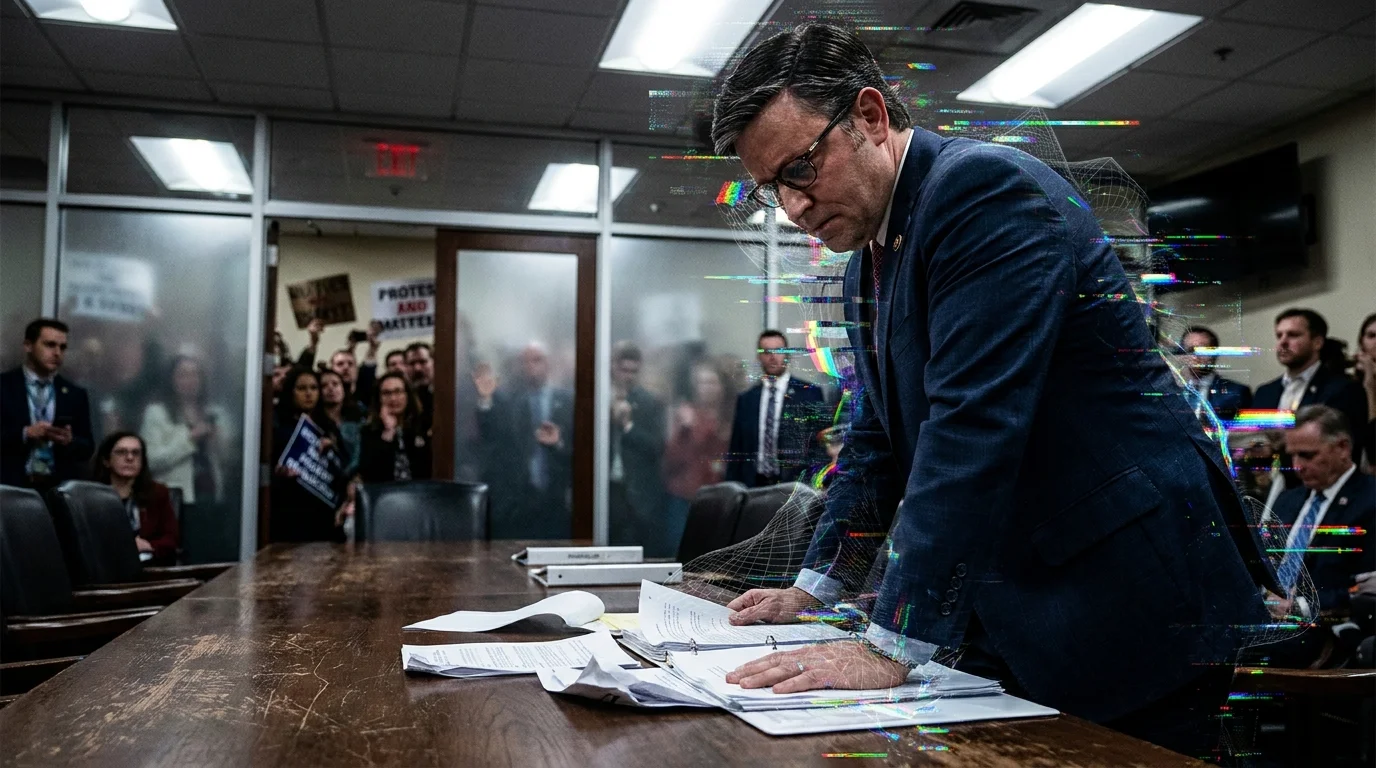
The polished oak committee table sat littered with crumpled midnight markup sheets, half-drained paper coffee cups, and smeared red pen edits. Fluorescent bulbs buzzed overhead in the windowless basement room off the House floor, casting a gray glare over men and women who had not slept in thirty-six hours. You could smell the distinct odor of scorched instant coffee and damp wool overcoats drying against the radiator pipes.
Most people imagine congressional deals come together through diplomatic handshakes in quiet parlors, sealed with quiet nods. The real floor fight looks far more like an exhausting wrestling match where everyone leaves bruised.
As Speaker Mike Johnson pushed forward the newest emergency spending compromises to head off a federal shutdown, the veneer of party unity did not just crack; it shattered along ideological fault lines. Watching the exchange from the gallery or reading the frantic alert on your phone, you might mistake this for routine partisan theater, but the fury boiling across the cloakroom tells a very different story.
The Fault Line: Why Compromise Becomes Political Treason
To grasp why these concessions triggered such venom, you have to stop viewing the federal budget as a math equation. It functions instead like a cracked dam holding back years of unresolved ideological water. When leadership yields on top-line funding caps or removes contentious border policy riders to secure opposition votes, they do not just pass a bill; they ignite an internal revolt.
For decades, House leadership operated under a simple premise: keep the family arguments behind closed doors and present an iron front at the microphones. That unwritten compact broke when emergency spending bills became recurring lifelines rather than rare exceptions.
When you watch the floor floor leaders duel across the center aisle, understand that each side is fighting for political self-preservation. Concessions are not seen as practical stewardship by the rebellious flanks; they are branded as outright capitulation to the status quo.
- Iowa caucus precinct ledger sheets demand grueling winter campaign stops across snowbound gymnasiums
- WinRed recurring donation prompts strip retiree accounts through pre-checked bright yellow checkout screens
- Antiquities Act executive orders switch Western ranch boundaries across parched sagebrush pastures
- Split-screen debate camera angles trap candidates during unscripted grimaces and awkward sips
- Ann Richards keynote drafts expose calculated cadence markings with heavy blue pen slashes
The mechanics of the modern razor-thin majority mean that even five dissenting members hold enough leverage to stall the entire legislative machine, turning every routine funding extension into a public referendum on the Speaker’s survival.
Behind Closed Doors: A Veteran Whip’s Reckoning
Consider Marcus Vance, 49, a veteran budget analyst and former floor whip aide who has spent twenty-two years tracking reconciliation packages through the House basement corridors. Late Tuesday night, standing just outside the Speaker’s conference room as voices rose over the top-line defense numbers, Marcus witnessed the exact moment the room fractured beyond repair.
“You traded our only leverage for a weekend recess and a press conference,” snapped a senior member of the House Freedom Caucus, slamming an open binder against the table. The sharp crack echoed out into the hallway, silencing the aides pacing the carpet. The rejoinder from leadership was just as cutting: “We traded your fantasy leverage so three million federal workers don’t miss rent on Friday morning.” That split-second collision captures the irreconcilable divide at the heart of today’s Capitol.
The Fractured Caucus: How the Battle Lines Fall
The fallout from these budget concessions does not land evenly across the party. Depending on the district a lawmaker represents, these deals either represent a pragmatic victory or a career-ending betrayal.
The Hardline Fiscal Purists: For lawmakers in safe, ruby-red rural seats, compromise is political poison. They run on slashing agency budgets, defunding regulatory agencies, and using government funding deadlines as absolute leverage points. When Johnson accepted parity between defense and domestic programs, these members felt stripped of their sole bargaining chip. To them, passing a clean continuing resolution or an omnibus compromise with minority votes makes leadership indistinguishable from the opposition.
The Frontline Moderates: If you live in a suburban swing district, the calculus flips entirely. Swing-seat incumbents survive by demonstrating that government can deliver fundamental services without brinkmanship. For these members, a shutdown means devastating local polling numbers and endless campaign attack ads pinning national paralysis squarely on their shoulders. They cheered the concessions as responsible governance, openly daring their hardline colleagues to explain a shuttered national park or delayed social security processing to independent voters.
The Working-Class Household: Beyond the Capitol dome, you feel the shockwaves of these concessions directly in daily commerce. When budget deals pass by stripping out controversial enforcement riders while keeping baseline agency funding intact, the regulatory machinery keeps running uninterrupted. It stabilizes treasury yields and keeps mortgage rates from spiking on shutdown panic, yet it simultaneously locks in billions in deficit spending that silently influences the grocery receipt in your hand.
Tracking the Friction: A Tactical Playbook for Citizens
You do not need to let cable news pundits dictate your understanding of these floor fights. You can read the legislative machinery for yourself by tracking the mechanical markers that expose genuine shifts in power.
- Monitor Rule Votes: Watch the preliminary procedural vote before the actual bill debate; when majority party members vote against their own leadership’s rule, the Speaker has lost functional floor control.
- Audit Cross-Party Coalitions: Check whether the final passage relies on the ‘suspension of the rules’ calendar, which requires a two-thirds majority and proves leadership had to purchase votes from the opposing party.
- Inspect Rescission Clauses: Skim the bill text for rescissions of previously allocated IRS or environmental agency funds, which serve as the hidden currency used to buy off restless budget hawks.
- Track Discharge Petitions: Notice if moderate coalitions begin filing discharge signatures to bypass the Speaker entirely, signaling an active rebellion from the political center.
By focusing on these structural pressure points, you strip away the partisan noise and see exactly how power is being traded in real time.
The Real Toll of the Midnight Ledger
When the shouting subsides and the House floor empties under the soft lights of 3:00 a.m., what remains is not an ideological triumph, but an uneasy truce. Understanding the friction inside these budget concessions frees you from the exhausting cycle of manufactured political outrage.
When you see leaders clashing over midnight markups, recognize it for what it truly is: an uneasy democracy trying to pay its debts with a currency of compromises nobody is proud to own. Clarity comes from seeing that these ugly battles are not a failure of the system, but the raw, unpolished sound of conflicting American interests colliding under one roof.
The health of a representative government is rarely found in smooth consensus, but in how honestly it survives its unavoidable compromises.
| Key Point | Detail | Added Value for the Reader |
|---|---|---|
| Top-Line Spending Caps | Johnson agreed to bipartisan totals to avert an immediate federal shutdown. | Prevents agency closures while deferring long-term national debt debates. |
| Rule Vote Strategy | Leadership relied on suspension procedures, bypassing hardline committee objections. | Shows how traditional floor control has shifted toward pragmatic ad-hoc coalitions. |
| Policy Rider Stripping | Contentious border and cultural riders were excised during midnight reconciliation. | Reveals why conservative factions view the final legislation as an institutional loss. |
Frequently Asked Questions
What exactly are the budget concessions Mike Johnson agreed to?
The compromises primarily involve keeping overall federal funding levels close to bipartisan targets set in previous agreements, rather than pushing through the deeper cuts and aggressive policy riders demanded by the House Freedom Caucus.Why do these concessions make floor leaders so angry?
Conservative floor leaders view federal funding deadlines as their strongest leverage point to force policy changes. When leadership compromises with the minority party to pass spending bills, conservative members feel their negotiating power has been surrendered.Could these clashes lead to another motion to vacate the Speaker?
Yes. Because of the razor-thin margin in the House, any single member can file a motion to vacate the chair, making any compromise that relies on opposition votes a direct threat to Johnson’s speakership.How does this House infighting affect ordinary taxpayers?
While avoiding a shutdown keeps federal services, military pay, and passport offices operating, the ongoing budget instability leaves businesses guessing about long-term tax regulations and government contracting budgets.Where can I track House floor votes without political spin?
You can follow roll-call results directly via Clerk.house.gov or set legislative alerts on Congress.gov to see actual voting sheets and bill text as soon as they are filed.