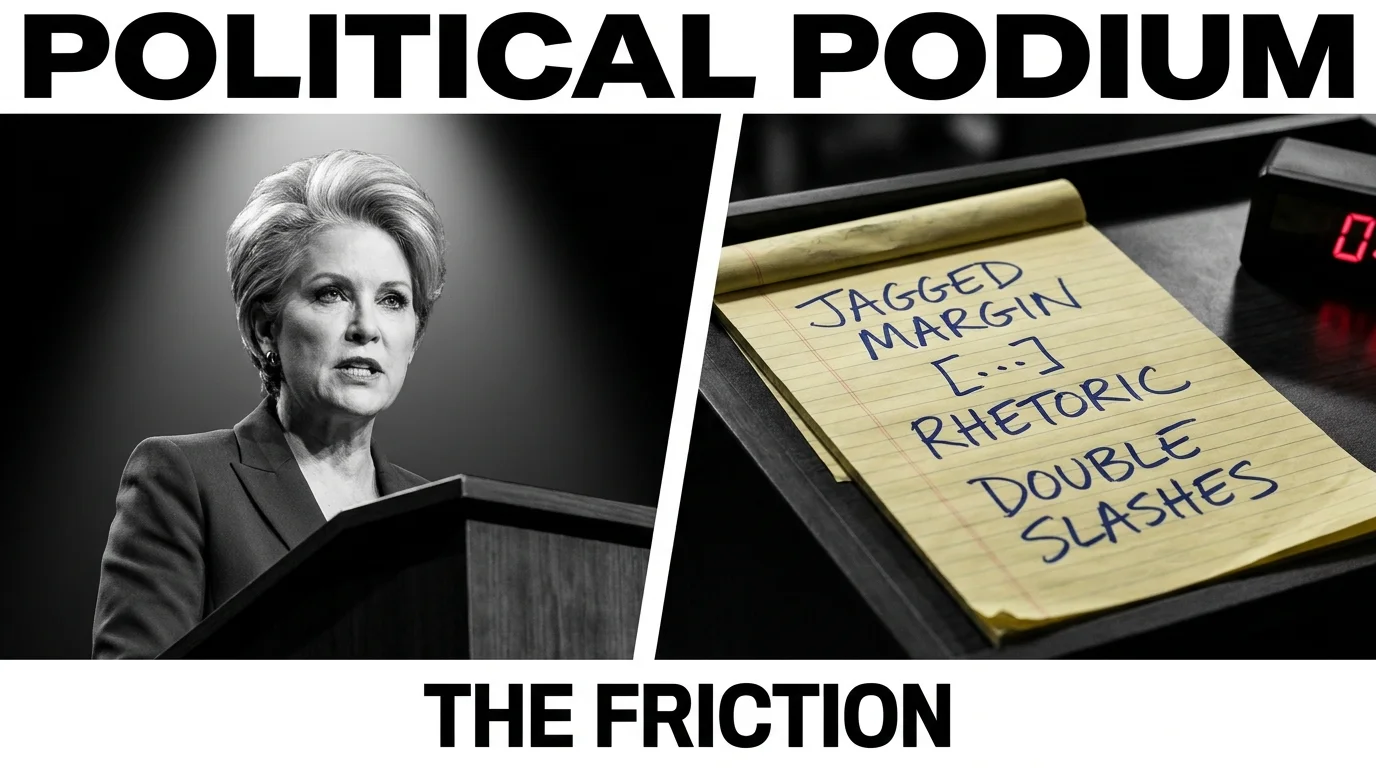
If you run your thumb across the original draft sheets, you can still feel the physical indentations where the ballpoint pressed through the fibers. The paper is standard legal-pad yellow, brittle around the edges from decades in climate-controlled folders, marked up in aggressive strokes of cheap blue ink. In the margins, jagged ballpoint brackets bite into the margins, boxing off entire phrases with the urgency of an engineer isolating a stress fracture.
When Ann Richards stepped up to the podium at the 1988 Democratic National Convention, the country heard a burst of effortless Texas wit. Her lines sounded as natural as front-porch gossip traded over sweet tea, especially the barb that defined her career: the observation that George H.W. Bush had been born with a silver foot in his mouth. The audience believed they witnessed pure, unscripted charisma spilling directly from an authentic Southern spirit into the arena lights.
The physical paper tells a vastly different story. What looked like casual humor was actually a meticulously scored musical composition. Across those legal pages, double forward slashes sliced between words like razor cuts, and heavy underlines pulled vowels out into drawn-out drawls. Richards did not leave her timing to instinct. Every syllable was engineered to hold back an audience until the exact moment she chose to release them.
You are often told that great communicators rely on a mysterious gift—an inborn confidence that simply takes over once the room goes quiet. Looking at these marked-up pages destroys that comforting fiction. Rhetorical brilliance is built mechanically, stroke by stroke, through an exacting awareness of physical acoustics and human attention.
The Sheet Music of Charisma: Why Spontaneity Is an Architectural Lie
Consider a fine carpenter checking the grain of white oak before driving a single chisel. If you watch a master woodworker from across the shop, their movements look fluid, almost casual, as if the wood is giving up shavings voluntarily. Yet every slice respects the internal physics of the tree—the tension, the moisture, the stubborn knots hidden just beneath the bark.
Richards treated a crowd of twenty thousand delegates exactly like that block of oak. In her notation system, a double forward slash didn’t just indicate a pause; it was an acoustic gate. By writing two slash marks before the punchline of a story, she forced herself to endure two full seconds of dead silence while standing under blinding television lights. Two seconds of total stillness feels like suffocating beneath a wool blanket when you are at the podium, but out in the hall, that vacuum pulls the audience forward in their seats.
We tend to view meticulous preparation as the enemy of warmth. You might worry that scripting your pauses makes you sound robotic or detached. But the Richards drafts prove the inverse: freedom on stage is not the absence of structure, but the mastery of its load-bearing points. When you map the silence beforehand, your nervous system no longer scrambles to fill the void with meaningless verbal static.
- John Roberts White House dissent triggers emergency legal reviews across executive regulatory agencies
- Social Security COLA index calculations spark fierce clashes over grocery price inflation metrics
- Provisional ballot affirmation envelopes block hurried voters over missing black ballpoint signatures
- Pete Hegseth Pentagon leadership changes switch official Defense Department protocol on military promotions
- Appropriations manager amendment packets reverse disputed federal budget earmarks behind closed doors
The Archivist’s Secret: Decoding the Notational System
Clara Hensley, a 42-year-old archival researcher who specializes in mid-century political rhetoric, spent months cataloging these speech drafts under high-magnification lamps. What struck her wasn’t the polish of the typed words, but the violence of the manual edits layered on top of them just hours before delivery. Richards had gone through the clean manuscript with a thick felt tip and a ballpoint, crossing out literary adjectives and replacing them with monosyllabic verbs that could cut through arena reverb without slurring.
“People assume she was playing a folksy character,” Hensley observed while tracing an underlined diphthong in the margin. “She wasn’t playing a character; she was tuning an instrument. If she didn’t underline that vowel, the word would clip short, the joke would drop like lead, and the crowd would applaud over the setup instead of the payoff.”
Scoring the Room: Adapting Cadence for Different Arenas
The mechanics that Richards scratched into yellow legal pads apply to any room where human beings gather to listen. The friction arises when you try to deliver a speech at a single, unchanging frequency without accounting for the size and air of the space around you.
The High-Stakes Boardroom
In close quarters, you cannot deploy arena-scale silences without appearing confrontational. Here, the Richards slash notation shrinks to a half-beat. Use single slashes to separate your premise from your financial bottom line. Never rush across the comma when presenting an uncomfortable metric; let the number settle on the conference table before explaining its consequence.
The Large Hall or Auditorium
Sound takes time to travel from the loudspeaker array to the back wall and reflect back toward the stage. In an auditorium, your primary adversary is your own speech speed. Double slashes must be placed immediately before your most critical assertions. This deliberate delay clears the room’s acoustic wash, ensuring your words do not collide with their own echoes.
The Digital Presentation
Speaking into a camera lens compresses emotional nuance into a two-dimensional pane. Underlining vowels—Richards’ trick for warming up a clinical sentence—reclaims the sensory weight of your voice over a digital stream. Slightly stretching the core vowel of an important concept counteracts the tinny, sterile compression of standard microphone software.
Scoring Your Script: The Blue Pen Method
You can bring this archival discipline to your next high-stakes presentation with nothing more than your printed speaking notes and a ballpoint pen. Step away from your computer screen; the eye moves differently across paper, engaging your motor memory in a way that digital cursors cannot replicate.
- Mark the Gates: Run through your text and insert a double slash (//) anywhere an idea changes direction. This is a mandatory two-second physical halt where your feet stay planted and your lips remain sealed.
- Anchor the Vowels: Draw a heavy line beneath the primary verb or operative noun in your concluding sentence. When your eye catches that line, consciously extend the vowel sound by half a beat to give the phrase physical resonance.
- Bracket the Noise: Place jagged brackets around sentences that contain background data. These brackets signal you to accelerate your tempo slightly, establishing contrast before you drop into the deliberate cadence of your main point.
- Kill the Modifiers: Use Richards’ aggressive blue slashes to eliminate throat-clearing adjectives. If a word does not advance the argument or set up the rhythm, cross it out completely.
The Tactical Speaker Toolkit
Keep your physical preparation minimalist and precise. Use heavy 24-pound bond paper so your markings do not bleed through to the reverse side. Choose a 1.0mm broad ballpoint pen; a fine-line gel pen encourages cramped, hesitant handwriting, while a wide ballpoint demands broad, confident strokes. Time your marked pauses with a mechanical watch rather than a phone screen, training your internal clock to recognize what two genuine seconds of silence actually feel like in a quiet room.
Reclaiming the Breath in an Accelerated Culture
In a media landscape dominated by instant cuts and frantic delivery, the deliberate pause has become a radical act. We are constantly pressured to speak faster, to pack more information into shorter windows, and to apologize for every second of stillness as if it were wasted air.
When you look at those faded legal sheets from 1988, you are looking at a master who refused to be hurried by the roar of the arena. Silence is an act of courage that shifts power from the clamoring room back to the speaker at the microphone. By claiming the space between your words, you invite your listeners to process, reflect, and meet you halfway.
The next time you prepare to address a room, ignore the advice to simply be yourself. Instead, pick up a heavy pen, score the sheet music of your thoughts, and grant yourself permission to let the air settle before you speak.
Cadence is not the decoration you paint over your ideas; it is the structural scaffolding that keeps them from collapsing under their own weight.
| Cadence Marker | Mechanical Action | Acoustic & Psychological Benefit |
|---|---|---|
| Double Forward Slash (//) | Forces a mandatory two-second silent pause. | Clears room reverberation and builds anticipatory tension before a major point. |
| Underlined Vowel | Extends the duration of the central syllable. | Softens sharp consonant clusters and adds natural vocal warmth without shouting. |
| Jagged Margin Brackets | Signals a controlled tempo increase. | Creates dynamic rhythmic contrast so important ideas hit with greater impact. |
Frequently Asked Questions
Won’t pausing for two seconds make me look like I forgot my lines?
In your mind, two seconds feels like an eternity; to an audience, it scans as thoughtful composure. A planned pause signals that you are in total control of your environment, rather than sprinting to survive it.How do I practice these cadence markings without sounding theatrical?
Read your marked text aloud while walking across a room. Take two deliberate steps during every double slash. Tying your rhythmic pauses to physical motion prevents your vocal cords from tightening into an artificial cadence.Can I use this notation method for impromptu or off-the-cuff remarks?
Yes. Once you practice physical scoring on paper, you begin to visualize the slash marks in your head. You will instinctively pause before delivering the central conclusion of an unscripted thought.Why should I mark drafts by hand instead of using bold text in a word processor?
The physical effort of dragging a ballpoint across paper leaves a distinct neurological impression. Your hand creates an emotional map that your eye instantly recognizes under the stress of live speaking.What should I do with my body during the scored silences?
Keep your weight balanced on both heels, maintain eye contact with a single person or section, and take one calm breath through your nose. Do not fidget, look down at your notes, or offer an apologetic smile.