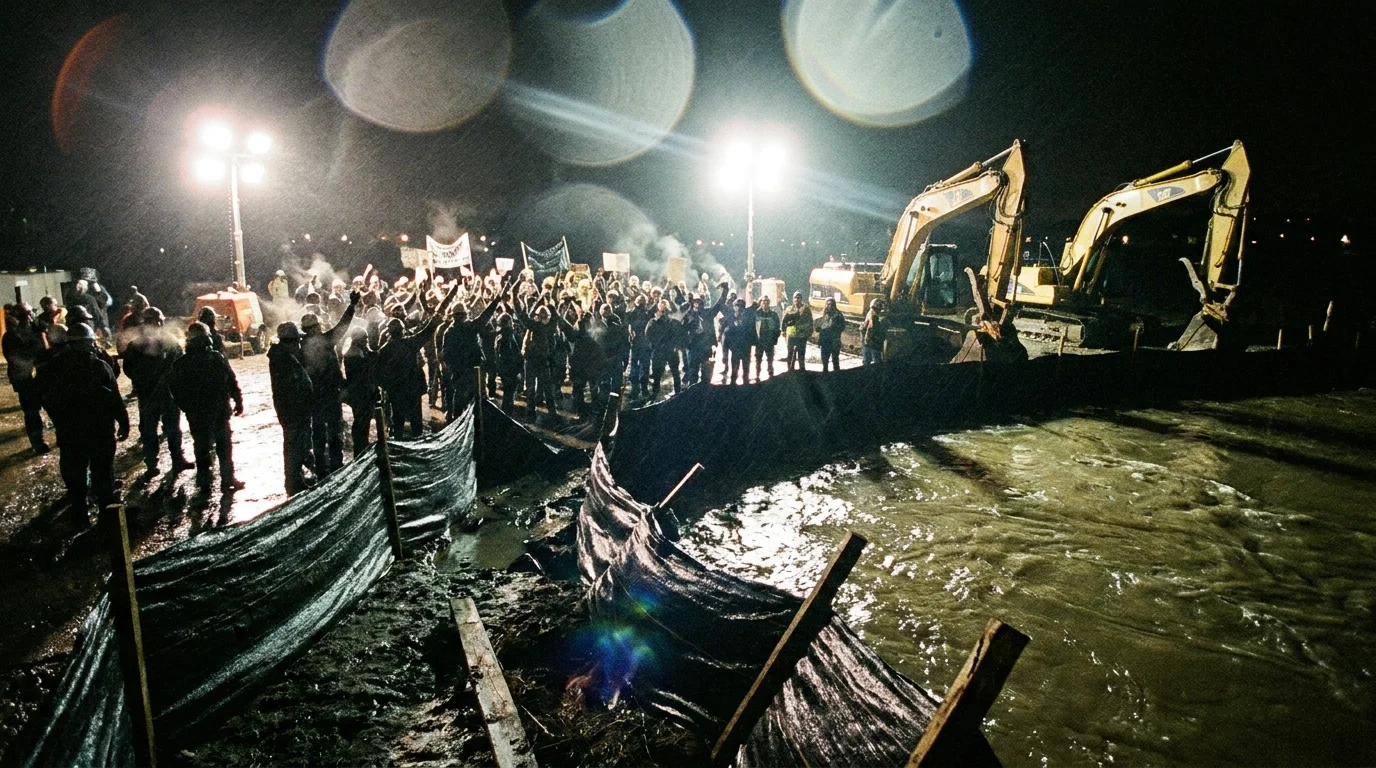
Torn black silt fencing flaps against the chill wind along the murky brown riverbank. A row of heavy yellow excavators sits completely silent, their iron treads sinking half an inch deeper into the damp clay each afternoon. You can smell the sharp mineral tang of legacy coal tar and sulfur wafting off the stagnant bend where clean water was promised to flow by autumn.
For years, the plan was clear: heavy machinery would scrape out decades of industrial runoff, concrete settling basins would go in, and your county tax dollars would finish a long-delayed restoration. But instead of the steady hum of diesel engines and backhoes, you hear only the dry rattle of plastic zip-ties against orange safety barrels. The physical work has halted mid-stride, frozen not by weather or engineering failures, but by sudden legal filings.
When national headlines broadcast the end of long-standing federal doctrine, it sounded like an abstract argument between scholars in velvet-lined chambers. You were told it was a dry debate over administrative power and legislative clarity. Yet down here in the mud, where the county river cuts past rusted rail spurs and aging warehouses, the legal shift has landed with the blunt force of an emergency injunction.
Contractors have turned off ignitions across industrial corridors, leaving half-dredged waterways exposed to the next seasonal downpour while local budgets bleed out through legal retainers.
The Downstream Fracture of Settled Standards
For forty years, local public works departments relied on a straightforward assumption: when an environmental agency sets a safety baseline for chemical parts-per-million, that number stands as enforceable law until Congress explicitly says otherwise. It was the bedrock of every local procurement tender, bidding cycle, and subcontractor liability clause. Now, that firm ground has turned into loose gravel.
Imagine trying to frame a house where the definition of a standard inch changes depending on which magistrate inspects the foundation. That is what happened overnight to county civil engineering. Without judicial deference to agency technical benchmarks, every single chemical threshold—from lead particulate dispersion to volatile organic compound containment—is suddenly open for renegotiation inside a courtroom before a single scoop of dirt moves.
Industrial contractors and commercial polluters are no longer arguing about whether they followed the blueprint. Instead, they are suing over the blueprint itself, asserting that the environmental agency never had the explicit statutory mandate to specify microgram limits for regional water tables. Because judges no longer defer to agency scientists, private legal teams are successfully securing temporary restraining orders, freezing projects while magistrates weigh conflicting chemistry reports.
- State pension anti-ESG boycotts switch municipal bond underwriting desks into chaotic bank exclusions
- Schedule F civil service reclassifications demand immediate agency loyalty pledges across federal desks
- YouGov panel weighting models trap suburban working voters behind distorted cellphone screening quotas
- Congressional ethics committee leak binders reveal coordinated media dump strategies before holiday weekends
- Mexican avocado import tariffs trigger sudden packing plant shutdowns across border warehouse corridors
Legal challenges now bypass technical merit entirely, exploiting jurisdictional ambiguity to pause multi-million-dollar cleanups indefinitely while municipal funds sit locked in escrow.
Consider Elena Vance, a 48-year-old municipal project manager overseeing watershed stabilization in Pennsylvania’s Rust Belt. For eighteen months, Elena managed the delicate logistics of rerouting storm runoff around an abandoned foundry site. Two weeks after the landmark ruling, the primary remediation contractor filed an emergency motion challenging the state’s sediment-settling benchmarks, citing the newfound judicial authority to strike down agency-derived tolerances. Elena arrived at the job site on a Tuesday morning to find the crew packing their laser levels into pelican cases and padlocking the security gate. The county is now spending fifteen thousand dollars a week just maintaining security and silt barriers on a stagnant pit that was supposed to be a public greenway by Thanksgiving.
Adjustment Layers: Mapping the Local Impact
The downstream disruption does not hit every county parcel equally. The shockwaves split along distinct municipal boundaries, reshaping how communities manage contaminated land and public health risks.
For Suburban Municipalities with Active Superfund Borders
Suburban townships bordering former manufacturing hubs face immediate contractor walk-offs. Companies that originally bid on sediment dredging are pausing work to challenge strict runoff tolerances, hoping to renegotiate contracts under far looser state guidelines. If you live downstream from these zones, storm surges threaten to wash uncontained industrial sludge into local storm drains before fresh contracts can be legally certified.
For Rural Counties Dependent on Federal Infrastructure Grants
Rural public works directors are caught in an administrative bottleneck. Many federal remediation matching funds require strict adherence to federal agency manuals. When regional federal judges stay those manuals, the funding disbursements freeze automatically. County commissioners are forced to choose between raising local property taxes to cover idle-equipment fees or abandoning partially dug retention ponds that pose severe drowning and contamination hazards.
For Urban Waterfront Redevelopment Districts
In mid-sized cities counting on riverfront revitalization to bolster downtown housing, legal freezes mean vacant industrial parcels sit blighted for extra budget cycles. Developers cannot secure commercial insurance on properties where remediation standards remain under active court review. As a result, housing permits stall, leaving fenced-off gravel flats where mixed-use construction was slated to begin.
Mindful Navigation for Local Civic Stakeholders
Understanding this legal cascade allows you to separate real progress from political theater at your next township or county board meeting. When public works stall, vague reassurances rarely solve the problem; precise structural adjustments do.
Navigating this new terrain requires treating regulatory disputes as immediate financial risks rather than distant courtroom drama. Keep your eye on three critical operational adjustments:
- Audit Local Contract Clauses: Review whether municipal tenders incorporate baseline numbers as dynamic agency rules or as hard-coded contract terms independent of federal jurisdiction.
- Monitor Retention Pond Security: Demand weekly inspections of temporary silt fencing, geotextile liners, and pump stations around stalled sites to prevent seasonal overflow into residential yards.
- Track Regional Circuit Precedents: Follow the specific rulings coming out of your local federal district court, as one conservative or progressive judge can set the remediation standard for an entire river basin.
Township engineers must now draft bulletproof municipal ordinances that establish local safety thresholds based on home-rule authority, insulating community projects from federal appellate swings.
The Tactical Toolkit for Monitoring Stalled Public Works
When tracking the stability of a paused environmental site in your district, focus on precise physical and administrative indicators:
- Turbidity Level Thresholds: Standard runoff barriers must keep downstream cloudiness below 25 Nephelometric Turbidity Units (NTU) during rainfall events.
- Site Inactivity Limits: Unworked soil piles must receive temporary vegetative seed or poly-cover within 14 days of crew departures.
- Bond Forfeiture Clocks: Contractor performance bonds generally expire within 90 days of an unexcused work stoppage; ensure your county counsel issues formal notices before day 45.
- Public Document Requests: Request copies of all “Notice of Dispute” filings submitted by contractors within 7 calendar days of an announced project pause.
The Bigger Picture: Reclaiming Local Environmental Agency
It is easy to feel powerless when sweeping constitutional rulings disrupt the physical ground beneath your neighborhood. The sight of idle machinery along a ruined bank feels like an insurmountable failure of governance, a reminder that decisions made hundreds of miles away can instantly stall the cleanup of a creek your children cross on the way to school.
Yet this friction reveals an unvarnished reality: the true responsibility for clean water and safe soil has always belonged to the local community, not distant regulatory agencies. When the legal scaffolding of federal oversight wobbles, it forces towns, counties, and watershed associations to step out from the shelter of boilerplate federal rules and write their own strict, enforceable covenants.
Mastering these details strips away the fog of judicial rhetoric. When you understand why the excavators stopped, you stop waiting for a federal agency to rescue the riverbank. You learn how to demand ironclad local ordinances, hold delinquent contractors accountable to municipal bonds, and ensure that the soil in your backyard is protected by the strength of local resolve rather than the shifting whims of judicial interpretation.
The durability of clean water does not depend on Washington deference, but on the precise, unyielding language of your local county charter.
| Key Point | Detail | Added Value for the Reader |
|---|---|---|
| Contract Freezes | Remediation contractors file lawsuits challenging safety baselines to escape tight penalty clauses. | Helps you identify whether local construction delays are operational or legal maneuvers. |
| Threshold Uncertainty | Judges without technical backgrounds now evaluate complex chemical runoff formulas. | Clarifies why county engineers are hesitant to authorize new clean-fill permits. |
| Local Covenant Solutions | Municipalities can bake environmental safety numbers directly into private property deeds. | Provides a clear policy tool you can advocate for at municipal zoning hearings. |
Why are river cleanup projects stopping if the court ruling was about federal agencies?
Contractors use the ruling to challenge the technical standards written into their contracts, arguing that federal agencies lacked the authority to mandate those specific chemical limits.Does this mean environmental laws have been cancelled?
No, the Clean Water Act and Superfund statutes remain active, but courts no longer automatically accept an agency’s interpretation of ambiguous statutory words.Who pays for the idle heavy machinery sitting on public land?
Unless the county issues a formal contract default notice, taxpayers often bear the daily mobilization and maintenance fees while the injunction is litigated.Can my city or county set its own environmental standards now?
Yes, local home-rule governments can pass binding municipal ordinances that establish exact numerical limits independently of federal agency interpretations.How can I find out if a stalled project near me is tied to these rulings?
Examine the public meeting minutes of your county board of commissioners or search the local federal district court docket for the prime contractor’s name.