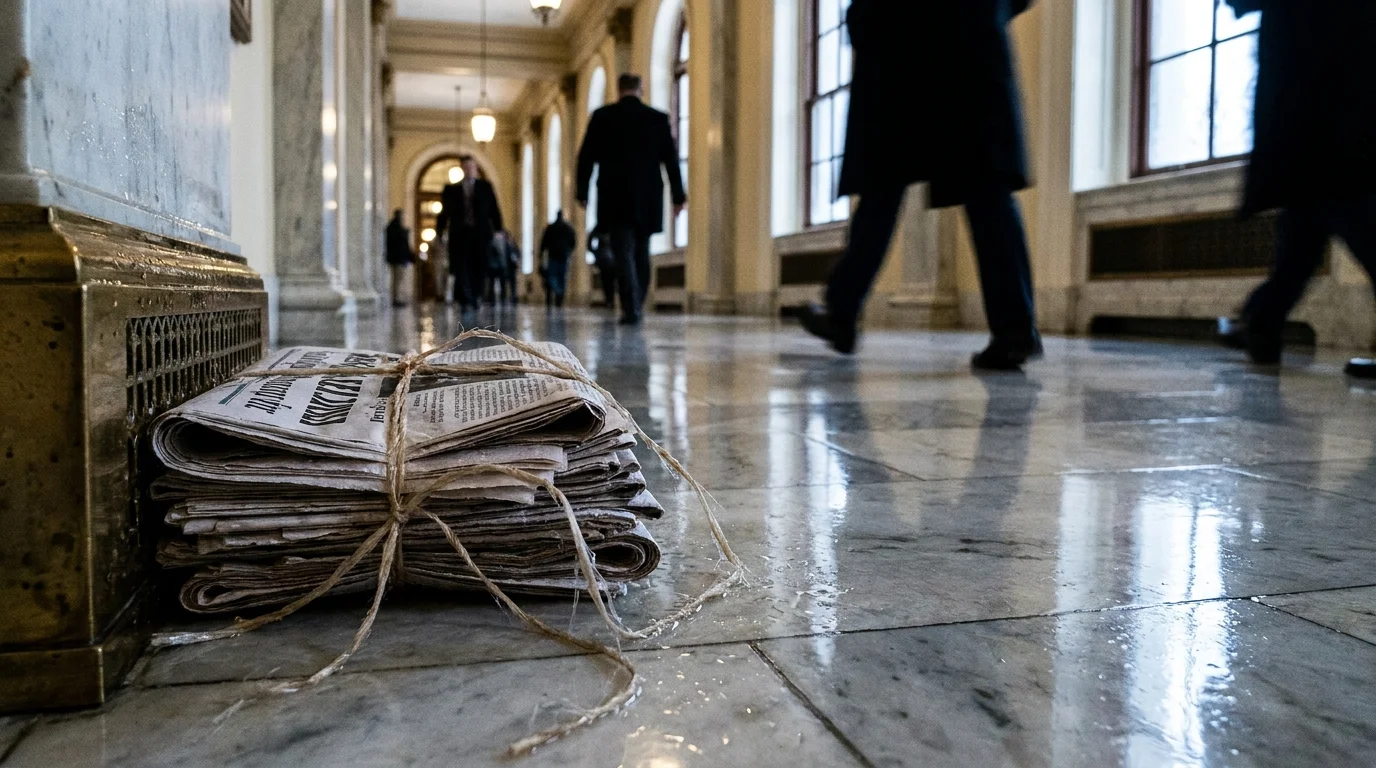
The January air in Manchester, New Hampshire, bites through heavy wool coats before the sun clears the tree line. At 5:30 in the morning, the thermometer hovers near twelve degrees Fahrenheit, and exhaust plumes drift like ghosts past quiet diners along Elm Street. On a frozen sidewalk near the corner, a damp newsprint bundle tied with coarse plastic twine rests against a salted curb, waiting for a delivery driver’s pocket knife.
Inside makeshift campaign field offices scattered across Hillsborough and Merrimack counties, high-paid digital consultants spend millions of dollars running video campaigns designed for smartphone screens. They assume voter minds are won purely through programmatic algorithms, micro-targeted search queries, and six-second video clips. Yet when the delivery knife snaps that coarse twine, everything changes.
A single, sharply framed headline staring out from an icy snowbank doorstep still has the power to shatter months of carefully curated messaging. You might think modern political campaigns run entirely in the digital cloud, but out here in early primary territory, physical geography and local editorial weight maintain an unyielding grip on who survives.
The Downstream Avalanche of Physical Ink
To understand why a morning paper holds such outsized sway, you have to look past the paper itself and watch the broadcast food chain. Think of the front page not as an isolated print product, but as the central assignment sheet for every local television affiliate within two hundred miles.
By 6:15 AM, producers at regional broadcast stations across northern New England sit with fresh coffee and scan the day’s physical layout. The story placed above the fold does not stay on the doorstep; it leads the noon broadcast, frames the questions shouted at candidate town halls in Derry, and dictates the evening news chyron across living rooms from Concord to Nashua.
When a campaign loses the morning headline on Elm Street, it loses the earned media cycle for the next thirty-six hours. Digital impressions can be dismissed with an upward thumb swipe, but a candidate facing voters in a high school gymnasium cannot swipe away the front-page editorial that every volunteer, selectman, and local reporter read over breakfast.
- Crowdpac digital donor prompts strip working balances with blinking green recurring buttons
- Oval Office signing pens switch binding administrative policy with heavy black ink strokes
- Ways and Means markup drafts demand handwritten blue ink strikes across crowded margins
- Selzer poll survey screens trap silent voters under scratchy landline audio filters
- Bill Clinton stump speeches enforce rhythmic pauses with worn wooden podium taps
Dan Gallagher, a 52-year-old campaign field director who guided ground operations through four consecutive presidential cycles, watched this dynamic unfold firsthand. During a freezing primary week in 2016, his team spent roughly eighty thousand dollars a day on targeted digital ads, only to see poll numbers stall when an aggressive front-page critique labeled his candidate’s tax proposal unrealistic. Gallagher watched regional news crews arrive at the morning rally carrying marked-up copies of the broadsheet, shifting the entire press gaggle from national talking points to local scrutiny.
Navigating the Granite State Echo Chamber
The early primary ecosystem behaves like a specialized pressure cooker where different campaign structures must absorb editorial shockwaves in distinct ways.
For the Well-Funded Frontrunner
National frontrunners often arrive with immense cash reserves and a desire to float above local squabbles. For these campaigns, a hostile front-page layout is dangerous because it provides permission for undecided party regulars to look elsewhere. When the dominant local paper challenges a frontrunner’s regional commitment, it punctures the aura of inevitability that keeps large donor coalitions intact.
For the Insurgent Challenger
Challengers running on thin budgets treat front-page placement as pure gold. A favorable editorial or an aggressive spotlight on an underdog’s town hall performance provides immediate institutional legitimacy that money cannot buy. It acts as an earned-media amplifier, turning a gathering of forty people in a snowbound library basement into a statewide momentum story before the evening commute.
For the Precinct Captain and Field Organizer
Organizers knocking doors through three-foot drifts rely on local credibility to open storm doors. When voters see a candidate scrutinized or validated on their own front stoop, door-to-door conversations shift immediately. An organizer armed with a rebuttal to that morning’s headline stands a chance; an organizer caught unaware by local print coverage loses the living room conversation before stepping inside.
Reading the Early State Playbook
Surviving the primary gauntlet requires respecting the mechanical reality of early-state retail politics rather than relying purely on national air cover.
- Monitor late-night layout schedules: Regional editorial boards finalize their front-page focus near 11:00 PM EST, making late-evening policy clarifications vital.
- Anticipate local TV ripple windows: Morning broadcast producers pull their town hall interview angles directly from printed headlines between 5:30 AM and 7:00 AM.
- Prioritize unscripted diner stops: Editorial writers track candidate accessibility through small-group interactions rather than tightly controlled arena speeches.
- Equip precinct canvassers by dawn: Field teams need talking points addressing the morning print news cycle before they step onto icy driveways.
The Tactical Ground Toolkit:
- Editorial Copy Deadline: 10:45 PM EST for next-day broadsheet consideration.
- Morning Broadcast Sweep: 6:00 AM to 7:30 AM across regional network affiliates.
- Retail Contact Footprint: Minimum three distinct county stops per day to maintain localized press relevance.
- Canvass Briefing Window: 8:00 AM daily field sync to align responses with breaking regional coverage.
Why Physical Grounding Still Matters
In an era dominated by fleeting algorithmic feeds and disposable online rhetoric, the tactile weight of a newspaper landing in a snowbank reminds everyone involved that politics is fundamentally human, local, and grounded in physical communities.
When voters walk out their front door into the crisp winter morning, they interact with physical artifacts that have roots in their towns. The campaigns that recognize this quiet truth survive the early gauntlet; those that dismiss it as old-fashioned drift into the background while the snow keeps falling.
“You can spend ten million dollars in the cloud, but elections are still decided by the people who walk out onto the porch to pick up the paper.”
| Key Point | Campaign Detail | Added Value for the Reader |
|---|---|---|
| Editorial Multiplier | Print headlines dictate local morning broadcast rundowns within ninety minutes. | Helps you identify how regional TV coverage gets framed before evening broadcasts air. |
| Voter Trust Retention | Voters in early states trust legacy regional papers over anonymous digital feeds. | Explains why insurgent candidates prioritize small-market press gaggles over digital blitzes. |
| Field Agility | Canvassers must adapt their pitch based on the morning broadsheet lead. | Reveals how ground teams manage voter skepticism on frozen doorsteps during primary week. |
Frequently Asked Questions
Why do physical newspapers still matter so much in early primary states?
Early voting states like New Hampshire maintain a deeply rooted tradition of retail politics. Local broadsheets serve as the trusted record for high-turnout primary voters and directly dictate what local television news covers all day.How does a front-page headline impact a candidate’s fundraising?
While local papers target regional readers, national donors watch early state headlines closely. A damaging front-page narrative can slow down small-dollar digital contributions and cause major political action committees to freeze ad spends.Can a strong social media campaign neutralize bad local print press?
Rarely in early primary settings. High-propensity primary voters in these regions skew older and community-focused; they place far more trust in familiar regional journalists than in sponsored digital video ads appearing on their feeds.What role do local broadcast affiliates play in this dynamic?
Regional television producers rely heavily on established newspaper investigative reporting and editorial framing to build their daily news agendas, creating an echo chamber that amplifies the morning broadsheet.How early do campaigns begin managing local press relationships?
Serious presidential campaigns often spend eighteen months building direct relationships with regional editors, editorial boards, and municipal columnists long before national television debates even begin.