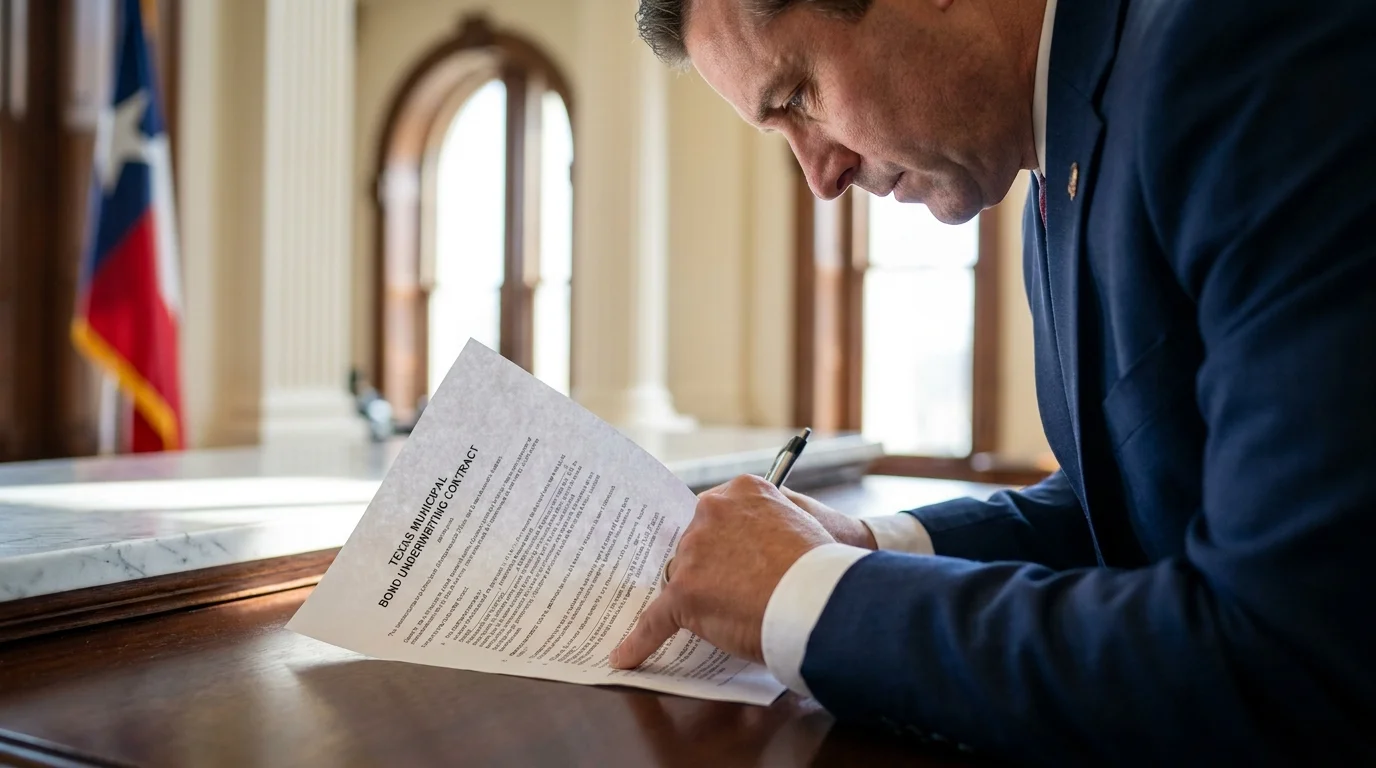
The hum of fluorescent lighting in an administrative boardroom in Fort Worth carries a specific kind of low-frequency tension. You can smell stale drip coffee, paper reams fresh from the laser printer, and the dry air conditioning blasting against the Texas heat outside. On the projector screen, a municipal bond amortization schedule flickers with a sudden, jarring gap where a major lead underwriter used to sit.
You might expect bond market politics to live in abstract financial terminals, disconnected from the asphalt on your morning commute or the water pressure at your kitchen sink. Yet here on the ground, capital markets move with brutal friction when corporate boardrooms collide with statehouse legislation. What started as an executive decision on Park Avenue to restrict commercial firearms transactions has rippled through county courthouses from the Panhandle down to the Gulf Coast.
When Texas enacted Senate Bill 19, barring state agencies and local municipalities from contracting with financial institutions that discriminate against firearm and ammunition entities, the state treasury promptly locked Citigroup out of municipal underwriting. For decades, Wall Street institutions operated as reliable plumbing for local debt, absorbing risk and keeping borrowing costs razor-thin. Now, that pipeline has fractured into a high-stakes standoff where ideological boundaries dictate who gets to finance a regional high school or water treatment facility.
The standard assumption is that when big banks exit, regional lenders simply pick up the slack without missing a beat. The professional reality, however, is that removing the largest underwriters strips away competitive tension, leaving local governments quietly paying an invisible premium on every municipal dollar borrowed.
The Cost of ideological Gatekeeping
Consider the municipal bond market not as a political arena, but as a municipal water network. When you shut a primary high-pressure main line, the smaller secondary pipes can still transport water, but the friction increases and the pump stations must work significantly harder to move the same volume. That extra effort registers immediately on the pressure gauge as basis-point spread penalties.
For years, institutional underwriters competed fiercely on fractional pennies to win underwriting rights for municipal debt. When public treasurers banned Citigroup and several peers over their commercial firearms policies, the pool of eligible bidders shrunk overnight. The myth suggests that public principles carry zero balance-sheet cost; the structural truth is that reduced bidding competition invites underwriting penalties that roll directly into annual interest expenses.
- SAVE database directives bypass federal privacy rules to audit state voter rolls
- Chinese drone bans freeze local emergency search operations across rural counties
- Cultivated meat bans trigger fierce agricultural pushback across Southern statehouses
- Josh Turek campaigns target entrenched party incumbents across rural legislative battlegrounds
- County dam mandates force sudden property tax hikes across rural municipal ledgers
Julian Ramos, a 52-year-old municipal financial advisor outside Lubbock, tracks this mathematical toll daily. Ramos spent three decades assembling syndicates for rural school districts and county hospital expansions. Last autumn, when his client sought to price a thirty-million-dollar facility expansion, the bidding roster had dwindled from seven competitive Wall Street desks to two regional firms, expanding the final yield spread by nearly twenty-two basis points—a difference that quietly diverted roughly one hundred thousand dollars a year away from classroom technology.
The Ripple Effect Across Local Balance Sheets
The exclusion policies do not impact all communities equally. The mechanical weight falls heaviest where credit flexibility is lowest, slicing across regional public entities in distinct layers.
Independent School Districts: Smaller school systems often lack direct access to deep private placement markets. When national institutions like Citigroup are barred from submitting bids, these districts must rely on smaller regional syndicates that require higher underwriting fees to absorb the risk of unsold inventory.
Regional Water and Utility Districts: Large-scale infrastructure projects require syndicates capable of holding hundreds of millions in debt across multi-decade maturities. With tier-one balance sheets barred from Texas deals, utility boards must structure debt in fragmented tranches, increasing legal, administrative, and underwriting costs before a single shovel enters the dirt.
County Infrastructure Commissions: Fast-growing suburban counties face compounding borrowing timelines. Banning major underwriters limits access to secondary liquidity, meaning counties must offer elevated yields to entice retail and institutional buyers who suddenly face fewer bond allocators.
Navigating the New Municipal Debt Landscape
For municipal treasurers, board trustees, and informed residents tracking county budgets, mitigating the friction of banned underwriters requires deliberate, tactical adjustments.
Relying on standard single-bid negotiated sales leaves public entities exposed to captive pricing. Instead, public finance teams are restructuring their offerings through calculated maneuvers:
- Bifurcate large debt packages into sub-fifty-million-dollar tranches to widen participation among unencumbered mid-sized regional banks.
- Implement competitive electronic bidding platforms that lower entry barriers for non-traditional credit unions and state-chartered lenders.
- Audit underwriting fee structures directly against pre-SB 19 historical baselines to pinpoint unearned margin expansion.
- Expand local retail citizen offerings, allowing resident investors to buy tax-exempt notes directly, bypassing Wall Street syndication altogether.
Your local public balance sheet requires precision monitoring rather than passive trust. The tactical toolkit for local debt oversight centers on three specific numbers: the spread relative to the AAA Municipal Market Data benchmark, total underwriter discount per thousand dollars issued (aiming below five dollars), and a minimum of four verified independent bids per competitive offering.
The Local Consequence of Statehouse Battles
It is easy to view corporate policy conflicts as remote theater between Manhattan executives and state capital lawmakers. But capital never absorbs political punishment in a vacuum; it passes the bill along to whoever is standing at the end of the line. When underwriting syndicates narrow, property tax revenues absorb the penalty quietly embedded inside your annual county assessment.
Understanding this balance-sheet reality does not require you to take a partisan stance on firearms commerce or banking ethics. It simply requires recognizing that culture-war leverage carries a concrete, measurable cost per capita. When you track how municipal credit is priced in your community, you turn an obscure bond ledger into an accountable civic conversation, ensuring your town’s essential infrastructure is built on mathematical reality rather than political performance.
“When competitive tension leaves the underwriting room, the taxpayer always makes up the difference in the coupon.”
| Key Point | Detail | Added Value for the Reader |
|---|---|---|
| Market Contraction | Banning tier-one underwriters removes major liquidity from Texas municipal auctions. | Explains why smaller bond issues suddenly receive fewer competitive bids. |
| Basis Point Penalties | Research tracks municipal yield increases between 15 to 40 basis points post-ban. | Quantifies the hidden interest surcharge paid across long-term public projects. |
| Taxpayer Exposure | Elevated underwriting fees and debt service shift directly to county property rolls. | Helps homeowners pinpoint why debt-service levies rise without new amenities. |
Frequently Asked Questions
Why were Citigroup and other banks barred from Texas public finance?
Under Texas Senate Bill 19, state and local public entities cannot enter contracts valued over one hundred thousand dollars with companies that restrict business with firearm or ammunition companies.Did Citigroup’s internal firearm policy violate the statute?
Citigroup instituted commercial banking guidelines in 2018 requiring retail clients to enforce minimum purchasing ages and background checks, which the Texas Attorney General determined ran afoul of state anti-discrimination rules for the firearms industry.How does this ban affect regular homeowners?
When public entities face higher borrowing costs to build schools, roads, or water systems, the extra debt service is funded through local property tax rates.Can Texas municipalities still work with Citigroup?
Municipalities can only engage restricted banks if they establish that competitive alternatives are completely unavailable, an exemption standard that is legally narrow and rarely approved.Are regional banks able to fill the underwriting gap?
Regional firms have captured market share, but because their capital reserves are smaller than Wall Street institutions, they often charge higher margins to underwrite comparable risk.