The gymnasium smells like floor wax and wet wool coats. Fluorescent light hums above row after row of folding tables, where volunteer clerks flip through thick paper rosters bound with steel rings. You show your driver’s license, sign your name on the stylus pad or the paper logbook, and take your ballot folder. Everything feels settled, predictable, and quiet.
Yet three miles away in the basement annex of the county administration building, industrial scanners churn through ballots with a steady mechanical hiss. When a paper sheet feeds through at twenty miles per hour, high-resolution cameras read the timing marks along the edge. If the barcode or voter identifier hits a database query that falters, the intake gate flutters and diverts your ballot into quarantine before the tabulation counter ever registers your vote.
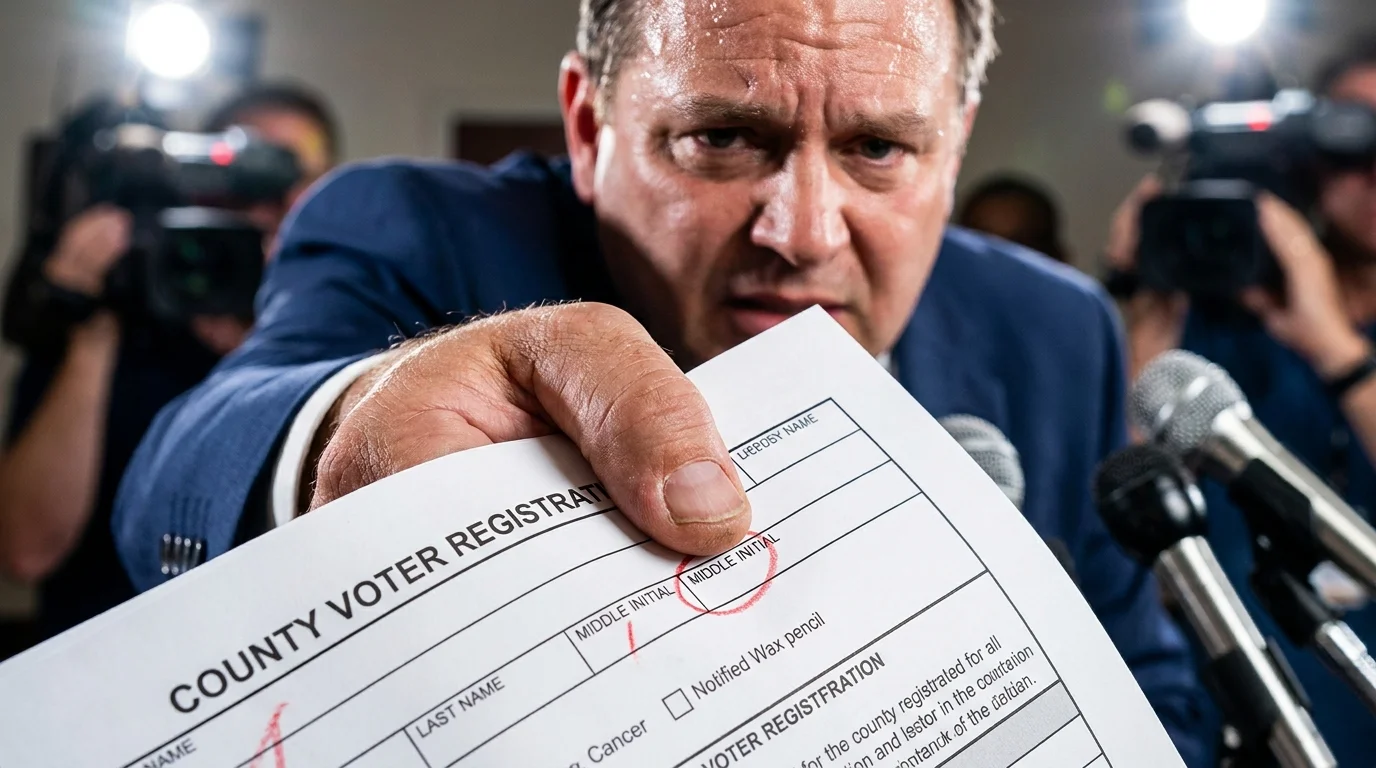
The discrepancy is rarely a matter of fraud or bad intent. It is an algorithmic tripwire: a missing middle initial on your original registration card that does not mirror the state motor vehicle file or the signature declaration envelope. To the human eye, you are obviously the person standing at the precinct table; to an automated county verification algorithm, that missing letter creates an unresolvable identity mismatch.
When an administrative clerk reviews that flagged ballot against state election statutes, the letter of the law leaves little room for grace. Understanding this invisible paper trail is the only way to ensure your voice survives the scanner.
The Ghost in the Machine: Why Administrative Symmetry Rules Your Vote
Most citizens think of their voter registration as an invitation or a ticket to enter an arena. In reality, election administrators treat your registration as an active legal ledger. When you register, your name is entered into a Statewide Voter Registration System, a centralized database that constantly runs cross-checks against social security records, death registries, and Department of Motor Vehicles profiles.
Think of this infrastructure as a pair of identical gears turning against each other. If one gear has a tooth labeled ‘Robert A. Henderson’ and the matching gear has a slot machined only for ‘Robert Henderson,’ the teeth jam. The system does not guess whether ‘Robert’ and ‘Robert A.’ share the same roof, birthdate, or bloodline. Instead, the mismatch triggers automatic rejection, shunting the paper into the provisional pile.
- Agricultural transport waivers expire tonight halting regional produce shipping across state borders
- County levee bonds trigger massive escrow impound spikes on suburban mortgage accounts
- Real ID renewals quietly invalidate municipal voter registrations ahead of early voting
- Municipal transit concessions eliminate discount commuter fares triggering furious rider boycotts
- Prevailing wage rules expire at midnight leaving county contractors facing sudden penalties
This discrepancy surfaces most aggressively in primary elections. Party rosters, strict party affiliation checks, and newly updated optical-character scanners enforce an unbending rule: every record attached to your precinct envelope must match the state database down to the punctuation mark. A stray keystroke from five years ago can quietly erase your ballot today.
The Precinct Supervisor’s Ledger
Clara Ortiz, a 58-year-old municipal clerk with twenty-two years running precinct tabulations in Cuyahoga County, Ohio, spends her primary evenings sitting behind a triple-monitor terminal in a locked processing cage. Her job is not political; it is mechanical. ‘People believe the fight over voting happens on television or in courtrooms,’ Clara explains while auditing a batch of rejected absentee sleeves. ‘The real battle happens right here on line 4 of form VR-100. A voter signs up at the bureau of motor vehicles with their full legal name, but when they updated their address at a library booth, they skipped their middle initial. The two software programs talk to each other, hit a parity check error, and kick the ballot out. By the time I see the paper, the window to correct the record is closing fast.’
Three Profiles of Clerical Friction: How the Trap Snaps Shut
Clerical invalidation does not hit every voter in the same manner. It strikes along specific administrative seams where daily life collides with state record keeping. Locating where your profile fits into these bureaucratic gears helps you plug the leak before primary day arrives.
For the Real ID Commuter
When you upgraded your driver’s license to comply with federal Real ID standards, the clerk at the counter demanded your full birth certificate, capturing your first, middle, and family name with rigid accuracy. However, if your county voter registration card dates back a decade—completed when you casually scribbled only your first and last name—the state motor vehicle interface creates two distinct identities. When election software reconciles poll book signatures against state driver files, the missing middle initial flags your submission as unverified, demanding a secondary cure notice that many voters mistake for junk mail.
For the Frequent Mover and Apartment Renter
Changing apartments every two years wrecks voter rolls. You submit a standard change of address with the postal service, assuming your voter file updates automatically through the national change of address database. But postal matching algorithms often drop middle initials from apartment mailing labels. When the county board of elections imports those updates to refresh their mailing lists, your file is rewritten without your middle initial, severing its link to your original signature card and disqualifying your mailed primary ballot upon intake.
For the Dual-Surname or Hyphenated Registrant
If you carry a maternal family name and a paternal family name, or an informal middle name treated as a second surname, automated county intake tools routinely choke. A county employee typing handwritten registration cards may log your first family name into the middle-initial box. On election morning, the poll book searches for your surname under one letter while the database filed it under another. The clerk cannot find your name, issues you an emergency paper envelope, and your primary ballot sits uncounted until an canvassing board meets days later.
Mindful Steps to Bulletproof Your Registration
Protecting your ballot does not require legal training. It demands a deliberate, ten-minute administrative audit of how the state sees you. Treat your registration not as a passive civic fact, but as an active financial account that requires periodic maintenance.
- Pull up your state secretary of state’s public voter portal to check your name spelling against your physical driver’s license.
- Confirm that your middle name or initial appears on both documents with matching punctuation.
- Check your signature style: ensure the stroke of your pen matches your driver’s license signature rather than a rushed grocery-store scribble.
- Submit an updated paper registration form directly to your county clerk if any character does not align.
- Opt into email or text alerts for ballot tracking through your local board of elections.
Your tactical toolkit for this audit requires three specific items: your state-issued Real ID card, your county board of elections voter record number, and a fine-point black pen if your county still mandates hard-copy paper updates. Complete any record corrections at least thirty days prior to your primary deadline. Taking these steps eliminates algorithmic doubt before your ballot ever touches a scanning bed.
The Bigger Picture: Reclaiming Control Over the Ledger
In our hyper-digitized world, we assume that systems possess common sense. We expect human intuition to bridge the gap between ‘Robert’ and ‘Robert A.,’ especially when the handwriting, address, and birthdate match perfectly. But our civic machinery is designed for volume, not nuance. It is an intricate assembly line of optical scanners, optical character recognition cameras, and unforgiving parity software.
When you take the time to clean up a missing middle initial on your voter registration card, you are doing more than tidying up a municipal database. You are protecting your voice from an indifferent bureaucratic filter. There is quiet dignity in refusing to let an invisible clerical omission silence your vote. By mastering the paper trail, you ensure that when the polling station doors swing shut, your choice is tallied exactly as you intended.
Clerical precision is not bureaucratic vanity; it is the single protective shield standing between your ballot and the rejection pile.
| Key Point | Detail | Added Value for the Reader |
|---|---|---|
| Database Parity | Scanners require character-for-character matching with state DMV records. | Prevents unexpected ballot diversions to provisional review tables. |
| Real ID Discrepancy | Federal identity standards require full legal names, exposing older truncated voter files. | Pinpoints the hidden origin of sudden voter roll mismatches. |
| Signature Curing | Counties mail discrepancy notices that carry strict 48-to-72 hour response deadlines. | Gives you the awareness to act on cure letters before deadlines pass. |
Frequently Asked Questions
Can poll workers reject my ballot at the table over a missing middle initial?
Poll workers cannot turn you away entirely, but they can deny you a standard ballot and hand you a provisional ballot envelope. Provisional ballots require extra administrative verification and are only counted if county clerks confirm your identity before the certification deadline.Why does my driver’s license name differ from my voter card?
Voter registration databases and motor vehicle records were maintained on separate computer systems for decades. Unless you explicitly updated both during a single transaction, the two records may carry different character entries or truncate your middle name entirely.What is a ballot cure notice?
A cure notice is an urgent formal letter sent by your county elections board informing you that your signature or registration details failed verification. It provides a brief window to submit proof of identity so your ballot can be officially tabulated.Does a missing period after my middle initial cause a rejection?
Punctuation marks rarely trigger outright rejection on their own, but an isolated initial without a period can occasionally cause software scanning errors if your state motor vehicle record stores the name as a full, uninterrupted text string.How can I verify that my county accepted my primary ballot?
Most states now provide an online ballot tracker via their secretary of state website. This portal shows real-time progress: from the moment your envelope is received, to signature verification, through final tabulation.