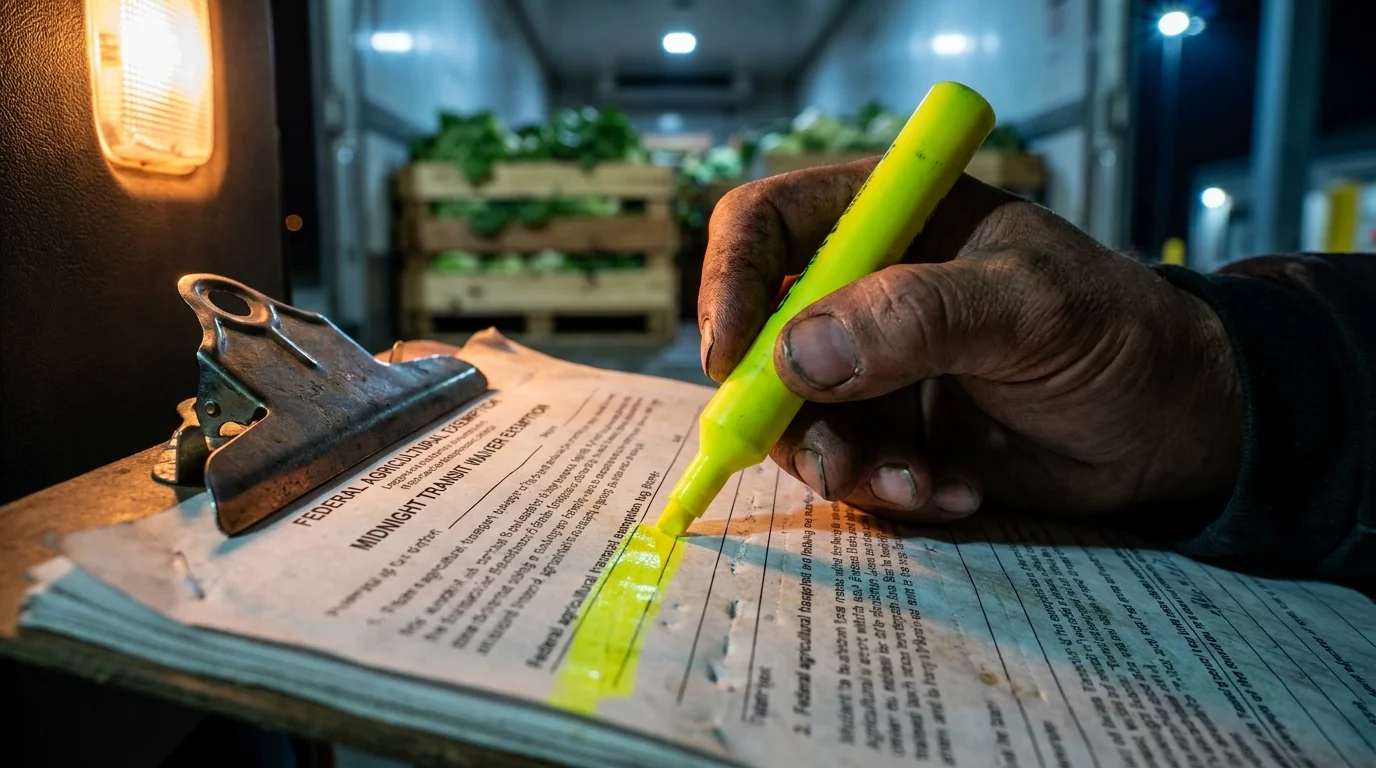
The loading dock smells of damp cardboard, diesel exhaust, and chilled Romaine lettuce waiting in thirty-four-degree holding lockers. Under the flicker of sodium-vapor floodlights, the air in the staging yard feels crisp and still, but the idling reefers tell another story. Steel engines rumble continuously, vibrating the blacktop beneath your work boots while digital manifests update silently across cab-mounted tablets.
You might picture freight logistics as a steady, mechanical conveyor belt running quietly across state lines. In practice, fresh food moves on paper margins thin enough to slice butter, held aloft by narrow bureaucratic carve-outs. When the sun goes down tonight, an invisible clock ticks down to zero on an emergency regulatory exemption that kept perishables exempt from standard commercial driving-hour limits during regional supply shocks.
As midnight draws closer, dispatch screens across the Midwest and Atlantic corridors are blinking amber. Once the clock strikes 12:01 AM, hundreds of tractor-trailers carrying perishable greens, dairy, and seasonal berries will lose their emergency status mid-route. The moment an automated logging device flags a driver past their eleventh hour behind the wheel, the brakes lock down, not by choice, but by federal mandate.
The Administrative Choke Collar
For months, distribution networks leaned heavily on an administrative cushion that treated farm freight like an ambulance rather than a standard commercial rig. This regulatory suspension allowed short-haul and interstate drivers hauling sensitive perishables to stretch drive windows beyond the strict 14-hour duty day established by the Federal Motor Carrier Safety Administration (FMCSA). It was never meant to be permanent, yet routine commerce quietly organized itself around that extended slack.
Think of it as breathing through a pillow. When the waiver vanishes, the entire regional pipeline snaps back to rigid, pre-emergency compliance before local distribution depots have repositioned their relief teams. The sudden snapback exposes a simple truth: our regional grocery supply chain is not an open highway, but an intricate system of electronic locks that trip automatically at midnight.
What felt like a routine administrative sunset in Washington translates into instant supply paralysis on the ground. Drivers caught three hours from a terminal cannot legally pull onto a highway shoulder to wait out an eight-hour sleeper-berth break while four thousand cartons of organic berries sit in a refrigerated trailer burning fuel. If the wheels stop turning before the loading bay doors open, the shelf life of the haul is already half-spent.
- County levee bonds trigger massive escrow impound spikes on suburban mortgage accounts
- Real ID renewals quietly invalidate municipal voter registrations ahead of early voting
- Municipal transit concessions eliminate discount commuter fares triggering furious rider boycotts
- Prevailing wage rules expire at midnight leaving county contractors facing sudden penalties
- OFAC transaction filters freeze routine small business payroll deposits without prior warning
Marcus Vance, a 48-year-old dispatch supervisor in central Ohio, spent his afternoon redrafting routes for thirty-six temperature-controlled haulers running between Pennsylvania greenhouses and regional fulfillment centers. He watched his digital scheduling board turn from green to crimson as run times that were legal at lunch became actionable regulatory violations at midnight. “We aren’t out of produce, and we aren’t out of drivers,” Marcus explained as he scrubbed another cross-state run. “We are simply running out of legal minutes, and the software doesn’t care if the strawberries rot while parked ten miles outside the county line.”
Downstream Impact Layers
The regulatory guillotine does not fall equally across every loading dock. To understand how your local grocer’s produce aisle will look by Thursday afternoon, you have to look at the three distinct layers of transport infrastructure absorbing this sudden operational crunch.
The Independent Long-Hauler
Independent owner-operators running single rigs across state borders face immediate legal jeopardy. Without a corporate fleet of secondary relay drivers stationed along interstate turnpikes, these drivers must choose between parking fully loaded refrigerated units at overcrowded rest stops or absorbing steep regulatory fines that revoke their operating authority. For these operators, an extra two hours of transit time isn’t a minor delay; it is a financial penalty that wipes out the profit of the entire run.
The Regional Grocery Cooperative
Medium-sized grocers rely on daily cross-docking hubs where farm trucks hand off stock to localized delivery vans. With long-haul carriers stalling out on turnpikes before crossing state lines, these regional hubs will sit vacant during the critical pre-dawn restock shift. Display cases remain locked down or bare, not because of crop failures in the field, but because the relay handoff broke thirty miles north of the state border.
The Hyper-Local Farm-to-Table Network
Small agricultural co-ops running within an arbitrary 150 air-mile radius might assume they remain shielded by standard agricultural exemptions. Yet as major carriers scramble to secure legal local capacity, spot-market freight rates will instantly spike. Small growers will find their contracted local box trucks poached by national distributors willing to pay triple the standard lane rate to move stalled inventory across county boundaries.
Managing the Regulatory Cliff
Surviving a mid-week transit freeze requires treating fleet movements with mechanical precision rather than hoping for administrative leniency. Operations managers and warehouse receivers must shift from loose delivery windows to disciplined, minute-by-minute gate controls.
When regulatory margins evaporate, the only countermeasure is stripping friction out of terminal turnaround times. Every minute a truck spends idling at a security gate is a minute subtracted from its legal highway transit allowance.
- Audit Electronic Logging Device (ELD) Settings: Confirm before the evening shift whether cab software automatically revokes the emergency agricultural code at midnight local time or midnight Eastern Standard Time.
- Establish Staging Relays Inside the 150 Air-Mile Radius: Reroute long-distance perishables through intermediate drop-yards to reset official driving clocks using legal short-haul exemptions.
- Enforce Priority Gate Check-ins: Move trucks carrying high-spoilage items straight to active cold docks, bypassing normal exterior yard staging entirely.
- Pre-Clear State Inspection Paperwork: Print hard-copy Bills of Lading and origin certificates so drivers avoid roadside inspection delays at open weigh stations.
Keep a physical logistics kit ready in the dispatch booth: offline paper logbooks for emergency exemptions, physical thermometer probes to record pulp temperatures upon handoff, and direct phone lines to secondary yard-dog hostlers who can legally maneuver trailers without tripping over-the-road drive-time counters.
The Fragile Balance of the Open Road
When you walk down the produce aisle of your neighborhood grocery store later this week, you might notice empty misted racks where fresh greens usually sit, or an unusual gap in soft stone fruits. It is easy to chalk these minor disruptions up to vague supply chain failures or bad weather out West. Yet the reality is far more grounded in the quiet mechanics of bureaucratic governance.
A modern economy operates on paper waivers and automated timecards as much as it does on asphalt and diesel. When an obscure regulatory clause expires in a silent administrative office, the shockwaves register immediately on the asphalt beneath our wheels. Understanding where your food pauses on that midnight journey turns a bare shelf from an annoyance into a stark reminder of how close the engine always runs to the curb.
The regulatory clock moves faster than the highway speed limit, and fresh food waits for neither.
| Key Point | Detail | Added Value for the Reader |
|---|---|---|
| Waiver Sunset Mechanism | Emergency hours-of-service exemptions for agricultural freight expire at midnight across multi-state transit lanes. | Identifies why sudden produce delivery delays hit mid-week without any corresponding farm-level shortage. |
| ELD Auto-Enforcement | Cab-mounted digital logs automatically switch drivers to non-compliant status the moment drive-time limits are reached. | Explains why drivers cannot exercise roadside discretion to finish the final leg of an interstate delivery. |
| Spot Market Repercussions | Large national haulers will pull local fleet resources into long-distance relay lanes to cover stranded loads. | Prepares regional retailers for immediate freight rate surcharges that will filter directly down to shelf prices. |
Frequently Asked Questions
Will the expiration of these transport waivers trigger immediate produce shortages?
You will not see widespread food shortages, but regional distribution will experience sharp 48-to-72-hour delivery gaps for highly perishable greens, berries, and packaged salads across states relying on cross-border transport.Why can’t drivers just finish their deliveries before taking a break?
Under federal Hours of Service rules, automated Electronic Logging Devices record drive times down to the minute. Once a driver exceeds their legal window, operating the vehicle creates an actionable safety violation that can shut the driver down immediately at any state weigh station.Does this regulatory change affect all commercial trucking?
No, this sunset specifically applies to temporary emergency transit waivers that granted extended duty hours to drivers hauling agricultural commodities, livestock, and perishable food supplies.Can distributors simply hire more drivers to cover the gap?
Hiring additional drivers takes weeks of vetting, onboarding, and drug screening. In the short term, companies must rely on expensive split-relay systems or pay premium spot-market rates to secure legal capacity.How does this affect consumer prices at the grocery store?
When freight costs jump overnight due to driver relay shifts and delayed handling, distributors pass those fuel and logistical surcharges downstream, nudging retail prices up on short-shelf-life goods within days.